Ethical IP Address Management and Privacy Solutions
 Chan
Chan
Managing IP addresses ethically and ensuring privacy are of paramount importance. IP addresses, which are unique identifiers for devices on a network, play a crucial role in facilitating Internet communication. However, improper management and exposure of IP addresses can lead to privacy breaches and security vulnerabilities. This article explores the best practices for ethical IP address management and privacy solutions.
Table of Contents
Understanding IP Address Management
IP Address Management (IPAM) refers to the processes and tools used to plan, track, and manage IP addresses within a network. Effective IPAM is essential for maintaining network performance, security, and compliance with regulations.
Components of Ethical IP Address Management:
Allocation and Assignment: Distributing IP addresses to devices within a network based on a well-defined policy to avoid conflicts and ensure efficient use.
Monitoring and Auditing: Continuously track IP address usage to detect anomalies, manage resources, and ensure policy compliance.
Security Measures: Implementing safeguards to protect IP address information from unauthorized access and misuse.
Importance of Ethical IP Address Management
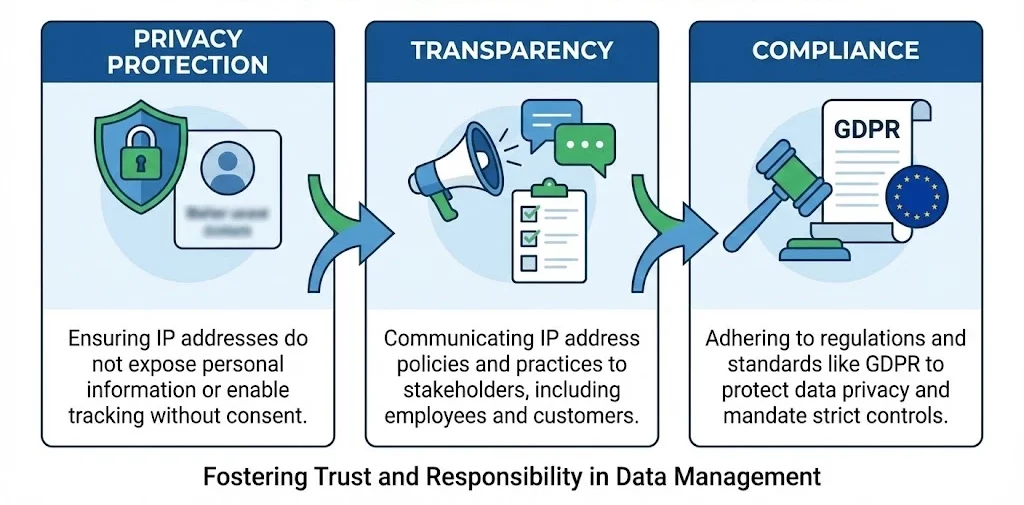
Ethical IP address management involves more than technical efficiency; it encompasses privacy, transparency, and responsibility.
Privacy Protection: Ensuring IP addresses do not expose personal information or enable tracking without consent.
Transparency: communicating IP address policies and practices to stakeholders, including employees and customers.
Compliance: adhering to regulations and standards such as GDPR (General Data Protection Regulation) to protect data privacy. The EU’s GDPR framework mandates strict controls over the processing and storage of personal data, including IP addresses, to protect user privacy.
Best Practices for Ethical IP Address Management
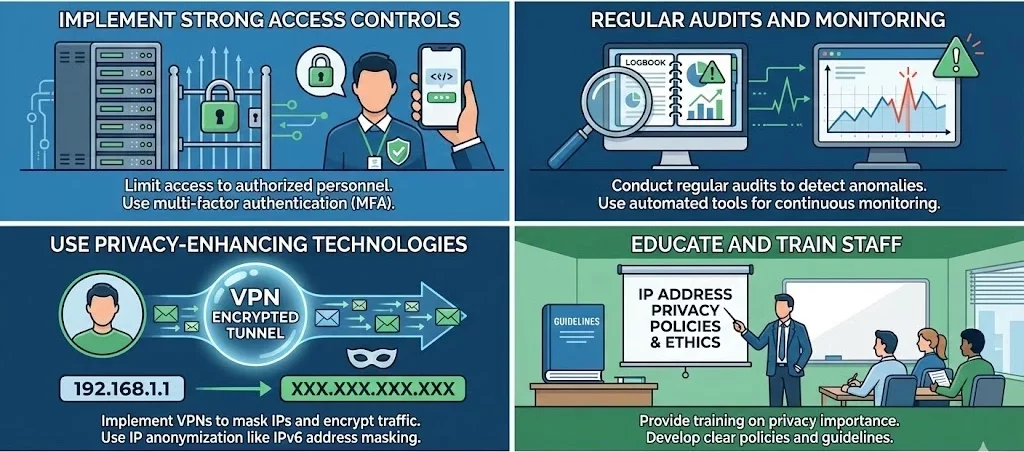
Implement strong access controls:
- Limit access to IP address management systems to authorized personnel only.
- Use multi-factor authentication (MFA) to enhance security.
Regular Audits and Monitoring:
- Conduct regular audits of IP address usage to detect and address any anomalies or unauthorized access.
- Use automated tools for continuous monitoring and alerts.
Use Privacy-Enhancing Technologies:
- Implement Virtual Private Networks (VPNs) to mask IP addresses and encrypt internet traffic.
- Use IP anonymization techniques, such as IPv6 address masking, to protect user identities.
Educate and train staff:
- Provide training to staff on the importance of IP address privacy and ethical management practices.
- Develop clear policies and guidelines for handling IP addresses.
Privacy Solutions for IP Address Management
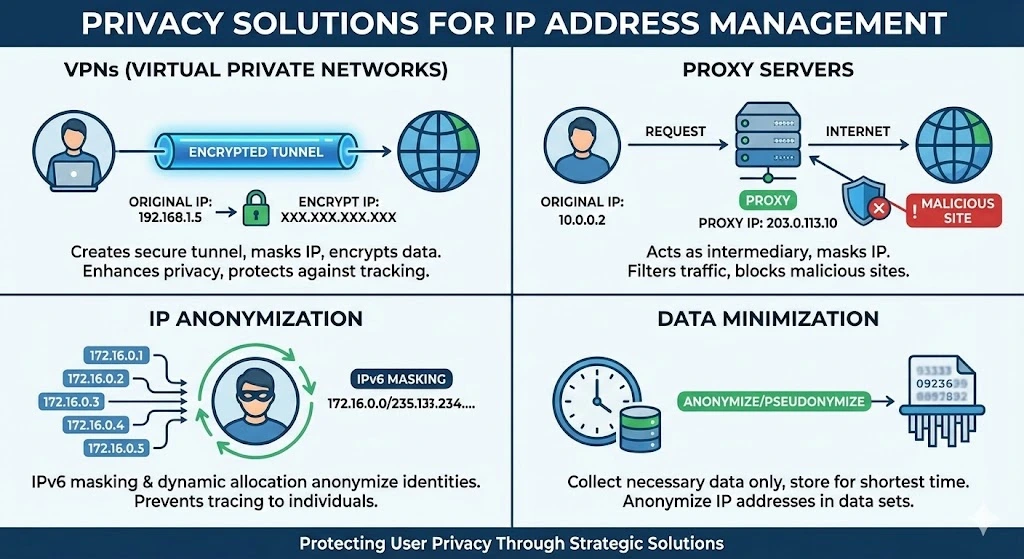
To address privacy concerns associated with IP addresses, several solutions can be implemented:
1. VPNs (Virtual Private Networks):
-
- VPNs create a secure tunnel for internet traffic, masking the user’s IP address and encrypting data.
- This enhances privacy and protects against tracking and surveillance.
2. Proxy Servers:
-
- Proxy servers act as intermediaries between users and the internet, masking the user’s IP address.
- They can also filter traffic to prevent access to malicious sites.
3. IP Anonymization:
-
- Techniques like IPv6 address masking and dynamic IP address allocation can anonymize user identities.
- These methods ensure that IP addresses cannot be easily traced back to individual users.
4. Data Minimization:
-
- Collect only the necessary IP address information and store it for the shortest time possible.
- Anonymize or pseudonymize IP addresses in data sets to enhance privacy.
Conclusion
Ethical IP address management and robust privacy solutions are essential for maintaining the integrity and security of digital networks. By implementing best practices, using privacy-enhancing technologies, and adhering to regulatory standards, organizations can protect user privacy and build trust in their digital services.
As the digital landscape continues to evolve, the importance of ethical practices in IP address management will only grow, ensuring a safer and more secure internet for all. Take a proactive step towards secure and responsible IP management by partnering with experts.
Visit LARUS to learn more about our comprehensive IP address management and privacy solutions, and how we can help safeguard your digital infrastructure. Ensure your network’s integrity today with LARUS!
Trusted IPv4 Leasing for Business Growth
Get enterprise-grade IPv4 space quickly, with seamless deployment and end-to-end management.
Get Started with i.leaseFAQs
Is an IP address considered "Personal Data" under GDPR?
Yes. Under the General Data Protection Regulation (GDPR), dynamic and static IP addresses are classified as “personal data” because they can potentially be linked to a specific individual (especially when combined with ISP logs). Organizations must therefore process and store IP logs with the same strict security measures as names or email addresses.
What is "IP Anonymization" and how does it work?
IP anonymization (or IP masking) is a technique used to obscure a user’s identity by removing the last octet (the final set of numbers) of an IP address before storing it. For example, 192.168.1.105 becomes 192.168.1.0.
How long should I retain IP address logs?
Ethical data retention policies suggest keeping IP logs only as long as necessary for security or operational purposes (Data Minimization). For many companies, a retention period of 30 to 90 days is standard for security auditing. Keeping logs indefinitely increases the risk of a privacy breach and may violate “Right to be Forgotten” principles.
What is the difference between a VPN and a Proxy for privacy?
- VPN (Virtual Private Network): Encrypts all your internet traffic and hides your IP address, offering high privacy and security.
- Proxy: Only hides your IP address for a specific application (like a web browser) but does not encrypt the data.
- Verdict: For ethical privacy protection, a VPN is the superior choice
Related Posts
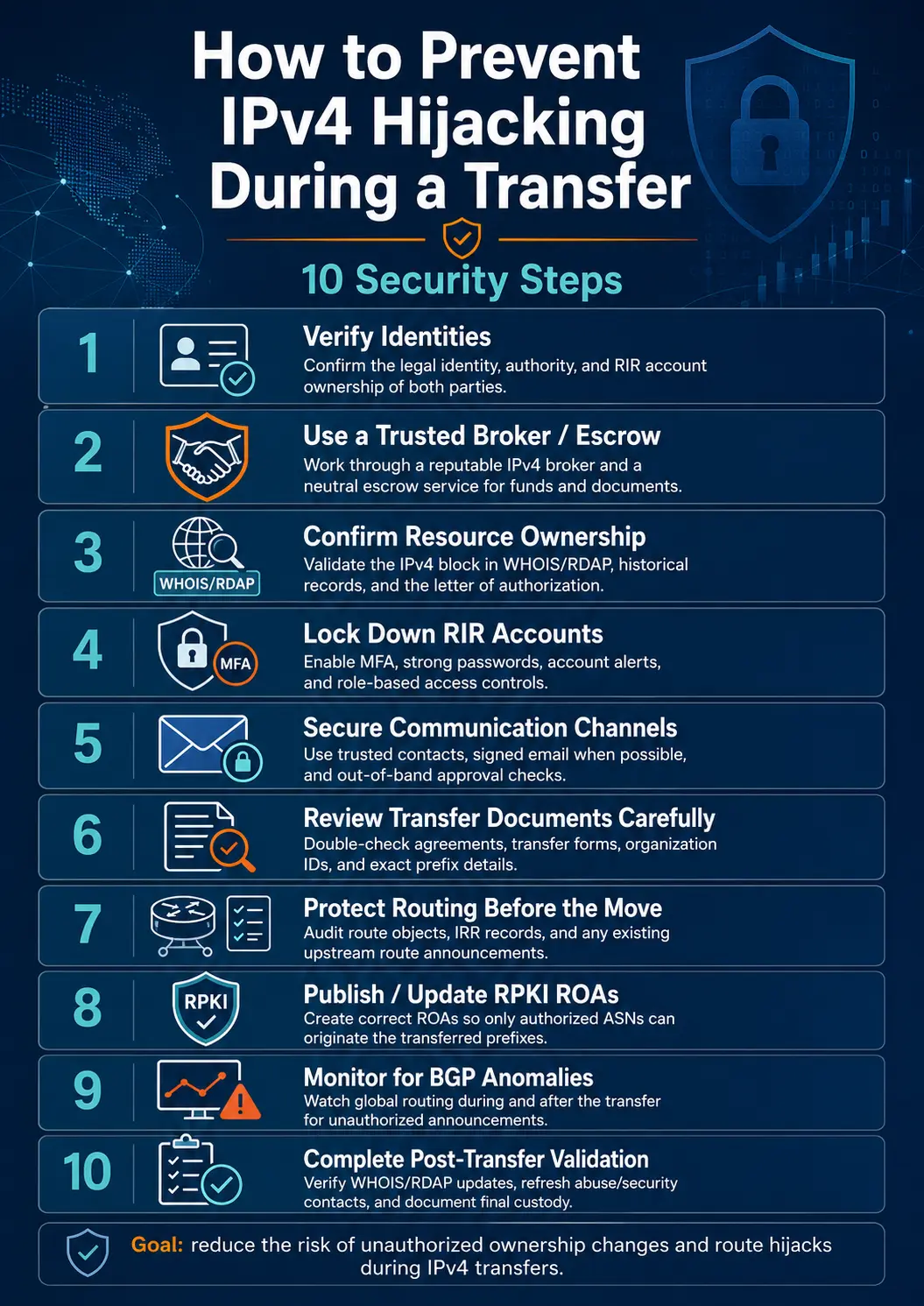
How to Prevent IPv4 Hijacking During a Transfer: 10 Security Steps
Transferring IPv4 address space is not only a commercial and registry process. It is also a sensitive routing operation. During an IPv4 transfer, control of a prefix moves from one organization to another. Registry records, Route Origin Authorizations, Internet Routing Registry objects, upstream-provider filters, reverse DNS settings, and live BGP announcements may all need to change. When these changes are completed in the wrong order—or when identity and authorizationRead more Related Posts How to Prevent IPv4 Hijacking During a Transfer: 10 Security Steps Transferring IPv4 address space is not only a commercial and registry process. It is also a sensitive routing operation. During Why the Cheapest IPv4 Lease May Cost More in the Long Run A low monthly price may look attractive during procurement, but the real cost of leased IPv4 addresses includes much more What Is a /24 IPv4 Subnet and Why Is It Popular for Leasing? A /24 IPv4 subnet is one of the most common block sizes in the IPv4 leasing market. For hosting providers, .related-post {} .related-post .post-list { text-align: left; } .related-post .post-list .item { margin: 5px; padding: 10px; } .related-post .headline { font-size: 18px !important; color: #999999 !important; } .related-post .post-list .item .post_thumb { max-height: 220px; margin: 10px 0px; padding: 0px; display: block; } .related-post .post-list .item .post_title { font-size: 16px; color: #3f3f3f; margin: 10px 0px; padding: 0px; display: block; text-decoration: none; } .related-post .post-list .item .post_excerpt { font-size: 13px; color: #3f3f3f; margin: 10px 0px; padding: 0px; display: block; text-decoration: none; } @media only screen and (min-width: 1024px) { .related-post .post-list .item { width: 30%; } } @media only screen and (min-width: 768px) and (max-width: 1023px) { .related-post .post-list .item { width: 90%; } } @media only screen and (min-width: 0px) and (max-width: 767px) { .related-post .post-list .item { width: 90%; } }
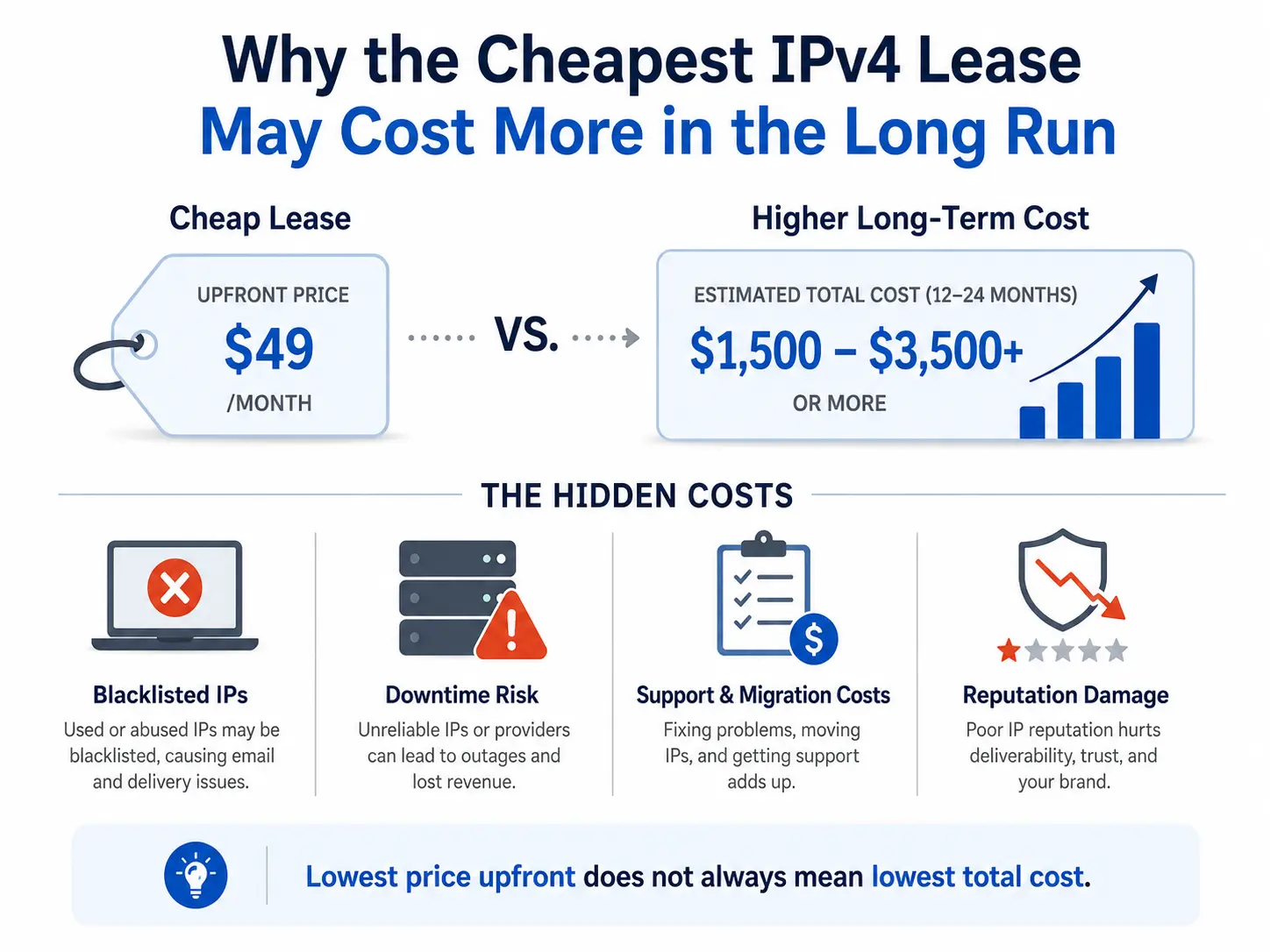
Why the Cheapest IPv4 Lease May Cost More in the Long Run
A low monthly price may look attractive during procurement, but the real cost of leased IPv4 addresses includes much more than the advertised rate. Poor IP reputation, incomplete routing authorisation, deployment delays, weak technical support, incorrect geolocation and uncertain renewal terms can quickly erase the initial saving. For testing or short-lived projects, a basic low-cost IPv4 lease may be sufficient. For production networks, however, businesses should evaluate the totalRead more Related Posts How to Prevent IPv4 Hijacking During a Transfer: 10 Security Steps Transferring IPv4 address space is not only a commercial and registry process. It is also a sensitive routing operation. During Why the Cheapest IPv4 Lease May Cost More in the Long Run A low monthly price may look attractive during procurement, but the real cost of leased IPv4 addresses includes much more What Is a /24 IPv4 Subnet and Why Is It Popular for Leasing? A /24 IPv4 subnet is one of the most common block sizes in the IPv4 leasing market. For hosting providers, .related-post {} .related-post .post-list { text-align: left; } .related-post .post-list .item { margin: 5px; padding: 10px; } .related-post .headline { font-size: 18px !important; color: #999999 !important; } .related-post .post-list .item .post_thumb { max-height: 220px; margin: 10px 0px; padding: 0px; display: block; } .related-post .post-list .item .post_title { font-size: 16px; color: #3f3f3f; margin: 10px 0px; padding: 0px; display: block; text-decoration: none; } .related-post .post-list .item .post_excerpt { font-size: 13px; color: #3f3f3f; margin: 10px 0px; padding: 0px; display: block; text-decoration: none; } @media only screen and (min-width: 1024px) { .related-post .post-list .item { width: 30%; } } @media only screen and (min-width: 768px) and (max-width: 1023px) { .related-post .post-list .item { width: 90%; } } @media only screen and (min-width: 0px) and (max-width: 767px) { .related-post .post-list .item { width: 90%; } }
What causes IPv4 deals to stall after the first agreement
IPv4 deals usually stall after the first agreement because agreeing on price is only the commercial beginning—not operational completion. A buyer and seller may agree on a block and price within hours, but the transaction can still be delayed by unclear ownership, incomplete documents, mismatched Regional Internet Registry requirements, recipient eligibility, reputation concerns, payment conditions, or missing routing authorization. The most common causes are: The seller’s authority over theRead more Related Posts How to Prevent IPv4 Hijacking During a Transfer: 10 Security Steps Transferring IPv4 address space is not only a commercial and registry process. It is also a sensitive routing operation. During Why the Cheapest IPv4 Lease May Cost More in the Long Run A low monthly price may look attractive during procurement, but the real cost of leased IPv4 addresses includes much more What Is a /24 IPv4 Subnet and Why Is It Popular for Leasing? A /24 IPv4 subnet is one of the most common block sizes in the IPv4 leasing market. For hosting providers, .related-post {} .related-post .post-list { text-align: left; } .related-post .post-list .item { margin: 5px; padding: 10px; } .related-post .headline { font-size: 18px !important; color: #999999 !important; } .related-post .post-list .item .post_thumb { max-height: 220px; margin: 10px 0px; padding: 0px; display: block; } .related-post .post-list .item .post_title { font-size: 16px; color: #3f3f3f; margin: 10px 0px; padding: 0px; display: block; text-decoration: none; } .related-post .post-list .item .post_excerpt { font-size: 13px; color: #3f3f3f; margin: 10px 0px; padding: 0px; display: block; text-decoration: none; } @media only screen and (min-width: 1024px) { .related-post .post-list .item { width: 30%; } } @media only screen and (min-width: 768px) and (max-width: 1023px) { .related-post .post-list .item { width: 90%; } } @media only screen and (min-width: 0px) and (max-width: 767px) { .related-post .post-list .item { width: 90%; } }
