Get ready for European IPv4 addresses
 admin
admin
If you want ripe RIPE IPv4 addresses, there will be a literal waiting list to join.
In a new policy approved and posted on Tuesday, the regional internet registry (RIR) that serves Europe, the Middle East and Central Asia, dubbed RIPE, has decided that the only way it can deal with the ever-diminishing number of unassigned IPv4 addresses is for everyone to form an orderly queue.
“On application for IPv4 resources, LIRs will receive IPv4 addresses according to the following,” notes the new policy. And the first bulletpoint? “All allocation requests are placed on a first-come-first-served waiting list. No guarantees are given about the waiting time.”
The registry has also decided that it is not worth its while dishing out tiny numbers of public IP addresses, and will only make an allocation once it has a full /24 block, i.e. 256 consecutive addresses, to hand over.
The new policy: “All address blocks smaller than the allocation size will be held by the RIPE NCC and are declared unallocatable until the missing fragments are received/recovered by the RIPE NCC and they can be allocated as a contiguous allocation.”
And a /24 is all you’re going to get. From the policy: “The size of the allocation made will be exactly one /24. The sum of all allocations made to a single LIR by the RIPE NCC is limited to a maximum of 256 IPv4 addresses (a single /24). If this allocation limit has been reached or exceeded, an LIR cannot request an IPv4 allocation under this policy.”
In other words, you will have to queue for an indefinite period of time to get your hands on a block of 256 addresses.
The good news is that faced with the absolutely stark, irrefutable fact that there really are no new IPv4 addresses, all corporations in Europe have collectively decided to expend all necessary resources to move permanently to IPv6.
Ha! Who you kidding? It’s NATs-a-go-go, and record prices on the IPv4 black market. Remind us again why the IETF didn’t make IPv6 backwards compatible… ®
Updated to add
We’d like to stress that the waiting list policy was announced only this week, and so, has yet to be implemented. Stay tuned, though: it will kick in when RIPE deems it necessary, likely when it runs out of IPv4 addresses later this year or early 2020.
Also, yes, as some have pointed out, there is a black market for IPv4 addresses if you want to get your hands on some right now rather than get in line.
And for those of us in North America, yes, ARIN already has an IPv4 waiting list of sorts. That registry notes:The IPv4 Waiting List is one of several ways an organization may request IPv4 addresses from ARIN. Other available options are to transfer resources or request IPv4 addresses from pools reserved specifically for micro-allocations (NRPM 4.4) or Dedicated IPv4 block to facilitate IPv6 Deployment (NRPM 4.10).
Related Posts
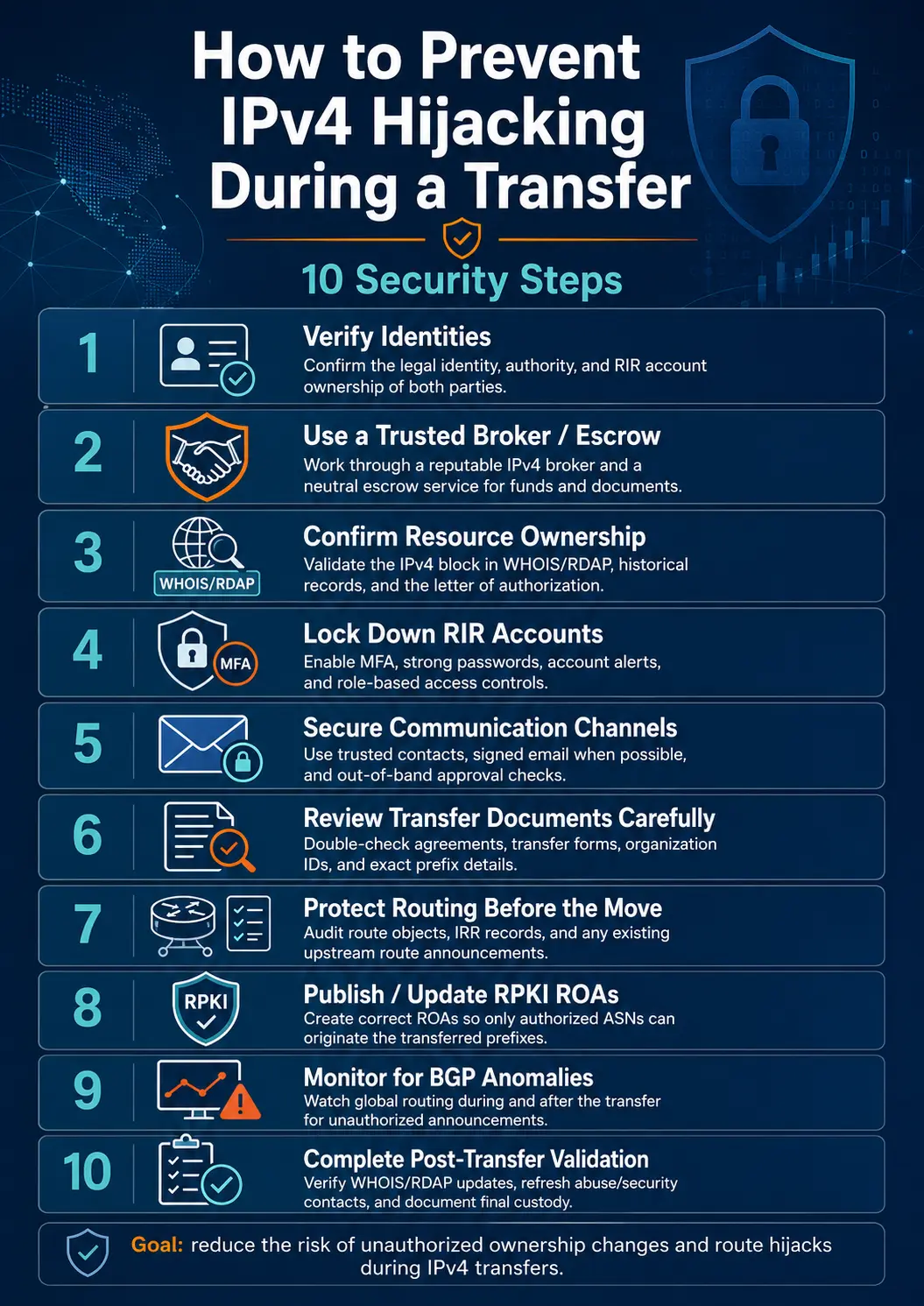
How to Prevent IPv4 Hijacking During a Transfer: 10 Security Steps
Transferring IPv4 address space is not only a commercial and registry process. It is also a sensitive routing operation. During an IPv4 transfer, control of a prefix moves from one organization to another. Registry records, Route Origin Authorizations, Internet Routing Registry objects, upstream-provider filters, reverse DNS settings, and live BGP announcements may all need to change. When these changes are completed in the wrong order—or when identity and authorizationRead more Related Posts How to Prevent IPv4 Hijacking During a Transfer: 10 Security Steps Transferring IPv4 address space is not only a commercial and registry process. It is also a sensitive routing operation. During Why the Cheapest IPv4 Lease May Cost More in the Long Run A low monthly price may look attractive during procurement, but the real cost of leased IPv4 addresses includes much more What Is a /24 IPv4 Subnet and Why Is It Popular for Leasing? A /24 IPv4 subnet is one of the most common block sizes in the IPv4 leasing market. For hosting providers, .related-post {} .related-post .post-list { text-align: left; } .related-post .post-list .item { margin: 5px; padding: 10px; } .related-post .headline { font-size: 18px !important; color: #999999 !important; } .related-post .post-list .item .post_thumb { max-height: 220px; margin: 10px 0px; padding: 0px; display: block; } .related-post .post-list .item .post_title { font-size: 16px; color: #3f3f3f; margin: 10px 0px; padding: 0px; display: block; text-decoration: none; } .related-post .post-list .item .post_excerpt { font-size: 13px; color: #3f3f3f; margin: 10px 0px; padding: 0px; display: block; text-decoration: none; } @media only screen and (min-width: 1024px) { .related-post .post-list .item { width: 30%; } } @media only screen and (min-width: 768px) and (max-width: 1023px) { .related-post .post-list .item { width: 90%; } } @media only screen and (min-width: 0px) and (max-width: 767px) { .related-post .post-list .item { width: 90%; } }
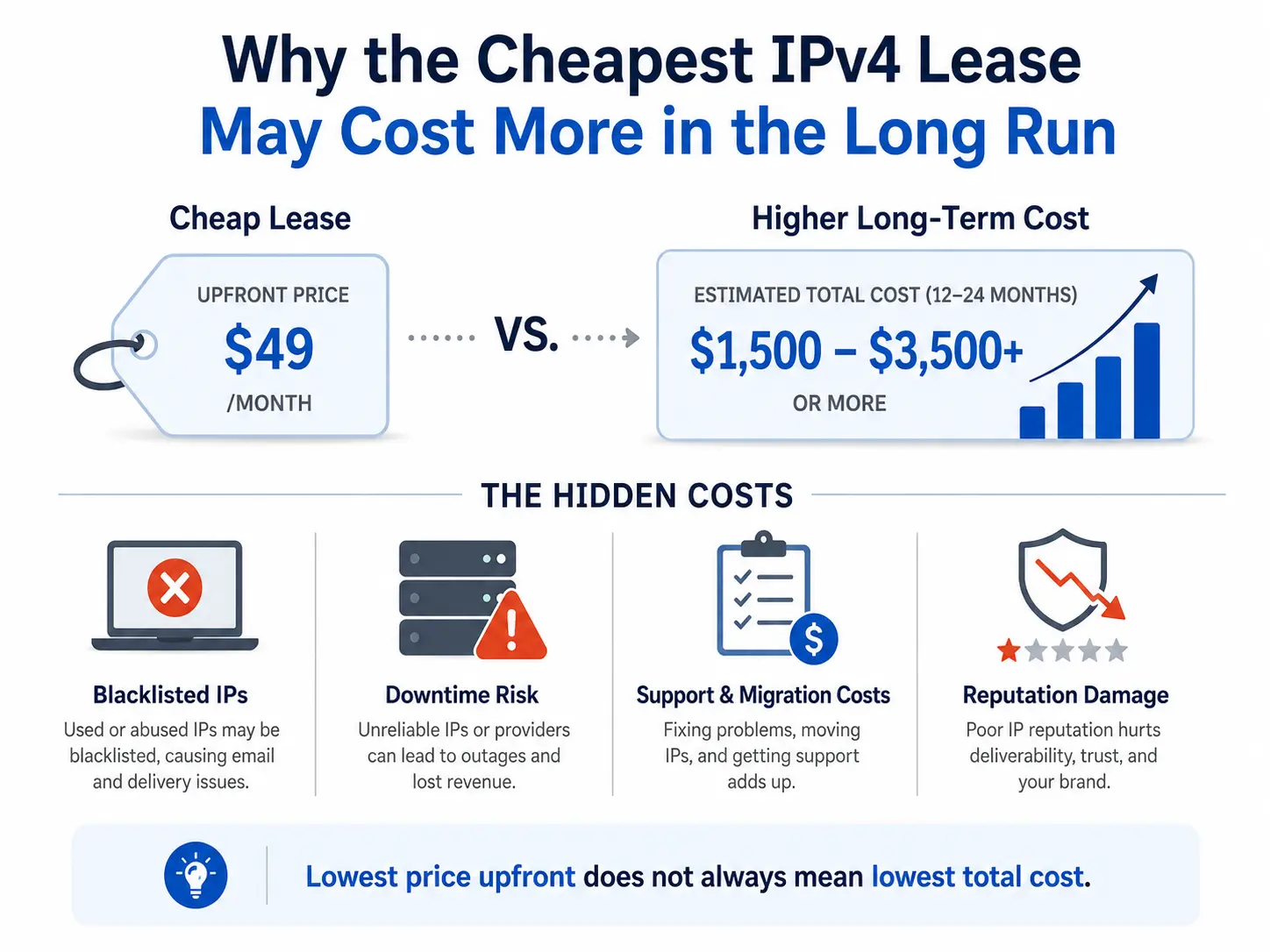
Why the Cheapest IPv4 Lease May Cost More in the Long Run
A low monthly price may look attractive during procurement, but the real cost of leased IPv4 addresses includes much more than the advertised rate. Poor IP reputation, incomplete routing authorisation, deployment delays, weak technical support, incorrect geolocation and uncertain renewal terms can quickly erase the initial saving. For testing or short-lived projects, a basic low-cost IPv4 lease may be sufficient. For production networks, however, businesses should evaluate the totalRead more Related Posts How to Prevent IPv4 Hijacking During a Transfer: 10 Security Steps Transferring IPv4 address space is not only a commercial and registry process. It is also a sensitive routing operation. During Why the Cheapest IPv4 Lease May Cost More in the Long Run A low monthly price may look attractive during procurement, but the real cost of leased IPv4 addresses includes much more What Is a /24 IPv4 Subnet and Why Is It Popular for Leasing? A /24 IPv4 subnet is one of the most common block sizes in the IPv4 leasing market. For hosting providers, .related-post {} .related-post .post-list { text-align: left; } .related-post .post-list .item { margin: 5px; padding: 10px; } .related-post .headline { font-size: 18px !important; color: #999999 !important; } .related-post .post-list .item .post_thumb { max-height: 220px; margin: 10px 0px; padding: 0px; display: block; } .related-post .post-list .item .post_title { font-size: 16px; color: #3f3f3f; margin: 10px 0px; padding: 0px; display: block; text-decoration: none; } .related-post .post-list .item .post_excerpt { font-size: 13px; color: #3f3f3f; margin: 10px 0px; padding: 0px; display: block; text-decoration: none; } @media only screen and (min-width: 1024px) { .related-post .post-list .item { width: 30%; } } @media only screen and (min-width: 768px) and (max-width: 1023px) { .related-post .post-list .item { width: 90%; } } @media only screen and (min-width: 0px) and (max-width: 767px) { .related-post .post-list .item { width: 90%; } }
What causes IPv4 deals to stall after the first agreement
IPv4 deals usually stall after the first agreement because agreeing on price is only the commercial beginning—not operational completion. A buyer and seller may agree on a block and price within hours, but the transaction can still be delayed by unclear ownership, incomplete documents, mismatched Regional Internet Registry requirements, recipient eligibility, reputation concerns, payment conditions, or missing routing authorization. The most common causes are: The seller’s authority over theRead more Related Posts How to Prevent IPv4 Hijacking During a Transfer: 10 Security Steps Transferring IPv4 address space is not only a commercial and registry process. It is also a sensitive routing operation. During Why the Cheapest IPv4 Lease May Cost More in the Long Run A low monthly price may look attractive during procurement, but the real cost of leased IPv4 addresses includes much more What Is a /24 IPv4 Subnet and Why Is It Popular for Leasing? A /24 IPv4 subnet is one of the most common block sizes in the IPv4 leasing market. For hosting providers, .related-post {} .related-post .post-list { text-align: left; } .related-post .post-list .item { margin: 5px; padding: 10px; } .related-post .headline { font-size: 18px !important; color: #999999 !important; } .related-post .post-list .item .post_thumb { max-height: 220px; margin: 10px 0px; padding: 0px; display: block; } .related-post .post-list .item .post_title { font-size: 16px; color: #3f3f3f; margin: 10px 0px; padding: 0px; display: block; text-decoration: none; } .related-post .post-list .item .post_excerpt { font-size: 13px; color: #3f3f3f; margin: 10px 0px; padding: 0px; display: block; text-decoration: none; } @media only screen and (min-width: 1024px) { .related-post .post-list .item { width: 30%; } } @media only screen and (min-width: 768px) and (max-width: 1023px) { .related-post .post-list .item { width: 90%; } } @media only screen and (min-width: 0px) and (max-width: 767px) { .related-post .post-list .item { width: 90%; } }
