Inbound vs. Outbound IPv4 Leasing: A Complete Guide for Enterprises
 Stephanie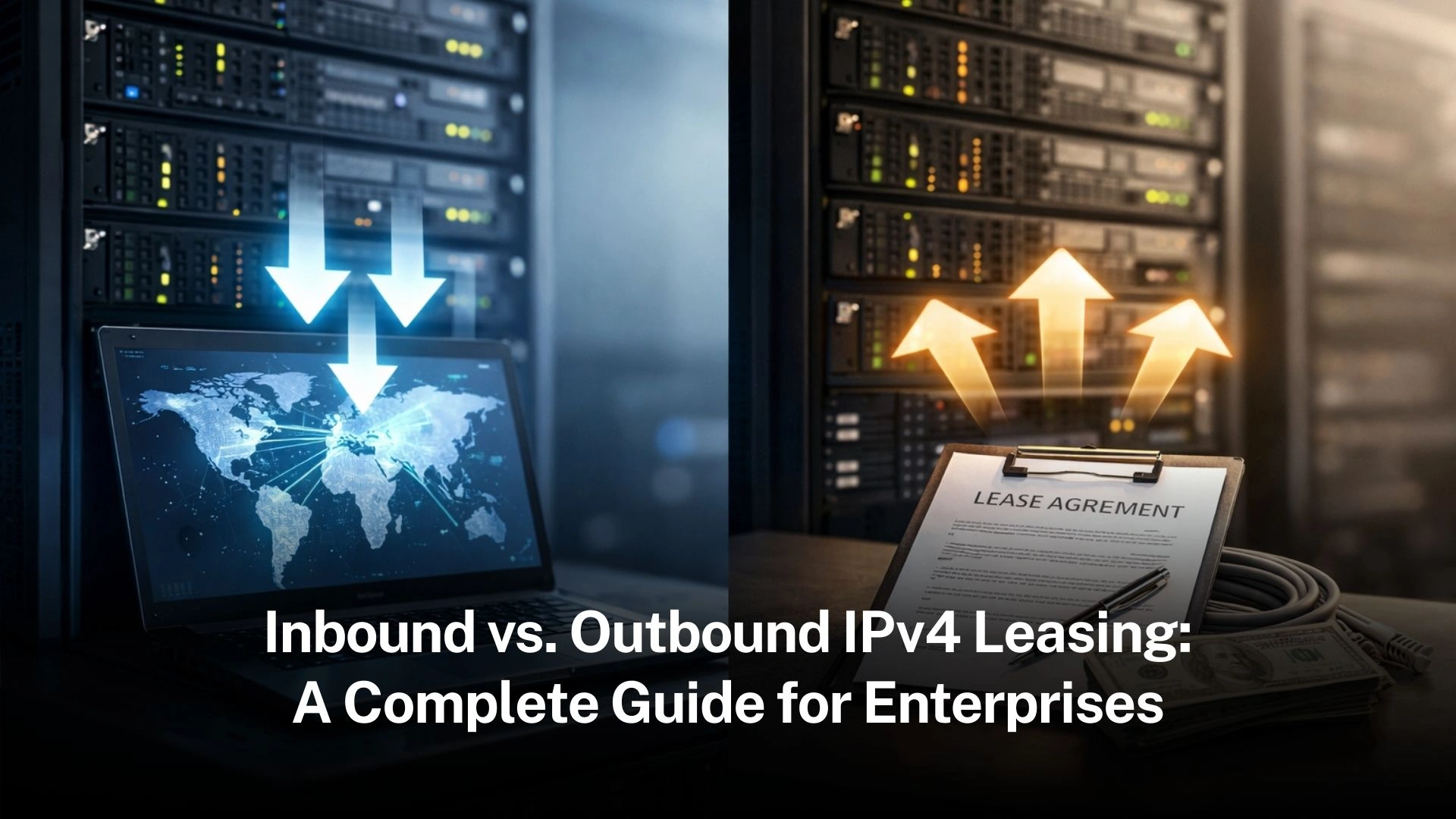
Understanding IPv4 leasing helps enterprises manage scarce address space, reducing risk and unlocking strategic growth opportunities in today’s digital economy.
Table of Contents
Key points
- Distinguishes between inbound (leasing in) and outbound (leasing out) IPv4 approaches and their strategic implications.
- Highlights contract structures, registry risk management and continuity considerations affecting global number resources.
Inbound vs. outbound IPv4 leasing: complete enterprise guide
In the post-exhaustion era of Internet Protocol version 4 (IPv4), leasing has become vital for organisations needing address space without outright ownership. Although IPv6 continues its gradual adoption, IPv4 remains entrenched in global routing due to compatibility requirements, legacy infrastructure and slower transition economics.
For enterprises, understanding the difference between inbound and outbound IPv4 leasing is essential to manage cost, security and operational continuity. This guide explains both, grounded in practical context and aligned with broader industry observations about registry fragility and continuity risk.
What is IPv4 leasing?
IPv4 leasing refers to renting IPv4 address space for defined periods instead of purchasing blocks outright. Businesses lease addresses from lessors — organisations or brokers with available IPv4 capacity — under contractual terms that grant usage rights.
Leasing is widely used because the global pool of IPv4 addresses has been depleted for years. Once the Internet Assigned Numbers Authority (IANA) distributed the last free blocks to the Regional Internet Registries (RIRs) in 2011, organisations could no longer secure large new allocations on demand.
Inbound IPv4 leasing — bringing addresses in
Inbound leasing means an enterprise acquires IPv4 addresses from a provider for its own use.
Why enterprises lease inbound
Organisations choose inbound leasing when their existing IPv4 resources are insufficient for:
- expanding digital services
- supporting new infrastructure
- sustaining IPv4-dependent applications
- facilitating temporary projects (e.g., events, campaigns)
Inbound leasing offers flexibility and cost effectiveness compared with purchasing IPv4 addresses outright, which can be expensive and slow to obtain.
“Leasing IPv4 addresses is generally faster than purchasing them outright and enables businesses to scale efficiently across projects.” — industry commentary on IPv4 marketplace dynamics.
Practical inbound use cases
- Cloud and hosting providers expanding service offerings without large upfront costs.
- Cybersecurity firms seeking dedicated addresses for threat mitigation and testing.
- Telecom and IoT operations requiring scalable IP capacity for devices and services.
Outbound IPv4 leasing — monetising your address space
Outbound leasing is when an enterprise with excess IPv4 capacity leases that space to others.
Strategic advantages of outbound leasing
Enterprises with surplus IPv4 blocks — often legacy holdings from early Internet allocations — can generate recurring revenue by leasing out unused addresses rather than selling them.
This model enables:
- recurring revenue streams instead of one-off sales
- retention of registry continuity through contractual arrangements rather than transferring ownership
- greater operational flexibility for future internal use
Outbound risks and considerations
Leasing out IPv4 blocks introduces structural and security considerations. Industry analysis highlights concerns about leasing markets operating outside formal RIR registry updates, creating potential management and routing security risks.
For example, in many leasing arrangements the registry still lists the lessor as the official holder of the space while the lessee advertises prefixes operationally — a contractual arrangement not reflected in global registry records.
This can complicate:
- Route Origin Authorization (ROA) management
- RPKI delegation
- BGP hijack mitigations if proper security controls aren’t in place
Enterprises contemplating outbound leasing should therefore build robust contractual protections and technical assurances.
-IPv4 is the Internet’s most important service enabler; a device or server cannot be online without it.
– Heng.Lu, CEO of LARUS Limited and founder of the LARUS Foundation
Registry fragility and continuity risk
Industry commentary places particular emphasis on the fragility of underlying registry infrastructure and the operational risks that leasing introduces. A structural vulnerability arises when primary registry governance operates on voluntary coordination rather than enforceable legal certainty — a reality that affects both inbound and outbound leasing.
An emerging response is first-party leasing with continuity guarantees. Under this model, the holder structures leasing arrangements with built-in continuity commitments to mitigate registry and contractual risks.
In practical terms, this translates into long-term service agreements that more closely resemble infrastructure contracts (like spectrum licences in telecommunications) rather than ad-hoc rentals.
Contract essentials for enterprise IPv4 leasing
Whether inbound or outbound, IPv4 leasing contracts should include:
Term and renewal clauses
- Clear definitions of lease duration and extensions help enterprises avoid sudden discontinuity.
Usage and compliance obligations
- Providers and lessees must agree on acceptable uses of the addresses, especially regarding security and routing practices.
Technical delegation details
- Details on ROA management and RPKI representation are critical, especially given registry-level vulnerabilities cited in research.
Liability and indemnity
- Contracts should allocate responsibilities for security incidents, maintenance and misconfiguration.
- Detailed contracts protect both inbound lessees dependent on address continuity and outbound lessors seeking to safeguard their assets.
Security considerations in leasing IPv4
Leasing introduces unique risks not present in internal allocations:
RPKI and ROA control
- If leases are arranged without proper delegation mechanisms, lessees may lack control over ROA updates.
- Delegated control allows lessees to participate in routing security frameworks, reducing the risk of hijacks or accidental misannouncements.
BGP operational risks
- Without careful route validation and coordination with upstream providers, leased IP space could be susceptible to BGP anomalies.
Choosing a leasing provider
Enterprises should evaluate providers on:
- Reputation and registry compliance
- Continuity guarantees
- Technical support for routing and security
- Flexibility in lease terms
- Providers vary in their business models — from brokers specialising in short-term leases to operators managing large contiguous blocks.
- Those seeking continuity advantages may explore first-party leasing platforms that retain control of underlying address space, aiming for stable, multi-year arrangements.
Inbound vs. outbound: strategic enterprise decisions
Ultimately, enterprises must weigh:
- Immediate capacity needs (inbound)
- Potential revenue from idle resources (outbound)
- Operational risk from registry fragility
- Security and routing control considerations
Inbound leasing aids growth without heavy capital expenditure, while outbound leasing monetises infrastructure without relinquishing long-term control.
Both strategies require clarity around contracts, technical delegation and alignment with registry governance realities.
Frequently Asked Questions
1. What is inbound IPv4 leasing?
Inbound IPv4 leasing is when an enterprise leases address space from a provider for its own operational use.
2. What is outbound IPv4 leasing?
Outbound IPv4 leasing occurs when an enterprise with excess address blocks rents them out to other organisations under contractual terms.
3. Is leasing IPv4 cheaper than buying?
Leasing is typically more flexible and lower upfront than purchasing, though long-term costs vary by provider and contract structure.
4. What security risks should enterprises consider?
Security risks include ROA control issues under RPKI and potential BGP routing anomalies if technical delegation is not adequately managed.
5. Why focus on registry risk?
Global number resources operate largely on coordinated governance frameworks, which can create structural vulnerabilities that well-drafted leasing contracts must address.
Related Blogs
Related Posts
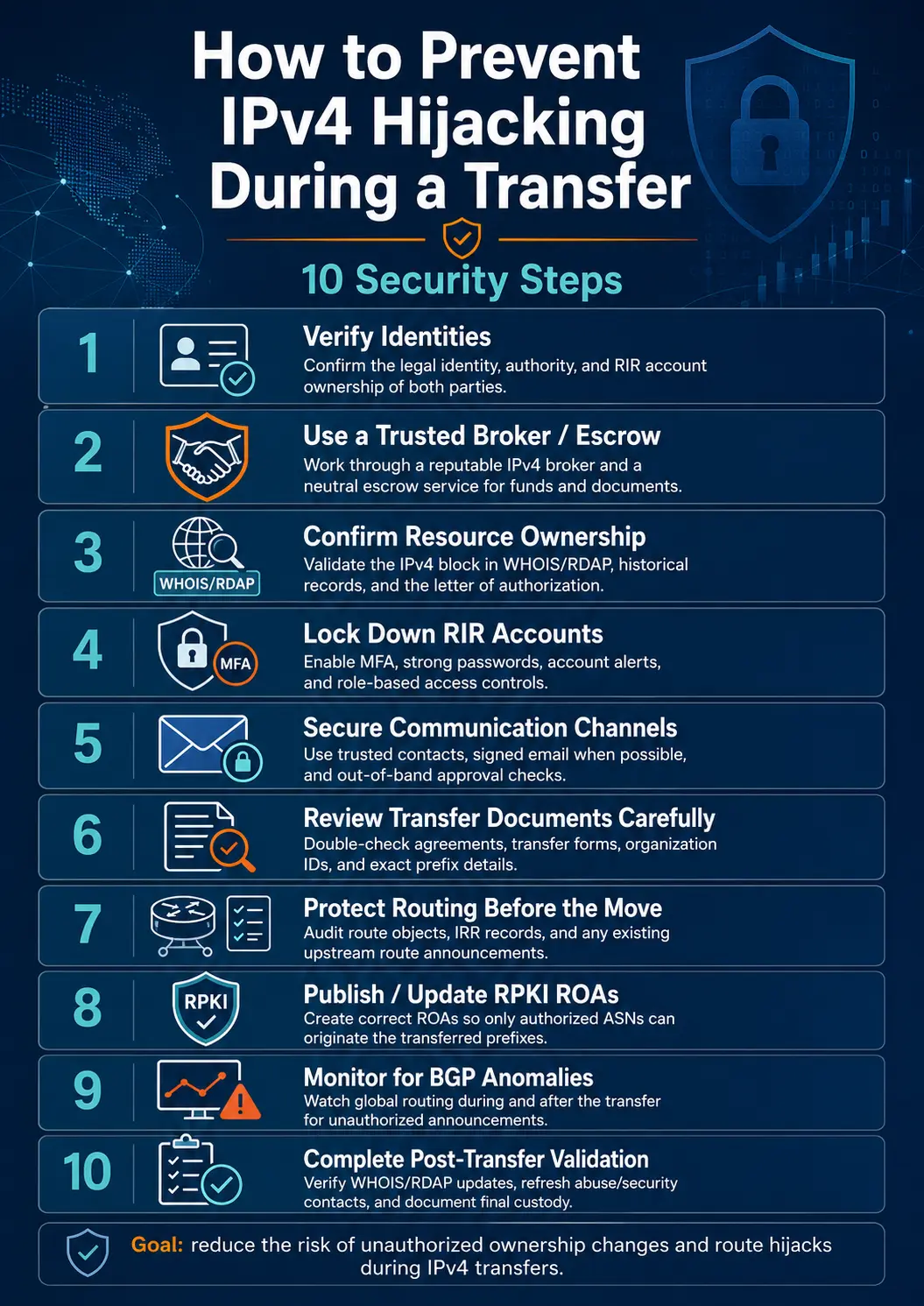
How to Prevent IPv4 Hijacking During a Transfer: 10 Security Steps
Transferring IPv4 address space is not only a commercial and registry process. It is also a sensitive routing operation. During an IPv4 transfer, control of a prefix moves from one organization to another. Registry records, Route Origin Authorizations, Internet Routing Registry objects, upstream-provider filters, reverse DNS settings, and live BGP announcements may all need to change. When these changes are completed in the wrong order—or when identity and authorizationRead more Related Posts How to Prevent IPv4 Hijacking During a Transfer: 10 Security Steps Transferring IPv4 address space is not only a commercial and registry process. It is also a sensitive routing operation. During Why the Cheapest IPv4 Lease May Cost More in the Long Run A low monthly price may look attractive during procurement, but the real cost of leased IPv4 addresses includes much more What Is a /24 IPv4 Subnet and Why Is It Popular for Leasing? A /24 IPv4 subnet is one of the most common block sizes in the IPv4 leasing market. For hosting providers, .related-post {} .related-post .post-list { text-align: left; } .related-post .post-list .item { margin: 5px; padding: 10px; } .related-post .headline { font-size: 18px !important; color: #999999 !important; } .related-post .post-list .item .post_thumb { max-height: 220px; margin: 10px 0px; padding: 0px; display: block; } .related-post .post-list .item .post_title { font-size: 16px; color: #3f3f3f; margin: 10px 0px; padding: 0px; display: block; text-decoration: none; } .related-post .post-list .item .post_excerpt { font-size: 13px; color: #3f3f3f; margin: 10px 0px; padding: 0px; display: block; text-decoration: none; } @media only screen and (min-width: 1024px) { .related-post .post-list .item { width: 30%; } } @media only screen and (min-width: 768px) and (max-width: 1023px) { .related-post .post-list .item { width: 90%; } } @media only screen and (min-width: 0px) and (max-width: 767px) { .related-post .post-list .item { width: 90%; } }
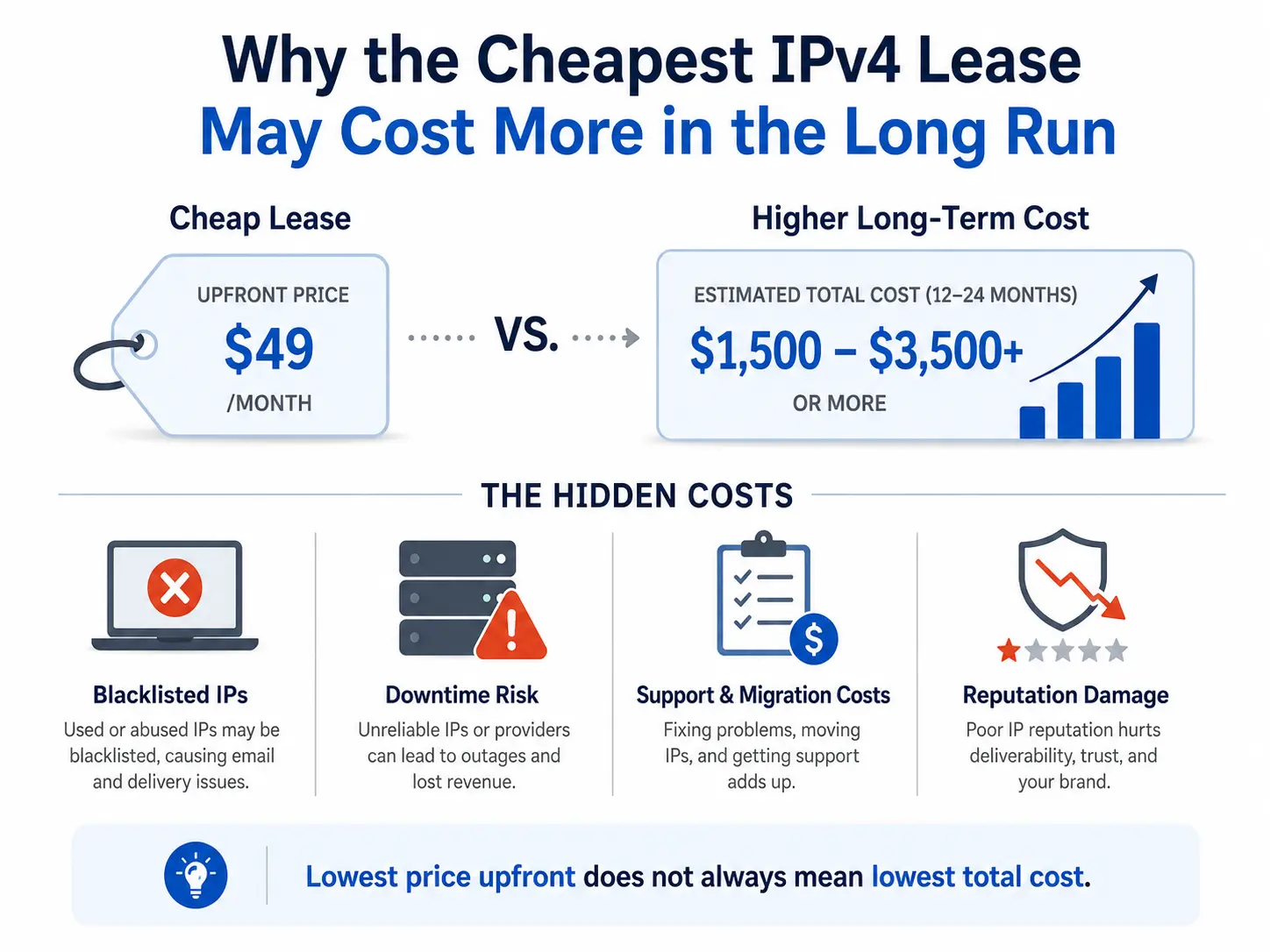
Why the Cheapest IPv4 Lease May Cost More in the Long Run
A low monthly price may look attractive during procurement, but the real cost of leased IPv4 addresses includes much more than the advertised rate. Poor IP reputation, incomplete routing authorisation, deployment delays, weak technical support, incorrect geolocation and uncertain renewal terms can quickly erase the initial saving. For testing or short-lived projects, a basic low-cost IPv4 lease may be sufficient. For production networks, however, businesses should evaluate the totalRead more Related Posts How to Prevent IPv4 Hijacking During a Transfer: 10 Security Steps Transferring IPv4 address space is not only a commercial and registry process. It is also a sensitive routing operation. During Why the Cheapest IPv4 Lease May Cost More in the Long Run A low monthly price may look attractive during procurement, but the real cost of leased IPv4 addresses includes much more What Is a /24 IPv4 Subnet and Why Is It Popular for Leasing? A /24 IPv4 subnet is one of the most common block sizes in the IPv4 leasing market. For hosting providers, .related-post {} .related-post .post-list { text-align: left; } .related-post .post-list .item { margin: 5px; padding: 10px; } .related-post .headline { font-size: 18px !important; color: #999999 !important; } .related-post .post-list .item .post_thumb { max-height: 220px; margin: 10px 0px; padding: 0px; display: block; } .related-post .post-list .item .post_title { font-size: 16px; color: #3f3f3f; margin: 10px 0px; padding: 0px; display: block; text-decoration: none; } .related-post .post-list .item .post_excerpt { font-size: 13px; color: #3f3f3f; margin: 10px 0px; padding: 0px; display: block; text-decoration: none; } @media only screen and (min-width: 1024px) { .related-post .post-list .item { width: 30%; } } @media only screen and (min-width: 768px) and (max-width: 1023px) { .related-post .post-list .item { width: 90%; } } @media only screen and (min-width: 0px) and (max-width: 767px) { .related-post .post-list .item { width: 90%; } }
What causes IPv4 deals to stall after the first agreement
IPv4 deals usually stall after the first agreement because agreeing on price is only the commercial beginning—not operational completion. A buyer and seller may agree on a block and price within hours, but the transaction can still be delayed by unclear ownership, incomplete documents, mismatched Regional Internet Registry requirements, recipient eligibility, reputation concerns, payment conditions, or missing routing authorization. The most common causes are: The seller’s authority over theRead more Related Posts How to Prevent IPv4 Hijacking During a Transfer: 10 Security Steps Transferring IPv4 address space is not only a commercial and registry process. It is also a sensitive routing operation. During Why the Cheapest IPv4 Lease May Cost More in the Long Run A low monthly price may look attractive during procurement, but the real cost of leased IPv4 addresses includes much more What Is a /24 IPv4 Subnet and Why Is It Popular for Leasing? A /24 IPv4 subnet is one of the most common block sizes in the IPv4 leasing market. For hosting providers, .related-post {} .related-post .post-list { text-align: left; } .related-post .post-list .item { margin: 5px; padding: 10px; } .related-post .headline { font-size: 18px !important; color: #999999 !important; } .related-post .post-list .item .post_thumb { max-height: 220px; margin: 10px 0px; padding: 0px; display: block; } .related-post .post-list .item .post_title { font-size: 16px; color: #3f3f3f; margin: 10px 0px; padding: 0px; display: block; text-decoration: none; } .related-post .post-list .item .post_excerpt { font-size: 13px; color: #3f3f3f; margin: 10px 0px; padding: 0px; display: block; text-decoration: none; } @media only screen and (min-width: 1024px) { .related-post .post-list .item { width: 30%; } } @media only screen and (min-width: 768px) and (max-width: 1023px) { .related-post .post-list .item { width: 90%; } } @media only screen and (min-width: 0px) and (max-width: 767px) { .related-post .post-list .item { width: 90%; } }
