IP Address Geolocation: Understanding its Uses and Implications
 Chan
Chan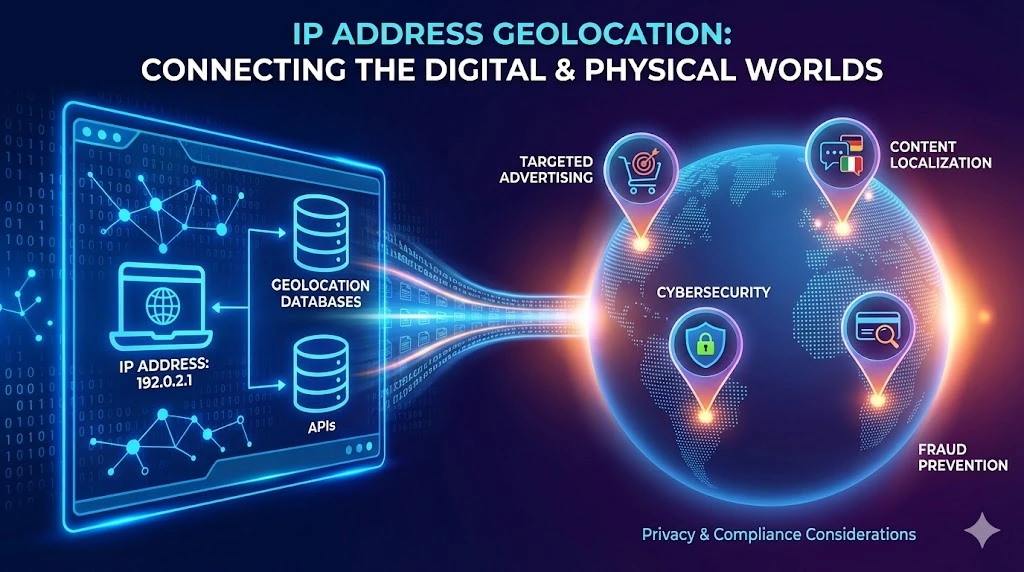
In today’s interconnected world wide web, the ability to determine the geographical location of an IP address has become increasingly important for various applications, ranging from targeted advertising to fraud detection and cybersecurity.
Table of Contents
In this article, we will explore IP address geolocation, shedding light on its uses, technologies, and potential implications.
What is IP address geolocation?
IP address geolocation refers to the process of mapping an IP address to a physical location on the Earth’s surface, such as a country, city, or even a specific street address. This geolocation data provides valuable insights into the geographical distribution of internet users, allowing organizations to tailor their services, content, and marketing strategies based on users’ locations.
Technologies Behind IP Address Geolocation
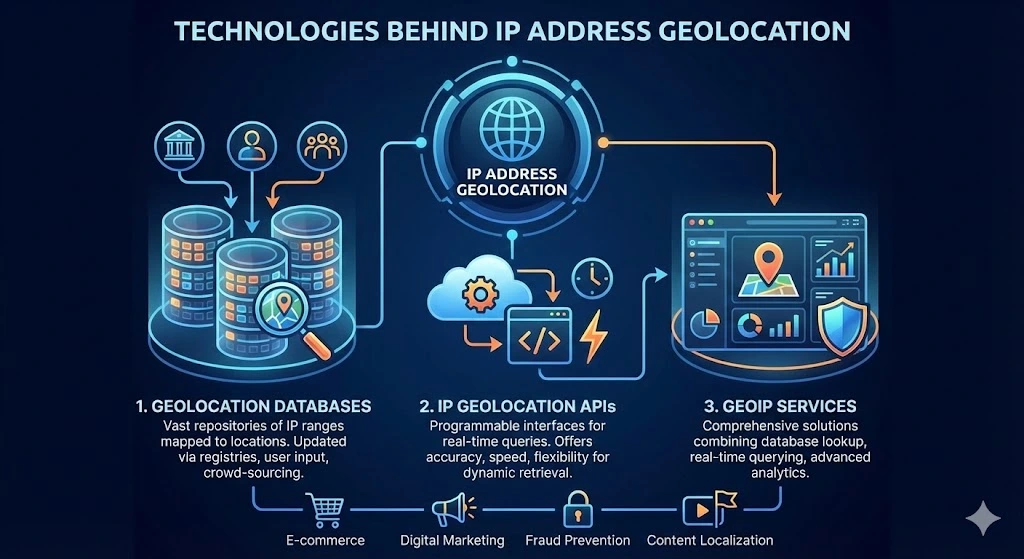
There are three technologies and techniques used to determine the geolocation of an IP address, including:
Geolocation Databases
Geolocation databases contain vast repositories of IP address ranges mapped to corresponding geographical locations. These databases are continuously updated and refined using various data sources, such as internet registries, user input, and crowd-sourced feedback.
IP Geolocation APIs
IP geolocation APIs provide developers with programmable interfaces to query geolocation data for a given IP address in real-time. These APIs offer accuracy, speed, and flexibility, enabling applications to dynamically retrieve geolocation information as needed.
GeoIP Services
GeoIP services offer comprehensive solutions for IP address geolocation, combining database lookup, real-time querying, and advanced analytics to deliver accurate and actionable geolocation insights. These services are widely used across industries for diverse applications, including e-commerce, digital marketing, fraud prevention, and content localization.
Uses of IP Address Geolocation
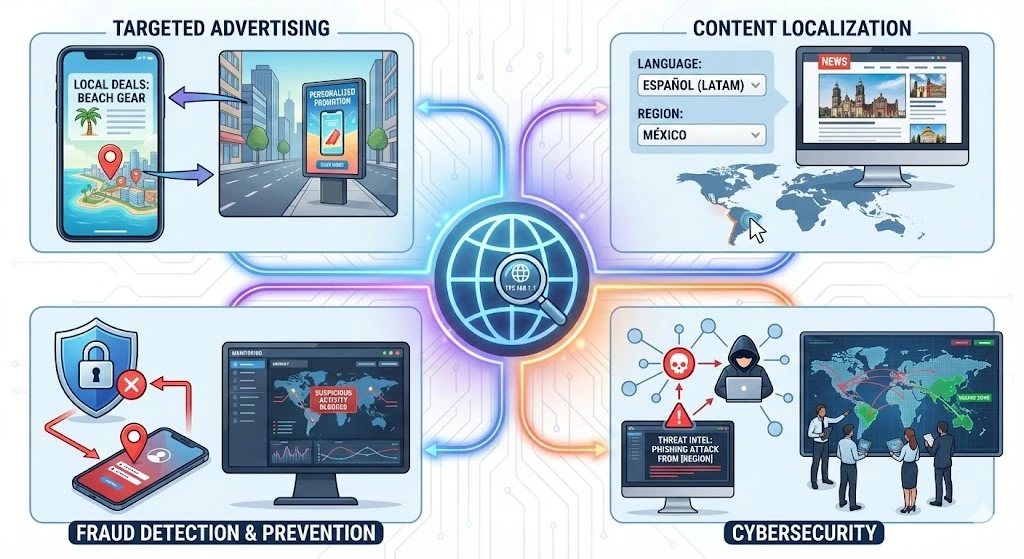
IP address geolocation has numerous practical applications across various industries and domains, including:
Targeted Advertising
By leveraging geolocation data, advertisers can deliver personalized ads and promotions based on users’ geographic locations, preferences, and interests. This targeted approach enhances ad relevance, engagement, and conversion rates, maximizing the effectiveness of digital advertising campaigns.
Content Localization
Content providers can use geolocation data to deliver localized content, services, and user experiences tailored to users’ linguistic, cultural, and regional preferences. This localization strategy enhances user engagement, satisfaction, and retention, particularly in multi-national or multi-lingual markets.
Fraud Detection and Prevention
Geolocation data is instrumental in detecting and preventing fraudulent activities, such as account hijacking, identity theft, and online scams. By analyzing anomalies in users’ geolocation patterns, organizations can identify suspicious behavior, block malicious actors, and mitigate fraud risks.
Cybersecurity
Geolocation data helps cybersecurity professionals identify and respond to cyber threats, such as phishing attacks, malware infections, and unauthorized access attempts. By correlating IP addresses with geographic locations, security teams can enhance threat intelligence, incident response, and perimeter defense strategies.
Implications and Considerations
While IP address geolocation offers valuable insights and benefits, it also raises important considerations and potential implications, including:
Privacy Concerns: Geolocation data can reveal sensitive information about individuals’ whereabouts, activities, and preferences, raising privacy concerns and ethical considerations regarding data collection, storage, and usage.
Accuracy Limitations: Despite advancements in geolocation technology, IP address geolocation may not always be accurate or reliable, especially in cases of dynamic IP assignments, proxy servers, and mobile devices with GPS capabilities.
Regulatory Compliance: Organizations must comply with applicable laws, regulations, and industry standards governing the collection, processing, and protection of geolocation data, such as the General Data Protection Regulation (GDPR) in the European Union and the California Consumer Privacy Act (CCPA) in the United States.
Conclusion
It is essential to balance the benefits of geolocation with privacy considerations, accuracy limitations, and regulatory compliance requirements to ensure the ethical use of geolocation data in today’s digital landscape. As we continue to leverage geolocation technology, let’s strive to harness its potential for positive impact while mitigating potential risks and challenges.
Trusted IPv4 Leasing for Business Growth
Get enterprise-grade IPv4 space quickly, with seamless deployment and end-to-end management.
Get Started with i.leaseFAQs
How accurate is IP geolocation for finding a person’s street address?
IP geolocation is generally not accurate down to a street address. It is highly reliable at the country and city level (roughly 80-99% accuracy), but it usually only points to the location of the Internet Service Provider’s (ISP) local exchange or data center, not the user’s exact home.
Why does my IP show me in a different city or country?
This “incorrect” geolocation happens for several reasons:
- VPN or Proxy: You are using a service that masks your IP.
- Mobile Networks: Mobile carriers often route data through regional hubs far from your actual location.
- Outdated Databases: Geolocation databases may not have updated their records for your specific IP range yet.
Can I change my IP geolocation?
Yes. The easiest way to change your perceived geographic location is by using a VPN (Virtual Private Network) or a Proxy server. These services route your traffic through a server in a different city or country, causing websites to see that server’s location instead of yours.
Related Posts
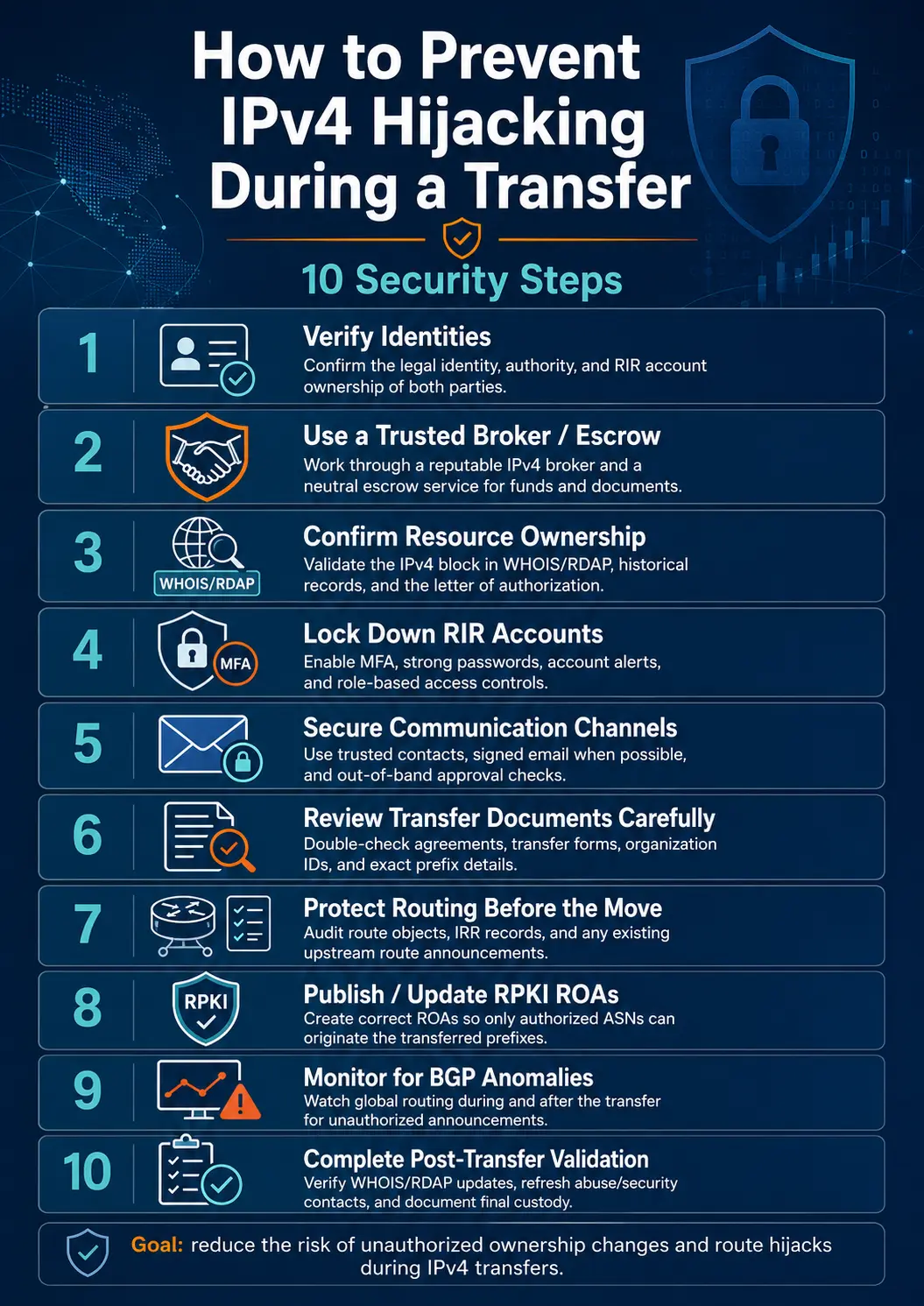
How to Prevent IPv4 Hijacking During a Transfer: 10 Security Steps
Transferring IPv4 address space is not only a commercial and registry process. It is also a sensitive routing operation. During an IPv4 transfer, control of a prefix moves from one organization to another. Registry records, Route Origin Authorizations, Internet Routing Registry objects, upstream-provider filters, reverse DNS settings, and live BGP announcements may all need to change. When these changes are completed in the wrong order—or when identity and authorizationRead more Related Posts How to Prevent IPv4 Hijacking During a Transfer: 10 Security Steps Transferring IPv4 address space is not only a commercial and registry process. It is also a sensitive routing operation. During Why the Cheapest IPv4 Lease May Cost More in the Long Run A low monthly price may look attractive during procurement, but the real cost of leased IPv4 addresses includes much more What Is a /24 IPv4 Subnet and Why Is It Popular for Leasing? A /24 IPv4 subnet is one of the most common block sizes in the IPv4 leasing market. For hosting providers, .related-post {} .related-post .post-list { text-align: left; } .related-post .post-list .item { margin: 5px; padding: 10px; } .related-post .headline { font-size: 18px !important; color: #999999 !important; } .related-post .post-list .item .post_thumb { max-height: 220px; margin: 10px 0px; padding: 0px; display: block; } .related-post .post-list .item .post_title { font-size: 16px; color: #3f3f3f; margin: 10px 0px; padding: 0px; display: block; text-decoration: none; } .related-post .post-list .item .post_excerpt { font-size: 13px; color: #3f3f3f; margin: 10px 0px; padding: 0px; display: block; text-decoration: none; } @media only screen and (min-width: 1024px) { .related-post .post-list .item { width: 30%; } } @media only screen and (min-width: 768px) and (max-width: 1023px) { .related-post .post-list .item { width: 90%; } } @media only screen and (min-width: 0px) and (max-width: 767px) { .related-post .post-list .item { width: 90%; } }
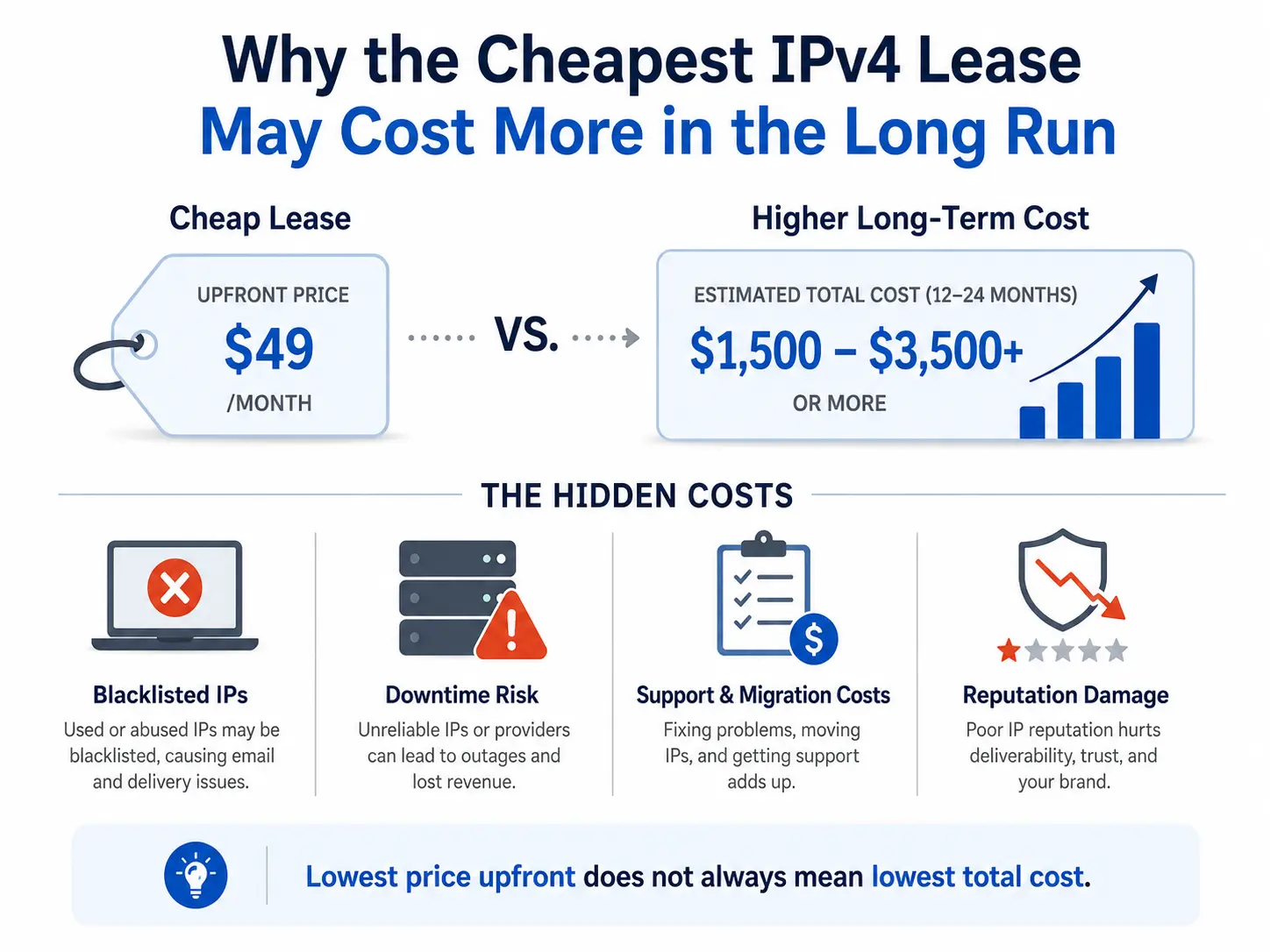
Why the Cheapest IPv4 Lease May Cost More in the Long Run
A low monthly price may look attractive during procurement, but the real cost of leased IPv4 addresses includes much more than the advertised rate. Poor IP reputation, incomplete routing authorisation, deployment delays, weak technical support, incorrect geolocation and uncertain renewal terms can quickly erase the initial saving. For testing or short-lived projects, a basic low-cost IPv4 lease may be sufficient. For production networks, however, businesses should evaluate the totalRead more Related Posts How to Prevent IPv4 Hijacking During a Transfer: 10 Security Steps Transferring IPv4 address space is not only a commercial and registry process. It is also a sensitive routing operation. During Why the Cheapest IPv4 Lease May Cost More in the Long Run A low monthly price may look attractive during procurement, but the real cost of leased IPv4 addresses includes much more What Is a /24 IPv4 Subnet and Why Is It Popular for Leasing? A /24 IPv4 subnet is one of the most common block sizes in the IPv4 leasing market. For hosting providers, .related-post {} .related-post .post-list { text-align: left; } .related-post .post-list .item { margin: 5px; padding: 10px; } .related-post .headline { font-size: 18px !important; color: #999999 !important; } .related-post .post-list .item .post_thumb { max-height: 220px; margin: 10px 0px; padding: 0px; display: block; } .related-post .post-list .item .post_title { font-size: 16px; color: #3f3f3f; margin: 10px 0px; padding: 0px; display: block; text-decoration: none; } .related-post .post-list .item .post_excerpt { font-size: 13px; color: #3f3f3f; margin: 10px 0px; padding: 0px; display: block; text-decoration: none; } @media only screen and (min-width: 1024px) { .related-post .post-list .item { width: 30%; } } @media only screen and (min-width: 768px) and (max-width: 1023px) { .related-post .post-list .item { width: 90%; } } @media only screen and (min-width: 0px) and (max-width: 767px) { .related-post .post-list .item { width: 90%; } }
What causes IPv4 deals to stall after the first agreement
IPv4 deals usually stall after the first agreement because agreeing on price is only the commercial beginning—not operational completion. A buyer and seller may agree on a block and price within hours, but the transaction can still be delayed by unclear ownership, incomplete documents, mismatched Regional Internet Registry requirements, recipient eligibility, reputation concerns, payment conditions, or missing routing authorization. The most common causes are: The seller’s authority over theRead more Related Posts How to Prevent IPv4 Hijacking During a Transfer: 10 Security Steps Transferring IPv4 address space is not only a commercial and registry process. It is also a sensitive routing operation. During Why the Cheapest IPv4 Lease May Cost More in the Long Run A low monthly price may look attractive during procurement, but the real cost of leased IPv4 addresses includes much more What Is a /24 IPv4 Subnet and Why Is It Popular for Leasing? A /24 IPv4 subnet is one of the most common block sizes in the IPv4 leasing market. For hosting providers, .related-post {} .related-post .post-list { text-align: left; } .related-post .post-list .item { margin: 5px; padding: 10px; } .related-post .headline { font-size: 18px !important; color: #999999 !important; } .related-post .post-list .item .post_thumb { max-height: 220px; margin: 10px 0px; padding: 0px; display: block; } .related-post .post-list .item .post_title { font-size: 16px; color: #3f3f3f; margin: 10px 0px; padding: 0px; display: block; text-decoration: none; } .related-post .post-list .item .post_excerpt { font-size: 13px; color: #3f3f3f; margin: 10px 0px; padding: 0px; display: block; text-decoration: none; } @media only screen and (min-width: 1024px) { .related-post .post-list .item { width: 30%; } } @media only screen and (min-width: 768px) and (max-width: 1023px) { .related-post .post-list .item { width: 90%; } } @media only screen and (min-width: 0px) and (max-width: 767px) { .related-post .post-list .item { width: 90%; } }
