Short-term vs Long-term IPv4 Leasing
 Stephanie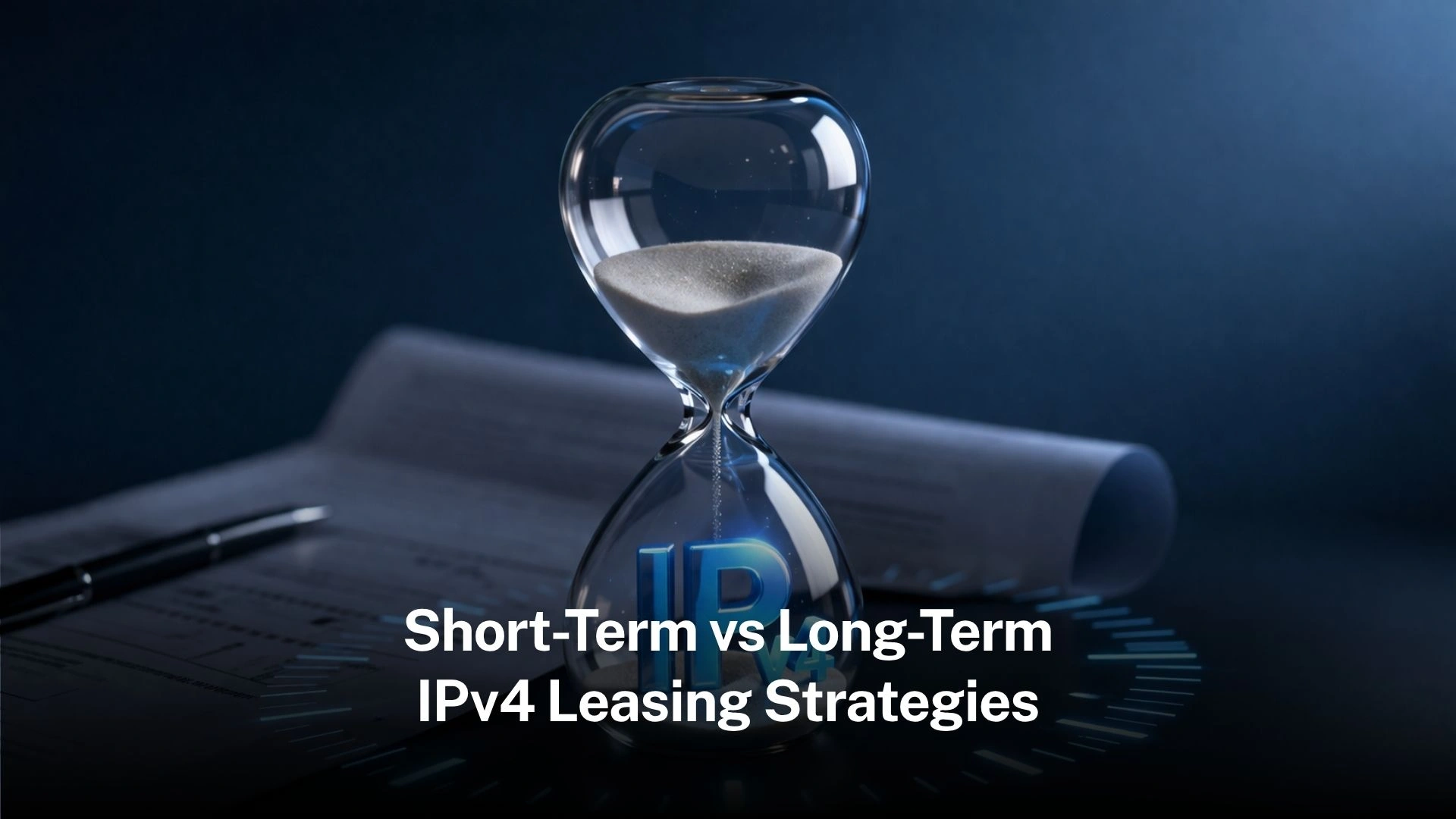
Facing IPv4 shortages, companies must weigh cost, speed, and network growth when choosing a lease plan.
Table of Contents
- Short-term leasing lets you scale resources up or down easily, but costs more over time and offers less supply certainty.
- Long-term leasing provides stable pricing and more reliable access, yet makes it harder to adjust your setup as needs evolve.
Introduction: Why leasing IPv4 addresses makes sense
IPv4 has evolved from a technical resource into a scarce economic asset.
Although IPv6 adoption continues, IPv4 still sits at the heart of most production networks. The transition has been slow – held back by migration challenges, legacy dependencies, and compatibility issues. At the same time, the global pool of unallocated IPv4 addresses is all but exhausted, pushing businesses towards the secondary market.
That’s where leasing IPv4 addresses comes in. Companies can lease IPv4 resources when they need them. This way they do not have to buy address blocks.
Not all IPv4 leasing strategies are the same. You have to choose between term and long-term leasing. This choice affects how much you spend, how flexible you are and how risk you take. For businesses choosing between short-term and long-term leasing is important, for planning their infrastructure and finances.
Understanding IPv4 leasing: beyond simple access to IP resources
At its core, IPv4 leasing gives organizations access to IP address space without the need to own it.
But in practice, it offers much more:
- Turns large upfront costs into manageable operating expenses
- Speeds up network deployment
- Enables scalable infrastructure planning
In today’s constrained market, leasing has shifted from a temporary fix to a core strategy for digital growth.
How the IPv4 leasing market has evolved
The IPv4 market has transformed significantly over the past decade.
What was once a loose, broker-driven ecosystem has matured into a much more structured leasing marketplace—driven by:
- Persistent supply shortages
- Rising demand from cloud and hosting providers
- Growing focus on compliance and IP reputation
Today, platforms like i.lease go far beyond simple transactions. They support end-to-end capabilities—sourcing, validation, routing readiness, and ongoing usability—that are essential yet often overlooked.
Short-term IPv4 leasing: agility in a fast-moving environment
Short-term IPv4 leasing usually lasts from a few weeks to several months. It helps businesses adapt quickly.
Why businesses choose short-term IPv4 leasing
- Maximum flexibility
Organisations can scale IP usage up or down with minimal commitment. - Faster time‑to‑market
Ideal for launching services, setting up test environments, or handling traffic spikes. - Lower immediate risk
Short‑term commitments mean businesses aren’t locked into long‑term uncertainty.
- Maximum flexibility
Trade-offs to consider
- Premium pricing
Short-term contracts generally cost more per IP. - Supply volatility
The availability of IPv4 addresses may change quickly especially when there is a demand. - Operational complexity
Frequent renewals require businesses to be actively managing their IPv4 leases.
- Premium pricing
Best-fit scenarios
- Startups and early-stage platforms
- Seasonal or event-driven traffic
- Temporary infrastructure scaling
- Proof-of-concept deployment
Long-term IPv4 leasing: stability and cost efficiency
Long-term IPv4 leasing typically lasts a minimum of one year. It is best suited to stable, predictable environments where future needs are clearly understood.
Key benefits of long-term leasing
- Lower cost per address
Longer commitments often secure more favourable pricing. - Operational stability
Consistent IP availability supports long-term service delivery. - Financial predictability
Fixed contracts simplify budgeting and forecasting.
Limitations to weigh
- Reduced flexibility
Adjusting capacity mid-term can be difficult. - Longer commitment horizon
Requires confidence in future demand. - Risk of over-provisioning
Unused IPs can impact efficiency.
Best-fit scenarios
- Cloud infrastructure providers
- Data centres and hosting companies
- Enterprises with steady demand
-IPv4 is the Internet’s most important service enabler; a device or server cannot be online without it.
– Heng.Lu, CEO of LARUS Limited and founder of the LARUS Foundation
Short term vs long term IPv4 leasing: which is right for you?
Criteria | Short-term leasing | Long-term leasing |
Flexibility | High | Limited |
Cost per IP | Higher | Lower |
Commitment | Low | High |
Risk | Supply uncertainty | Contract lock-in |
Ideal use | Variable demand | Stable workloads |
Cost strategy: when leasing makes financial sense
From a financial standpoint, leasing IPv4 offers clear short-term benefits:
- No large upfront investment
- Costs aligned with usage
- Easier financial planning
That said, over longer periods, cumulative lease costs can add up significantly. This leads to a straightforward strategic framework:
- Short lifecycle needs → short-term leasing
- Predictable growth → long-term leasing
- Multi-year certainty → consider ownership or hybrid models
Risk factors in the IPv4 leasing marketplace
While leasing offers flexibility, it also comes with several risks that deserve close attention.
Key considerations
- IP address reputation from prior use
- Market price fluctuations
- Contractual restrictions
Best practices
- Work with trusted IPv4 leasing marketplace providers
- Validate IP history before deployment
- Align lease duration with business forecasts
Hybrid IPv4 leasing strategies: the emerging standard
Increasingly, organisations are moving away from choosing a single model – they are combining both.
A typical hybrid approach:
- Long‑term leasing for baseline capacity
- Short‑term leasing for peak demand
This allows businesses to:
- Reduce costs
- Maintain flexibility
- Avoid overcommitment
This hybrid model is quickly becoming the default strategy in the IPv4 leasing marketplace.
Conclusion: building a smarter IPv4 leasing strategy
In today’s constrained environment, IPv4 leasing is no longer optional—it is strategic.
The decision between short-term and long-term leasing depends on:
- Demand predictability
- Cost sensitivity
- Growth plans
- Risk tolerance
Flexible, data‑driven organisations—often combining both leasing models—will scale efficiently in the years ahead.
Frequently Asked Questions
1. What does it mean to lease IPv4?
Leasing IPv4 means renting blocks of IP addresses for a set period, rather than buying them outright.
2. Is short‑term IPv4 leasing more expensive?
Yes – it typically comes with higher monthly rates due to the flexibility and shorter commitment periods.
3. When should I choose long‑term IPv4 leasing?
When your IP demand is stable and predictable over time.
4. Can IPv4 leasing replace buying addresses?
For many businesses, yes – especially when flexibility and cash flow are key priorities.
5. What is an IPv4 leasing marketplace?
A platform that connects IP suppliers and users, enabling secure, compliant leasing transactions.
Related Blogs
Related Posts
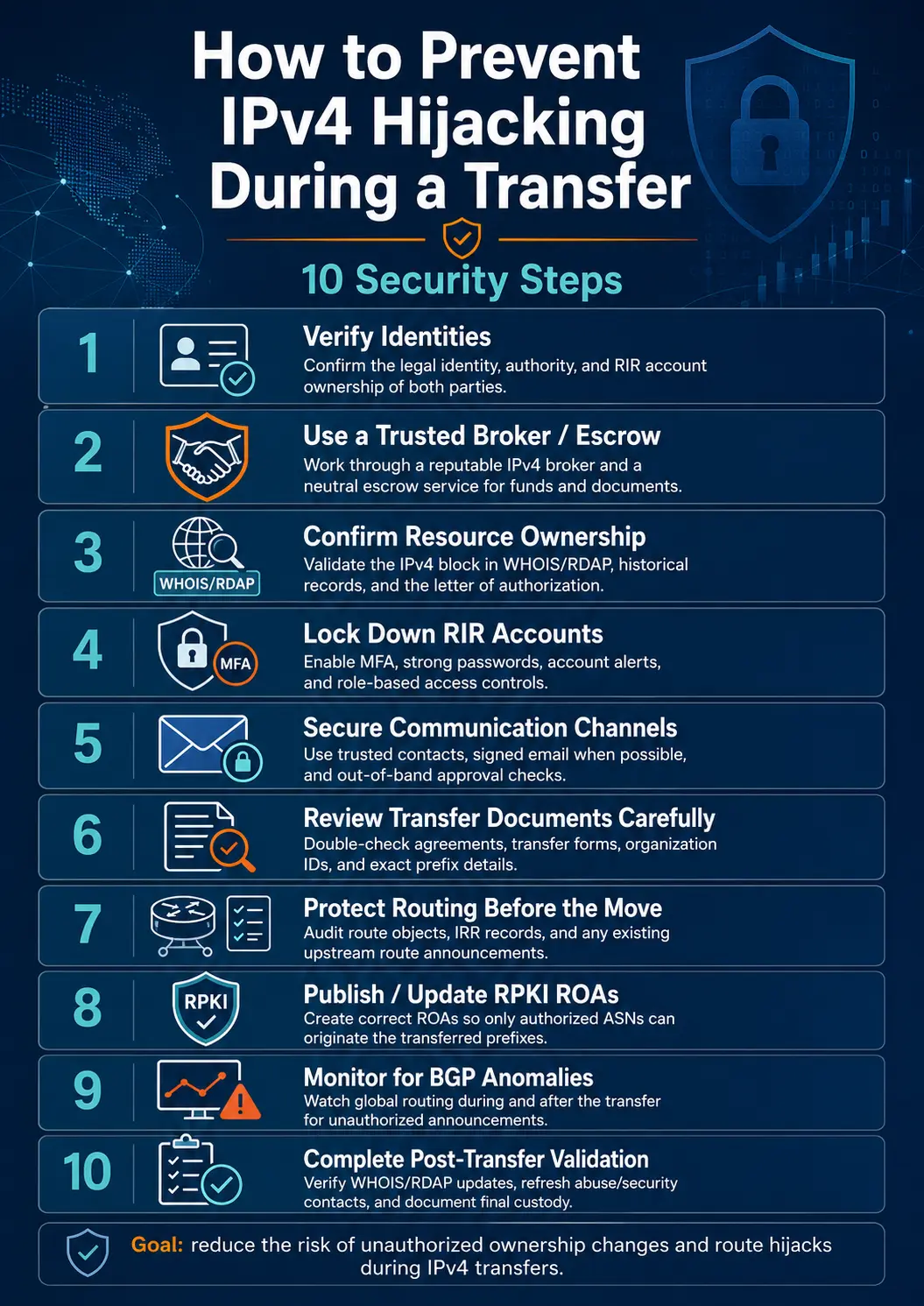
How to Prevent IPv4 Hijacking During a Transfer: 10 Security Steps
Transferring IPv4 address space is not only a commercial and registry process. It is also a sensitive routing operation. During an IPv4 transfer, control of a prefix moves from one organization to another. Registry records, Route Origin Authorizations, Internet Routing Registry objects, upstream-provider filters, reverse DNS settings, and live BGP announcements may all need to change. When these changes are completed in the wrong order—or when identity and authorizationRead more Related Posts How to Prevent IPv4 Hijacking During a Transfer: 10 Security Steps Transferring IPv4 address space is not only a commercial and registry process. It is also a sensitive routing operation. During Why the Cheapest IPv4 Lease May Cost More in the Long Run A low monthly price may look attractive during procurement, but the real cost of leased IPv4 addresses includes much more What Is a /24 IPv4 Subnet and Why Is It Popular for Leasing? A /24 IPv4 subnet is one of the most common block sizes in the IPv4 leasing market. For hosting providers, .related-post {} .related-post .post-list { text-align: left; } .related-post .post-list .item { margin: 5px; padding: 10px; } .related-post .headline { font-size: 18px !important; color: #999999 !important; } .related-post .post-list .item .post_thumb { max-height: 220px; margin: 10px 0px; padding: 0px; display: block; } .related-post .post-list .item .post_title { font-size: 16px; color: #3f3f3f; margin: 10px 0px; padding: 0px; display: block; text-decoration: none; } .related-post .post-list .item .post_excerpt { font-size: 13px; color: #3f3f3f; margin: 10px 0px; padding: 0px; display: block; text-decoration: none; } @media only screen and (min-width: 1024px) { .related-post .post-list .item { width: 30%; } } @media only screen and (min-width: 768px) and (max-width: 1023px) { .related-post .post-list .item { width: 90%; } } @media only screen and (min-width: 0px) and (max-width: 767px) { .related-post .post-list .item { width: 90%; } }
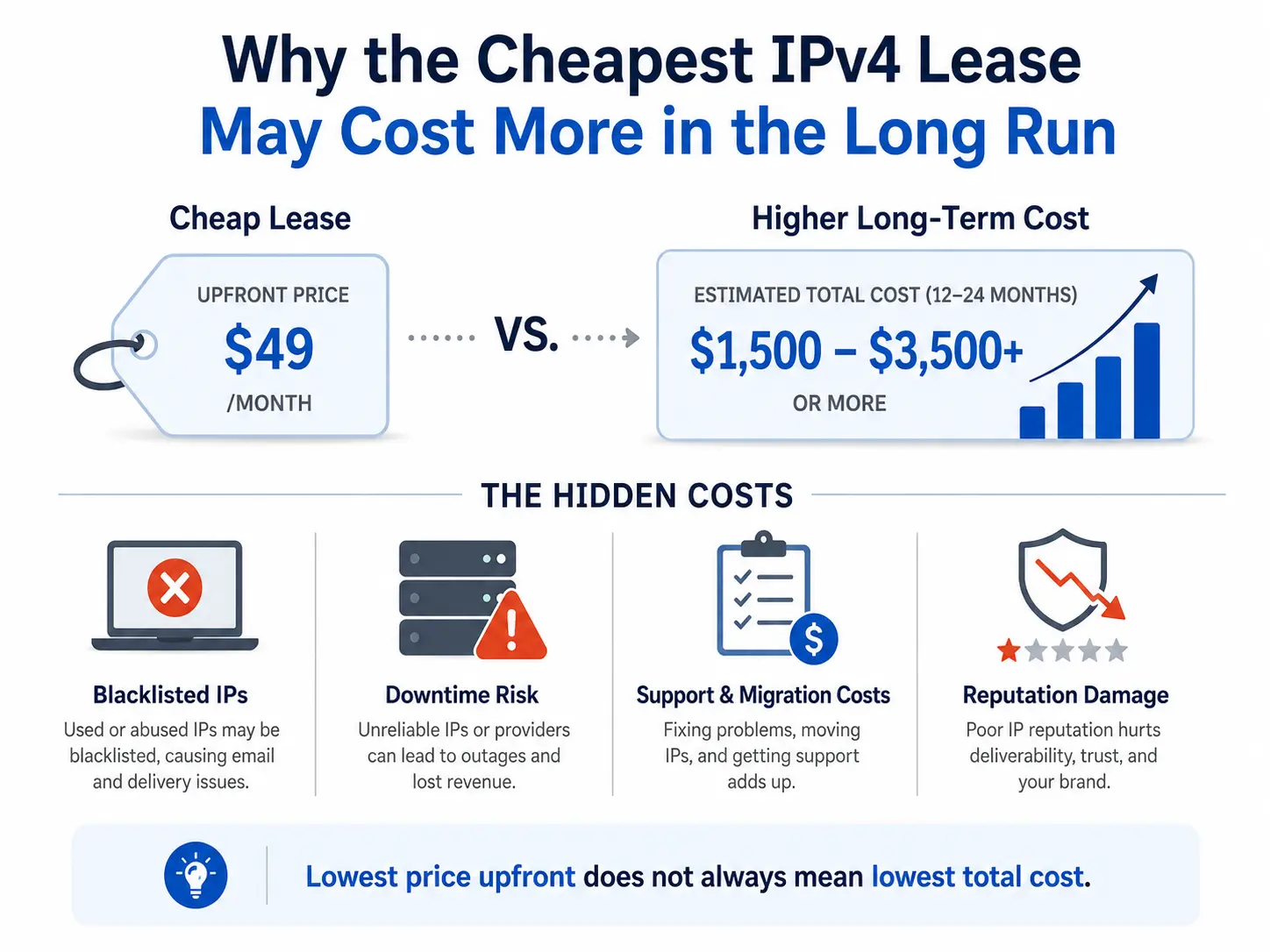
Why the Cheapest IPv4 Lease May Cost More in the Long Run
A low monthly price may look attractive during procurement, but the real cost of leased IPv4 addresses includes much more than the advertised rate. Poor IP reputation, incomplete routing authorisation, deployment delays, weak technical support, incorrect geolocation and uncertain renewal terms can quickly erase the initial saving. For testing or short-lived projects, a basic low-cost IPv4 lease may be sufficient. For production networks, however, businesses should evaluate the totalRead more Related Posts How to Prevent IPv4 Hijacking During a Transfer: 10 Security Steps Transferring IPv4 address space is not only a commercial and registry process. It is also a sensitive routing operation. During Why the Cheapest IPv4 Lease May Cost More in the Long Run A low monthly price may look attractive during procurement, but the real cost of leased IPv4 addresses includes much more What Is a /24 IPv4 Subnet and Why Is It Popular for Leasing? A /24 IPv4 subnet is one of the most common block sizes in the IPv4 leasing market. For hosting providers, .related-post {} .related-post .post-list { text-align: left; } .related-post .post-list .item { margin: 5px; padding: 10px; } .related-post .headline { font-size: 18px !important; color: #999999 !important; } .related-post .post-list .item .post_thumb { max-height: 220px; margin: 10px 0px; padding: 0px; display: block; } .related-post .post-list .item .post_title { font-size: 16px; color: #3f3f3f; margin: 10px 0px; padding: 0px; display: block; text-decoration: none; } .related-post .post-list .item .post_excerpt { font-size: 13px; color: #3f3f3f; margin: 10px 0px; padding: 0px; display: block; text-decoration: none; } @media only screen and (min-width: 1024px) { .related-post .post-list .item { width: 30%; } } @media only screen and (min-width: 768px) and (max-width: 1023px) { .related-post .post-list .item { width: 90%; } } @media only screen and (min-width: 0px) and (max-width: 767px) { .related-post .post-list .item { width: 90%; } }
What causes IPv4 deals to stall after the first agreement
IPv4 deals usually stall after the first agreement because agreeing on price is only the commercial beginning—not operational completion. A buyer and seller may agree on a block and price within hours, but the transaction can still be delayed by unclear ownership, incomplete documents, mismatched Regional Internet Registry requirements, recipient eligibility, reputation concerns, payment conditions, or missing routing authorization. The most common causes are: The seller’s authority over theRead more Related Posts How to Prevent IPv4 Hijacking During a Transfer: 10 Security Steps Transferring IPv4 address space is not only a commercial and registry process. It is also a sensitive routing operation. During Why the Cheapest IPv4 Lease May Cost More in the Long Run A low monthly price may look attractive during procurement, but the real cost of leased IPv4 addresses includes much more What Is a /24 IPv4 Subnet and Why Is It Popular for Leasing? A /24 IPv4 subnet is one of the most common block sizes in the IPv4 leasing market. For hosting providers, .related-post {} .related-post .post-list { text-align: left; } .related-post .post-list .item { margin: 5px; padding: 10px; } .related-post .headline { font-size: 18px !important; color: #999999 !important; } .related-post .post-list .item .post_thumb { max-height: 220px; margin: 10px 0px; padding: 0px; display: block; } .related-post .post-list .item .post_title { font-size: 16px; color: #3f3f3f; margin: 10px 0px; padding: 0px; display: block; text-decoration: none; } .related-post .post-list .item .post_excerpt { font-size: 13px; color: #3f3f3f; margin: 10px 0px; padding: 0px; display: block; text-decoration: none; } @media only screen and (min-width: 1024px) { .related-post .post-list .item { width: 30%; } } @media only screen and (min-width: 768px) and (max-width: 1023px) { .related-post .post-list .item { width: 90%; } } @media only screen and (min-width: 0px) and (max-width: 767px) { .related-post .post-list .item { width: 90%; } }
