The Future of IPv4 Markets: Why Control Will Matter More Than Price
 Stephanie
The future of IPv4 markets will not be decided by price alone.
Table of Contents
Price matters. Supply matters. Demand matters. IPv6 adoption matters. But for businesses that depend on IPv4 addresses to run hosting platforms, VPN infrastructure, SaaS applications, cloud workloads, telecom services, email systems, cybersecurity tools, or customer-facing platforms, the deeper issue is control.
A company may lease IPv4 addresses.
A company may buy IPv4 addresses.
A company may hold IPv4 assets on paper.
A company may use a broker, marketplace, or provider chain to access address space.
But the real question is this:
Who controls the conditions that keep those IPv4 addresses usable?
That is where the future of IPv4 markets becomes more than a trading story. It becomes a business-continuity story.
The next phase of the IPv4 market will reward structures that provide source clarity, routing readiness, reputation confidence, renewal accountability, documentation quality, transfer reliability, and operational continuity. Markets will not only ask whether IPv4 is available. They will ask whether the address space can remain stable after it becomes part of a running network.
This is the practical business meaning of Sovereignty Inversion: a company may believe it controls its IPv4 future because it has leased, purchased, or deployed address space, while practical control over recognition, routing, transferability, documentation, or continuity may still sit somewhere else.
As Heng.lu doctrine puts it: “Markets allocate scarce capital. Administrators maintain ledgers.”
For IPv4 users, that distinction matters. The future IPv4 market will not only be about who can find addresses. It will be about who can prove control, continuity, and usable infrastructure value.
Why the IPv4 Market Is Entering a New Phase
The IPv4 market has already moved through several stages.
The first stage was allocation. IPv4 addresses were distributed as technical resources to support network growth.
The second stage was exhaustion. As the free IPv4 pool became limited, companies began treating unused address blocks as valuable resources.
The third stage was commercialisation. IPv4 addresses became tradable, leasable, transferable, and financially visible.
The next stage is different.
The next stage is about proof.
Businesses will not only ask whether an IPv4 block exists. They will ask whether it can support production infrastructure safely.
They will want to know:
- Is the source clear?
- Can the block route properly?
- Is the IP reputation usable?
- Can renewal be confirmed?
- Is transfer documentation reliable?
- Can the provider support escalation?
- Can the address space remain stable after deployment?
This is why the future of IPv4 markets will be shaped by continuity, not only price.
From Price Market to Control Market
A young market often focuses on price.
Buyers ask how much an IPv4 address costs. Lessees ask for the monthly rate. Sellers ask whether the price is high enough to justify monetising unused address space.
But as a market matures, price becomes only one layer of evaluation.
In a mature IPv4 market, businesses also ask:
- Can this address block be trusted?
- Can it be deployed quickly?
- Can it be renewed without uncertainty?
- Can it be transferred without delay?
- Can it support the customer’s actual use case?
- Can it survive compliance, routing, and documentation review?
The market is therefore moving from a simple price market to a control market.
Price tells the business what it pays.
Control tells the business what it can rely on.
Sovereignty Inversion in IPv4 Markets
The future of IPv4 markets must be understood through the risk of Sovereignty Inversion.
In practical IPv4 business terms, Sovereignty Inversion appears when a company appears to control address space commercially, but the practical levers of control sit outside the company.
This can happen in leasing.
A business may lease IPv4 addresses and build services around them. But if renewal, routing authorisation, source records, abuse handling, or escalation depends on a provider chain the business does not fully understand, practical control may not sit with the business.
It can also happen in purchasing.
A business may buy IPv4 addresses and believe it has long-term control. But if transfer history, registry records, routing readiness, IP reputation, or future portability remains unclear, the buyer may still face control gaps after the purchase.
This does not mean leasing or buying IPv4 is wrong. Both can be valid strategies. The issue is whether the structure gives the business enough operational control after the transaction.
For the wider doctrine behind this issue, see Sovereignty Inversion on Heng.lu.
Why Market Price Does Not Equal Market Safety
A low IPv4 price can look attractive.
But a low price does not automatically mean a safe structure.
A cheap IPv4 lease may come with weak renewal accountability. A low-cost purchase may involve unclear source history. A fast brokered transaction may lack enough routing documentation. A large block may carry poor reputation. A cross-region deal may involve additional transfer friction.
In the future IPv4 market, businesses will need to compare total risk, not only visible price.
Total risk includes:
- source risk
- routing risk
- renewal risk
- transfer risk
- documentation risk
- reputation risk
- provider-chain risk
- business-continuity risk
This is why the future IPv4 market will increasingly reward providers that can reduce uncertainty, not only providers that advertise lower prices.
The Future of IPv4 Leasing
IPv4 leasing will remain important because many businesses need flexibility.
Leasing can help companies deploy quickly, preserve capital, scale infrastructure, test new regions, support customer demand, and avoid committing to permanent ownership before demand is proven.
But the future of IPv4 leasing will not be based only on monthly cost.
The future will depend on whether the lease structure is reliable.
A strong IPv4 leasing structure should include:
- clear source relationship
- routing support
- LOA or route object support where applicable
- ROA or RPKI-related coordination where applicable
- IP reputation review
- renewal accountability
- abuse-handling process
- documentation readiness
- defined escalation path
The future leasing market will therefore separate serious providers from weak provider chains.
Businesses will not only ask, “How much per IP per month?”
They will ask, “Can this lease support our running network?”
The Future of IPv4 Purchasing
IPv4 purchasing will also remain important, especially for companies with long-term infrastructure needs.
Buying IPv4 can provide stronger long-term control than leasing, but it does not remove every risk.
Future IPv4 buyers will need to evaluate:
- source history
- transfer eligibility
- registry documentation
- IP reputation
- routing readiness
- abuse records
- future resale or liquidity
- long-term internal management capacity
Purchasing IPv4 is not only an acquisition decision. It is an operational responsibility.
A buyer may gain stronger control over the address block, but the buyer must also be prepared to manage records, routing, documentation, abuse handling, reputation, and future transferability.
In the future IPv4 market, buyers will value clean structure as much as clean pricing.
Why Brokers and Marketplaces Must Evolve
Brokers and marketplaces helped make the IPv4 market more accessible.
They helped buyers find available address blocks. They helped sellers monetise unused resources. They helped reduce basic transaction friction.
But the future market needs more than simple matching.
It needs stronger trust infrastructure.
Future IPv4 marketplaces must evolve from listing platforms into continuity-aware platforms. That means helping customers understand not only what is available, but whether the address space is usable, documented, reputable, routable, renewable, and suitable for the customer’s business.
The market will increasingly expect:
- clearer source checks
- better reputation screening
- stronger routing support
- more transparent documentation
- better renewal management
- more reliable escalation
- clearer separation between broker-chain risk and direct operational support
In other words, the IPv4 market is moving from transaction facilitation toward continuity assurance.
What Businesses Will Demand from Future IPv4 Markets
Businesses that depend on IPv4 will become more sophisticated buyers and lessees.
They will not only ask for supply. They will ask for evidence.
Future IPv4 customers will demand:
- Proof of source: where the IPv4 block comes from and who can authorise its use.
- Proof of routing readiness: whether the block can be announced and accepted properly.
- Proof of reputation: whether the block has abuse, spam, or blacklist concerns.
- Proof of renewal accountability: who keeps access stable over time.
- Proof of documentation: whether the records can survive customer, legal, or compliance review.
- Proof of escalation: who responds when routing, abuse, reputation, or continuity issues appear.
This is how the IPv4 market becomes more mature.
Mature markets do not only trade assets. They build confidence around the conditions that make those assets usable.
How i.lease Supports the Next Phase of IPv4 Markets
i.lease supports the next phase of IPv4 markets by focusing on continuity-first IPv4 access.
Instead of treating IPv4 as a simple commodity listing, i.lease helps businesses evaluate the structure behind IPv4 leasing, buying, and selling.
That structure includes:
- source clarity
- routing support
- IP reputation checks
- renewal accountability
- documentation readiness
- provider-chain transparency
- transfer awareness
- operational reliability
Businesses that need flexible capacity can explore IPv4 leasing. Companies that need long-term control can review options to buy IPv4 addresses. Address holders with unused resources can learn how to sell IPv4 addresses through a clearer commercial path.
Through LARUS-backed IPv4 operations, i.lease helps businesses think beyond price and availability. The goal is to support IPv4 decisions that are commercially useful, technically deployable, and operationally stable.
IPv4 Market Readiness Checklist
Before choosing an IPv4 lease, purchase, or marketplace provider, businesses should ask:
- Is the IPv4 source clear?
- Who has authority to lease, sell, route, or transfer the block?
- Is routing support available?
- Are LOA, route object, ROA, or RPKI-related workflows required?
- Has the IP reputation been reviewed?
- Are there abuse records, blacklist issues, or prior misuse concerns?
- Who owns renewal accountability?
- What happens if an upstream source delays?
- Who provides documentation for customers or compliance teams?
- Can the address block support the intended use case?
- What is the escalation path if routing or reputation issues appear?
- Can the business move, renew, or replace the address block without major disruption?
- Does the provider reduce Sovereignty Inversion, or does it increase dependence on hidden control layers?
If these questions are not answered clearly, the IPv4 market risk is not solved. It is only hidden.
Final Thought
The future of IPv4 markets will not be defined only by whether prices rise or fall.
The more important question is whether IPv4 access becomes more reliable, transparent, and continuity-aware.
A market that only provides addresses is incomplete.
A mature IPv4 market must provide confidence.
Confidence that the source is clear.
Confidence that routing can work.
Confidence that reputation is usable.
Confidence that renewal is accountable.
Confidence that documentation can survive review.
Confidence that the business will not lose control after deployment.
This is why control will matter more than price.
The next phase of the IPv4 market belongs to providers and platforms that can prove continuity.
Before choosing an IPv4 source, ask one question:
Are we buying access, or are we securing control?
If the answer is unclear, the future risk is already present.
Also Read
- Lease IP Addresses: Why Businesses Lease IPv4 and What to Check First
- IPv4 Leasing vs Purchasing: Structural Risk in the IPv4 Address Market
- Running-Code Primacy: Why IPv4 Leasing Should Be Judged by Operational Proof
- Your IPv4 Looks Stable — Until the Provider Chain Breaks
- Is Your Company Absorbing IPv4 Risk?
Frequently Asked Questions
What is the future of IPv4 markets?
The future of IPv4 markets will likely be shaped by continued demand for IPv4 compatibility, growth in leasing, secondary-market transactions, and stronger demand for source clarity, routing support, reputation checks, renewal accountability, and operational continuity.
Why will control matter more than price in IPv4 markets?
Control matters because businesses need IPv4 addresses to remain usable after deployment. A low price is not enough if the address block has weak routing support, unclear renewal, poor reputation, incomplete documentation, or hidden provider-chain risk.
What is Sovereignty Inversion in IPv4 markets?
Sovereignty Inversion in IPv4 markets happens when a business appears to control IPv4 address space commercially, but practical control over routing, renewal, transferability, documentation, or recognition sits with external providers, registries, or upstream structures.
Will IPv6 end the IPv4 market?
IPv6 adoption will continue, but many businesses still need IPv4 compatibility for customers, legacy systems, hosting, cloud infrastructure, VPNs, email, and global reachability. As long as IPv4 remains operationally necessary, IPv4 markets are likely to continue.
What should businesses check before leasing IPv4?
Businesses should check source clarity, routing support, IP reputation, renewal accountability, documentation readiness, abuse handling, and escalation responsibility before leasing IPv4 addresses.
What should businesses check before buying IPv4?
Businesses should check source history, transfer eligibility, registry records, IP reputation, routing readiness, documentation quality, abuse history, and future resale or portability before buying IPv4 addresses.
How does i.lease help businesses in the IPv4 market?
i.lease helps businesses evaluate IPv4 leasing, buying, and selling through a continuity-first approach focused on source clarity, routing support, reputation checks, renewal accountability, documentation readiness, provider-chain transparency, and operational reliability.
Related Blogs
Related Posts
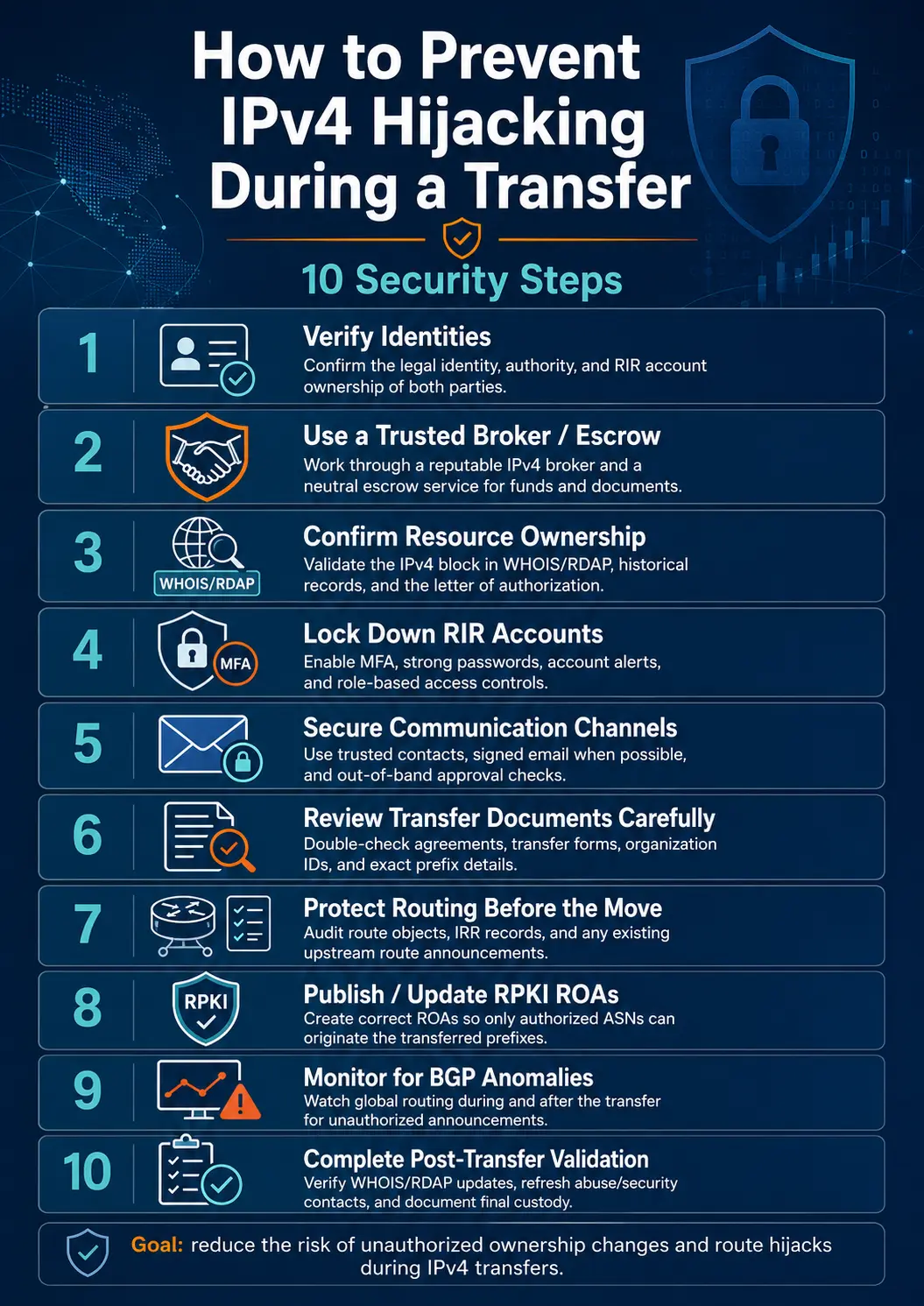
How to Prevent IPv4 Hijacking During a Transfer: 10 Security Steps
Transferring IPv4 address space is not only a commercial and registry process. It is also a sensitive routing operation. During an IPv4 transfer, control of a prefix moves from one organization to another. Registry records, Route Origin Authorizations, Internet Routing Registry objects, upstream-provider filters, reverse DNS settings, and live BGP announcements may all need to change. When these changes are completed in the wrong order—or when identity and authorizationRead more Related Posts How to Prevent IPv4 Hijacking During a Transfer: 10 Security Steps Transferring IPv4 address space is not only a commercial and registry process. It is also a sensitive routing operation. During Why the Cheapest IPv4 Lease May Cost More in the Long Run A low monthly price may look attractive during procurement, but the real cost of leased IPv4 addresses includes much more What Is a /24 IPv4 Subnet and Why Is It Popular for Leasing? A /24 IPv4 subnet is one of the most common block sizes in the IPv4 leasing market. For hosting providers, .related-post {} .related-post .post-list { text-align: left; } .related-post .post-list .item { margin: 5px; padding: 10px; } .related-post .headline { font-size: 18px !important; color: #999999 !important; } .related-post .post-list .item .post_thumb { max-height: 220px; margin: 10px 0px; padding: 0px; display: block; } .related-post .post-list .item .post_title { font-size: 16px; color: #3f3f3f; margin: 10px 0px; padding: 0px; display: block; text-decoration: none; } .related-post .post-list .item .post_excerpt { font-size: 13px; color: #3f3f3f; margin: 10px 0px; padding: 0px; display: block; text-decoration: none; } @media only screen and (min-width: 1024px) { .related-post .post-list .item { width: 30%; } } @media only screen and (min-width: 768px) and (max-width: 1023px) { .related-post .post-list .item { width: 90%; } } @media only screen and (min-width: 0px) and (max-width: 767px) { .related-post .post-list .item { width: 90%; } }
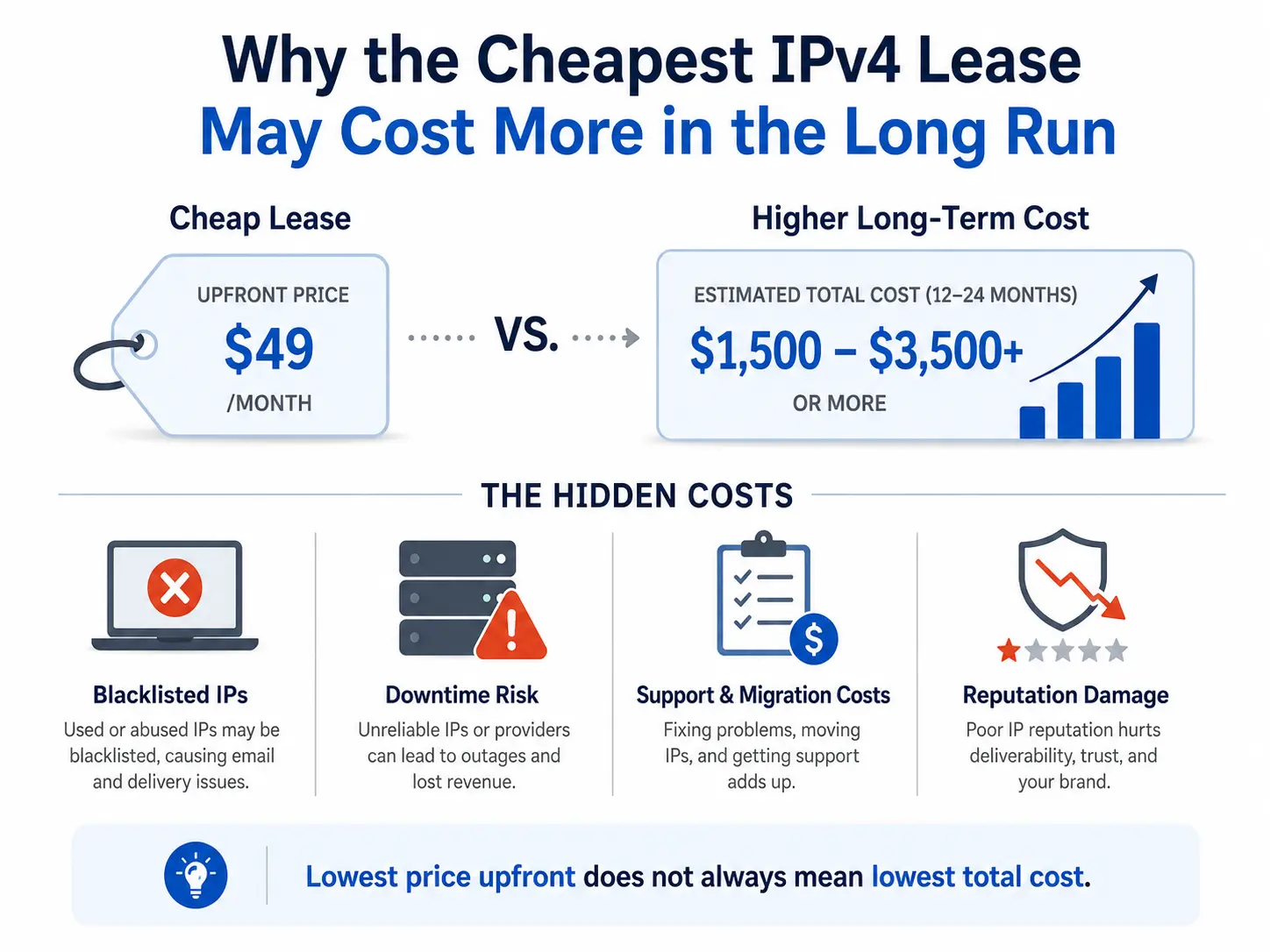
Why the Cheapest IPv4 Lease May Cost More in the Long Run
A low monthly price may look attractive during procurement, but the real cost of leased IPv4 addresses includes much more than the advertised rate. Poor IP reputation, incomplete routing authorisation, deployment delays, weak technical support, incorrect geolocation and uncertain renewal terms can quickly erase the initial saving. For testing or short-lived projects, a basic low-cost IPv4 lease may be sufficient. For production networks, however, businesses should evaluate the totalRead more Related Posts How to Prevent IPv4 Hijacking During a Transfer: 10 Security Steps Transferring IPv4 address space is not only a commercial and registry process. It is also a sensitive routing operation. During Why the Cheapest IPv4 Lease May Cost More in the Long Run A low monthly price may look attractive during procurement, but the real cost of leased IPv4 addresses includes much more What Is a /24 IPv4 Subnet and Why Is It Popular for Leasing? A /24 IPv4 subnet is one of the most common block sizes in the IPv4 leasing market. For hosting providers, .related-post {} .related-post .post-list { text-align: left; } .related-post .post-list .item { margin: 5px; padding: 10px; } .related-post .headline { font-size: 18px !important; color: #999999 !important; } .related-post .post-list .item .post_thumb { max-height: 220px; margin: 10px 0px; padding: 0px; display: block; } .related-post .post-list .item .post_title { font-size: 16px; color: #3f3f3f; margin: 10px 0px; padding: 0px; display: block; text-decoration: none; } .related-post .post-list .item .post_excerpt { font-size: 13px; color: #3f3f3f; margin: 10px 0px; padding: 0px; display: block; text-decoration: none; } @media only screen and (min-width: 1024px) { .related-post .post-list .item { width: 30%; } } @media only screen and (min-width: 768px) and (max-width: 1023px) { .related-post .post-list .item { width: 90%; } } @media only screen and (min-width: 0px) and (max-width: 767px) { .related-post .post-list .item { width: 90%; } }
What causes IPv4 deals to stall after the first agreement
IPv4 deals usually stall after the first agreement because agreeing on price is only the commercial beginning—not operational completion. A buyer and seller may agree on a block and price within hours, but the transaction can still be delayed by unclear ownership, incomplete documents, mismatched Regional Internet Registry requirements, recipient eligibility, reputation concerns, payment conditions, or missing routing authorization. The most common causes are: The seller’s authority over theRead more Related Posts How to Prevent IPv4 Hijacking During a Transfer: 10 Security Steps Transferring IPv4 address space is not only a commercial and registry process. It is also a sensitive routing operation. During Why the Cheapest IPv4 Lease May Cost More in the Long Run A low monthly price may look attractive during procurement, but the real cost of leased IPv4 addresses includes much more What Is a /24 IPv4 Subnet and Why Is It Popular for Leasing? A /24 IPv4 subnet is one of the most common block sizes in the IPv4 leasing market. For hosting providers, .related-post {} .related-post .post-list { text-align: left; } .related-post .post-list .item { margin: 5px; padding: 10px; } .related-post .headline { font-size: 18px !important; color: #999999 !important; } .related-post .post-list .item .post_thumb { max-height: 220px; margin: 10px 0px; padding: 0px; display: block; } .related-post .post-list .item .post_title { font-size: 16px; color: #3f3f3f; margin: 10px 0px; padding: 0px; display: block; text-decoration: none; } .related-post .post-list .item .post_excerpt { font-size: 13px; color: #3f3f3f; margin: 10px 0px; padding: 0px; display: block; text-decoration: none; } @media only screen and (min-width: 1024px) { .related-post .post-list .item { width: 30%; } } @media only screen and (min-width: 768px) and (max-width: 1023px) { .related-post .post-list .item { width: 90%; } } @media only screen and (min-width: 0px) and (max-width: 767px) { .related-post .post-list .item { width: 90%; } }
