Understanding Operational Risk in IPv4 Address Markets
 Stephanie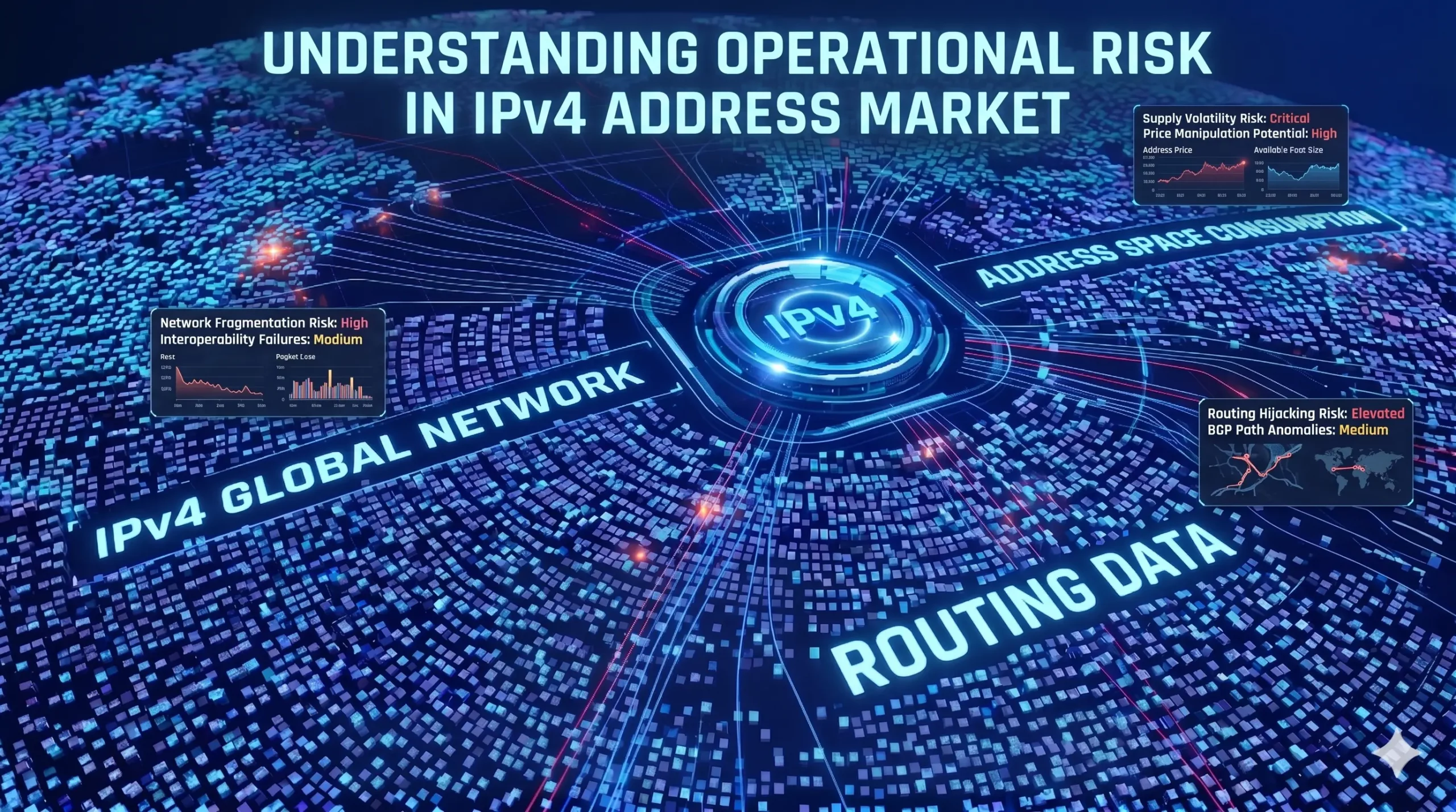
IPv4 has long stopped being a simple technical identifier system. It has become a constrained, priced, and operationally embedded infrastructure asset class.
Table of Contents
Yet most of the industry still speaks about it as if it were a straightforward marketplace problem: buyers, sellers, brokers, escrow, transfer, done.
That framing is increasingly outdated.
The real structure of risk in IPv4 markets does not sit in pricing, negotiation, or even counterparty trust. It sits in a deeper layer that most market participants only encounter indirectly: the registry layer.
This is where operational risk actually lives.
And this is why platforms like i.LEASE exist.
The hidden layer: where IPv4 risk actually lives
Every IPv4 address ultimately depends on a chain of authority and enforcement rooted in Regional Internet Registries (RIRs). These entities define allocation rules, validate transfers, and maintain the canonical record of who “controls” which address blocks.
On paper, this sounds administrative.
In practice, it is a discretionary control layer over operational infrastructure.
That distinction matters.
Because unlike traditional financial or commodity markets, IPv4 assets do not exist independently of their registry state. A block is not just “owned” — it is continuously validated, referenced, and operationalized through registry systems, routing policies, compliance checks, and inter-RIR processes.
This creates a structural dependency:
If the registry layer changes interpretation, enforcement, or acceptance behavior, the operational usability of the asset can change — even if the commercial transaction was fully completed.
This is the core of registry risk.
Why “broker risk” is misunderstood
In most asset markets, brokers are evaluated on execution quality: speed, pricing, inventory access, and transaction reliability.
In IPv4 markets, this model is incomplete.
A broker can:
- Match buyers and sellers
- Facilitate escrow
- Prepare transfer paperwork
- Coordinate RIR submission flows
But none of these functions address the fundamental dependency underneath:
the broker does not control the registry layer.
This creates a false sense of completion when a transaction closes. The commercial event is finished, but the operational dependency is not.
As Lu Heng argues in his framing of registry risk, the market often confuses:
- transaction completion
with - operational continuity
These are not the same thing.
Operational risk is not transactional — it is structural
IPv4 assets are increasingly embedded in critical infrastructure:
- cloud routing systems
- mobile networks
- VPN and security infrastructures
- SaaS delivery systems
- enterprise routing and compliance controls
- global email and authentication systems
This means IPv4 is no longer a passive asset. It is an active dependency layer.
And active dependencies behave differently from financial assets.
They introduce a key principle:
The risk is not in acquiring the asset. The risk is in keeping it operational under evolving registry and policy conditions.
This includes:
- transfer policy interpretation changes
- RIR membership and validation rules
- historical record inconsistencies
- inter-registry coordination gaps
- disputes over legitimacy or provenance
- downstream routing acceptance issues
These are not edge cases. They are structural realities of the system.
Why escrow and paperwork do not eliminate registry risk
A common assumption in the IPv4 market is that risk is fully mitigated through:
- escrow services
- clean transfer documentation
- RIR policy compliance
- due diligence on counterparties
These mechanisms are necessary, but not sufficient.
They address transaction integrity, not registry continuity.
Even when every step is correctly executed, the registry layer still retains interpretive authority over:
- acceptance timing
- validation depth
- historical review requirements
- transfer eligibility interpretation
- post-transfer record consistency
In other words, the registry is not a passive database. It is an active governance system.
And governance systems introduce non-linear risk.
Why operational continuity has become the real market problem
As IPv4 scarcity increases, the asset behaves less like a commodity and more like infrastructure capital.
This shifts the primary risk axis:
- From price volatility → to operational continuity
- From counterparty risk → to registry dependency risk
- From transaction failure → to lifecycle failure
A transaction that “completes” but later fails to maintain stable operational continuity is not a success — it is a latent infrastructure failure.
This is the part of the market that traditional brokerage models do not address.
The role of execution layers like i.LEASE
The emergence of execution-focused platforms such as i.LEASE reflects a structural shift in how the IPv4 market is evolving.
Instead of treating brokerage as the endpoint, execution-layer models treat it as only one component in a larger system that includes:
- registry interaction intelligence
- lifecycle management beyond transfer
- operational continuity awareness
- policy and governance interpretation
- downstream usability assurance
The key shift is conceptual:
The goal is no longer just to complete IPv4 transactions.
The goal is to ensure IPv4 assets remain operational after transactions.
This is where the distinction between “brokerage” and “execution” becomes meaningful.
A broker completes a deal.
An execution layer manages the consequences of that deal in a registry-dependent environment.
Registry risk is not optional — it is inherent
It is tempting to believe registry risk can be eliminated through better compliance, better brokers, or better documentation.
But registry risk is not a flaw in execution.
It is a property of the system itself.
Because IPv4 exists at the intersection of:
- historical allocation systems
- regional policy frameworks
- non-uniform registry governance
- global routing infrastructure
- and commercial secondary markets
No single layer has full control.
This fragmentation is precisely what produces operational risk.
Rethinking what “trust” means in IPv4 markets
In traditional brokerage thinking, trust is about honesty and execution capability.
In IPv4 markets, trust must expand to include:
- understanding registry behavior under stress
- anticipating policy interpretation shifts
- managing lifecycle continuity beyond transfer
- recognizing where legal ownership diverges from operational control
This is a fundamentally different trust model.
It is not about whether a broker can complete a transaction.
It is about whether the system supporting that transaction can remain stable afterward.
Conclusion: from brokerage to infrastructure continuity
The IPv4 market is no longer defined by scarcity alone. It is defined by structural dependency on a governance layer that was never designed for active asset trading at global scale.
That mismatch creates the central tension in the market today:
- Transactions are easy to execute
- Continuity is hard to guarantee
And it is in that gap that registry risk lives.
i.LEASE exists in response to that gap — not as a traditional broker, but as an execution layer designed around the reality that IPv4 is no longer just an address market.
It is infrastructure.
And infrastructure does not end at the point of sale.
It begins there.
Frequent Asked Questions
What is operational risk in IPv4 address markets?
Operational risk in IPv4 markets refers to potential losses caused by failures in processes, systems, or governance when buying, leasing, or managing IP address blocks. This includes issues like poor documentation, misconfigured routing, or abuse history attached to address ranges.
Why are IPv4 addresses considered risky assets to manage?
IPv4 addresses are scarce and traded like digital commodities. Because they can be transferred or leased between parties, they carry risks such as unclear ownership rights, outdated registry data, and historical abuse (“reputation residue”) that can impact network performance and trust.
What is “abuse residue” in IPv4 address blocks?
Abuse residue refers to the reputation problems that remain tied to an IP range even after it changes users. If an address was previously used for spam, malware, or bot traffic, it may still be flagged by blocklists, causing delivery issues or higher verification rates for new users.
How does poor IP management increase operational risk?
Unmanaged or poorly tracked IPv4 inventories can lead to security gaps, such as unpatched devices, incorrect routing, or unused addresses being hijacked. Attackers often target unmonitored IP ranges because they are less likely to be defended or quickly noticed.
What reduces operational risk in IPv4 transactions?
Risk is reduced through strong governance practices like:
- Proper due diligence before purchase or lease
- Accurate WHOIS/RIR registration updates
- RPKI/ROA validation for routing security
- Continuous monitoring and abuse handling processes
- Clear contracts and transparent ownership records
Related Posts
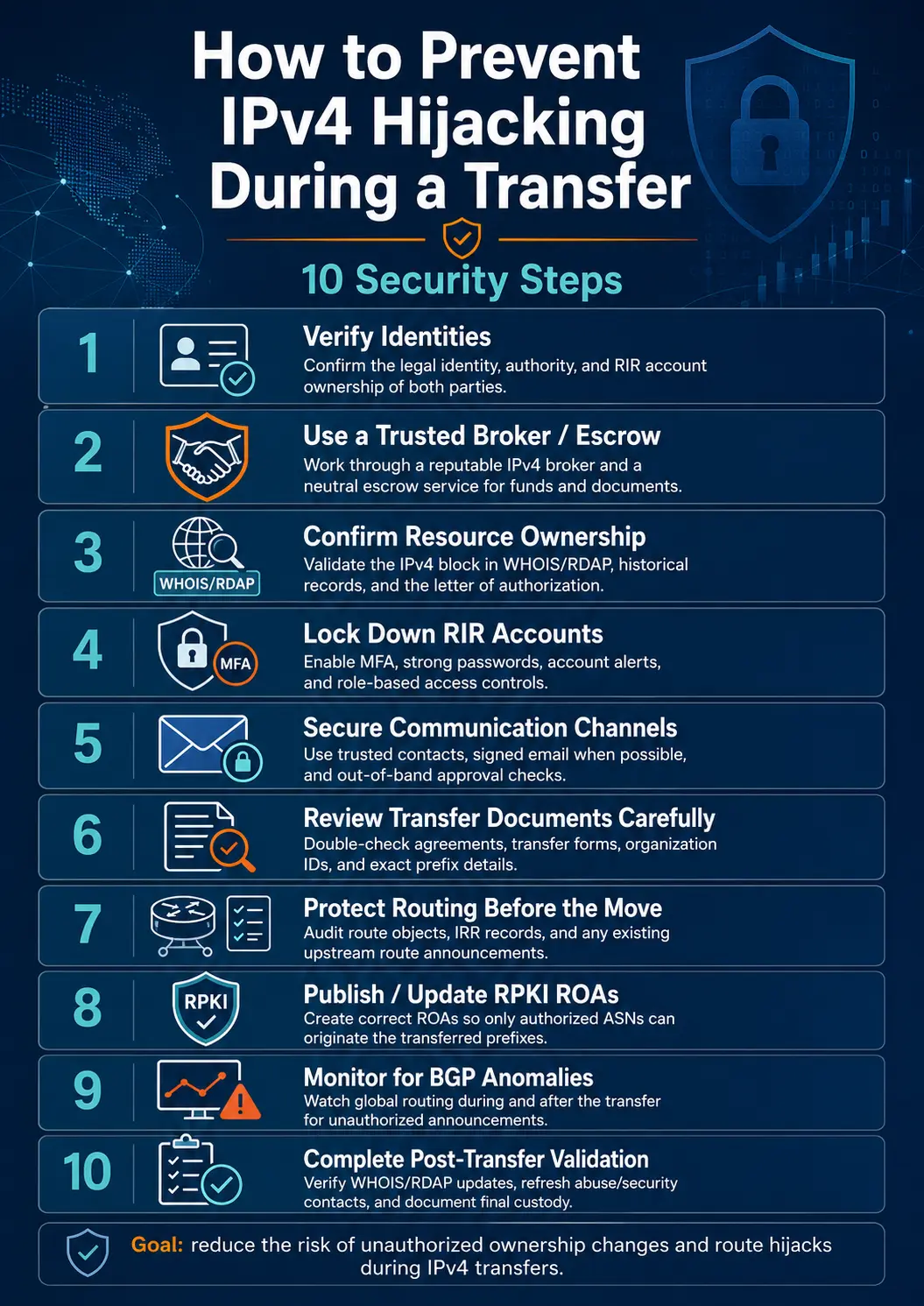
How to Prevent IPv4 Hijacking During a Transfer: 10 Security Steps
Transferring IPv4 address space is not only a commercial and registry process. It is also a sensitive routing operation. During an IPv4 transfer, control of a prefix moves from one organization to another. Registry records, Route Origin Authorizations, Internet Routing Registry objects, upstream-provider filters, reverse DNS settings, and live BGP announcements may all need to change. When these changes are completed in the wrong order—or when identity and authorizationRead more Related Posts How to Prevent IPv4 Hijacking During a Transfer: 10 Security Steps Transferring IPv4 address space is not only a commercial and registry process. It is also a sensitive routing operation. During Why the Cheapest IPv4 Lease May Cost More in the Long Run A low monthly price may look attractive during procurement, but the real cost of leased IPv4 addresses includes much more What Is a /24 IPv4 Subnet and Why Is It Popular for Leasing? A /24 IPv4 subnet is one of the most common block sizes in the IPv4 leasing market. For hosting providers, .related-post {} .related-post .post-list { text-align: left; } .related-post .post-list .item { margin: 5px; padding: 10px; } .related-post .headline { font-size: 18px !important; color: #999999 !important; } .related-post .post-list .item .post_thumb { max-height: 220px; margin: 10px 0px; padding: 0px; display: block; } .related-post .post-list .item .post_title { font-size: 16px; color: #3f3f3f; margin: 10px 0px; padding: 0px; display: block; text-decoration: none; } .related-post .post-list .item .post_excerpt { font-size: 13px; color: #3f3f3f; margin: 10px 0px; padding: 0px; display: block; text-decoration: none; } @media only screen and (min-width: 1024px) { .related-post .post-list .item { width: 30%; } } @media only screen and (min-width: 768px) and (max-width: 1023px) { .related-post .post-list .item { width: 90%; } } @media only screen and (min-width: 0px) and (max-width: 767px) { .related-post .post-list .item { width: 90%; } }
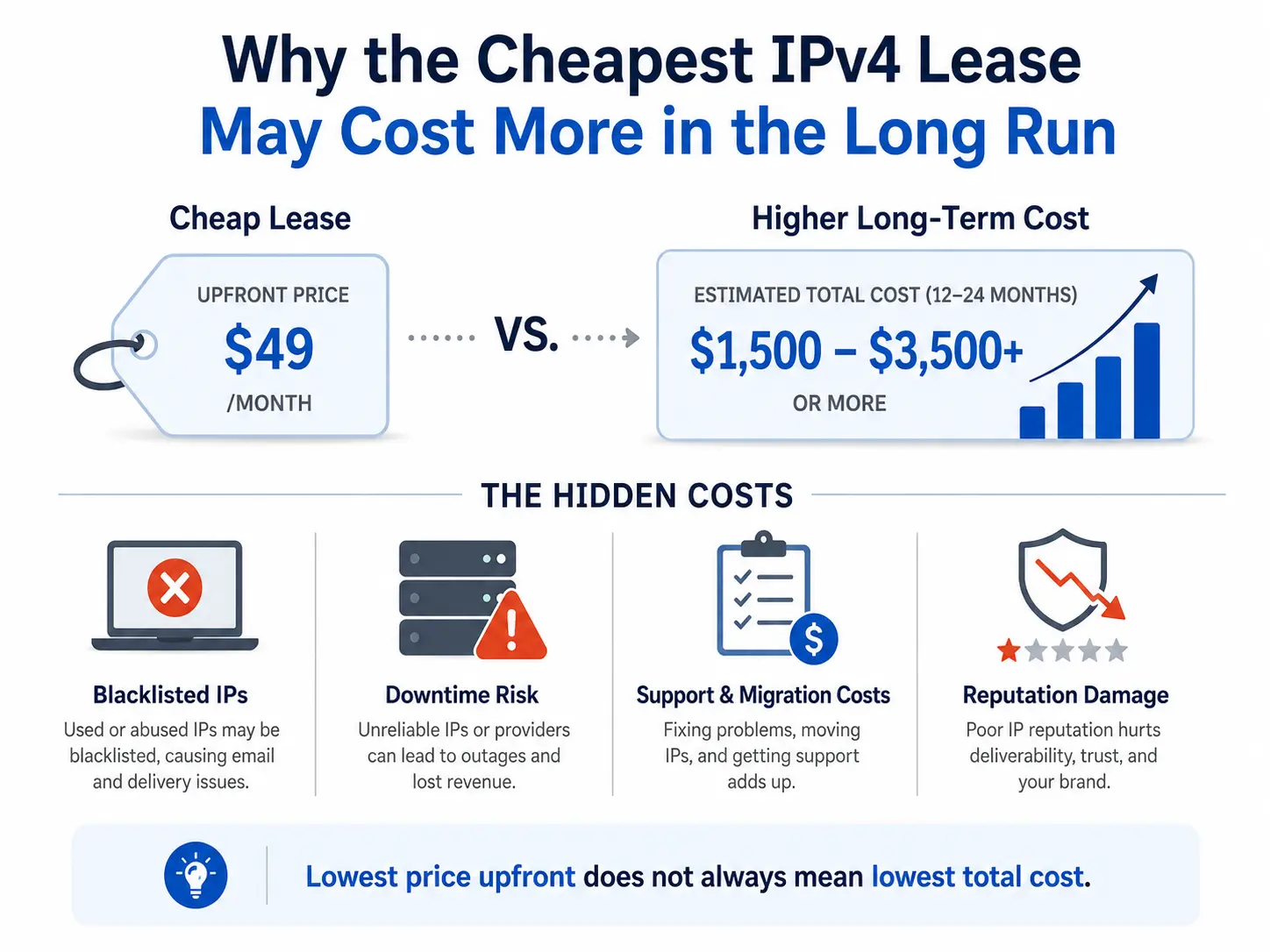
Why the Cheapest IPv4 Lease May Cost More in the Long Run
A low monthly price may look attractive during procurement, but the real cost of leased IPv4 addresses includes much more than the advertised rate. Poor IP reputation, incomplete routing authorisation, deployment delays, weak technical support, incorrect geolocation and uncertain renewal terms can quickly erase the initial saving. For testing or short-lived projects, a basic low-cost IPv4 lease may be sufficient. For production networks, however, businesses should evaluate the totalRead more Related Posts How to Prevent IPv4 Hijacking During a Transfer: 10 Security Steps Transferring IPv4 address space is not only a commercial and registry process. It is also a sensitive routing operation. During Why the Cheapest IPv4 Lease May Cost More in the Long Run A low monthly price may look attractive during procurement, but the real cost of leased IPv4 addresses includes much more What Is a /24 IPv4 Subnet and Why Is It Popular for Leasing? A /24 IPv4 subnet is one of the most common block sizes in the IPv4 leasing market. For hosting providers, .related-post {} .related-post .post-list { text-align: left; } .related-post .post-list .item { margin: 5px; padding: 10px; } .related-post .headline { font-size: 18px !important; color: #999999 !important; } .related-post .post-list .item .post_thumb { max-height: 220px; margin: 10px 0px; padding: 0px; display: block; } .related-post .post-list .item .post_title { font-size: 16px; color: #3f3f3f; margin: 10px 0px; padding: 0px; display: block; text-decoration: none; } .related-post .post-list .item .post_excerpt { font-size: 13px; color: #3f3f3f; margin: 10px 0px; padding: 0px; display: block; text-decoration: none; } @media only screen and (min-width: 1024px) { .related-post .post-list .item { width: 30%; } } @media only screen and (min-width: 768px) and (max-width: 1023px) { .related-post .post-list .item { width: 90%; } } @media only screen and (min-width: 0px) and (max-width: 767px) { .related-post .post-list .item { width: 90%; } }
What causes IPv4 deals to stall after the first agreement
IPv4 deals usually stall after the first agreement because agreeing on price is only the commercial beginning—not operational completion. A buyer and seller may agree on a block and price within hours, but the transaction can still be delayed by unclear ownership, incomplete documents, mismatched Regional Internet Registry requirements, recipient eligibility, reputation concerns, payment conditions, or missing routing authorization. The most common causes are: The seller’s authority over theRead more Related Posts How to Prevent IPv4 Hijacking During a Transfer: 10 Security Steps Transferring IPv4 address space is not only a commercial and registry process. It is also a sensitive routing operation. During Why the Cheapest IPv4 Lease May Cost More in the Long Run A low monthly price may look attractive during procurement, but the real cost of leased IPv4 addresses includes much more What Is a /24 IPv4 Subnet and Why Is It Popular for Leasing? A /24 IPv4 subnet is one of the most common block sizes in the IPv4 leasing market. For hosting providers, .related-post {} .related-post .post-list { text-align: left; } .related-post .post-list .item { margin: 5px; padding: 10px; } .related-post .headline { font-size: 18px !important; color: #999999 !important; } .related-post .post-list .item .post_thumb { max-height: 220px; margin: 10px 0px; padding: 0px; display: block; } .related-post .post-list .item .post_title { font-size: 16px; color: #3f3f3f; margin: 10px 0px; padding: 0px; display: block; text-decoration: none; } .related-post .post-list .item .post_excerpt { font-size: 13px; color: #3f3f3f; margin: 10px 0px; padding: 0px; display: block; text-decoration: none; } @media only screen and (min-width: 1024px) { .related-post .post-list .item { width: 30%; } } @media only screen and (min-width: 768px) and (max-width: 1023px) { .related-post .post-list .item { width: 90%; } } @media only screen and (min-width: 0px) and (max-width: 767px) { .related-post .post-list .item { width: 90%; } }
