Can Your Business Survive a US$100 IPv4 Liability Gap?
 Stephanie
Can Your Business Survive a US$100 IPv4 Liability Gap?
Most businesses treat IPv4 addresses as a technical resource. They see them as numbers used for servers, hosting, VPNs, SaaS platforms, telecom services, cloud infrastructure, and customer access. But the real danger is not the number itself. The real danger is the structure behind the number.
Table of Contents
Your business may depend on IPv4 addresses every day, but the registry and provider layers behind those addresses may not carry the same level of responsibility that your business carries. If something goes wrong, your company may face service disruption, emergency replacement costs, customer complaints, failed deployment, and revenue loss. Yet in some registry contract structures discussed by Heng.lu and CircleID, liability can be described in symbolic terms, including caps as low as the greater of recent fees or US$100.
That is the uncomfortable question every business should ask before choosing an IPv4 provider: if your IPv4 access fails, who actually carries the risk?
IPv4 Risk Is Not Only Technical
IPv4 is no longer just an administrative record. It is a business dependency. A single IPv4 block can support websites, applications, customer accounts, VPN access, email infrastructure, hosting platforms, security systems, and revenue-generating services.
When IPv4 works, nobody notices it. When IPv4 fails, the entire business feels it. Servers may become unreachable. Customers may lose access. Email reputation may suffer. Routing may need urgent repair. New projects may be delayed. Technical teams may be forced into emergency sourcing instead of planned infrastructure management.
This is why IPv4 decisions should not be treated as simple procurement. They are business-continuity decisions. The provider you choose, the contract you sign, the source of the address space, the reputation of the block, and the support structure behind the transaction all matter.
The US$100 LIABILITY Gap
The most frightening part of IPv4 risk is the gap between the value your business depends on and the liability some registry structures may actually carry.
A company may build a production environment, customer platform, or hosting business around IPv4 resources. The operational value may be significant. The commercial damage from disruption may be serious. But the underlying registry or administrative layer may limit its own downside far below the real-world impact experienced by the operator.
This is the core warning: the registry layer should not be treated as harmless paperwork. It is a recognition layer. It can affect transferability, renewal expectations, routing confidence, and business continuity. If the recognition layer becomes uncertain, the business using the resource carries the pain first.
That is why the US$100 liability discussion matters. It is not about the amount alone. It is about the mismatch. Your business may carry the full operational consequence, while the institution or chain behind the resource may carry only limited contractual exposure.
For a business that depends on IPv4, that mismatch is not small. It is structural.
US$100 Liability Gap and Double Extraction
The US$100 liability gap can become a practical form of Double Extraction. A business may pay for IPv4 access, build services around the address block, and depend on that infrastructure every day, while the upstream registry or provider structure limits its own exposure far below the real business consequence.
In that situation, the customer carries the operating risk twice. First, the business pays for IPv4 access as a necessary input for hosting, cloud, VPN, SaaS, email, telecom, or customer-facing services. Second, if recognition, renewal, routing, transferability, documentation, or provider support fails, the business may still absorb the outage, migration cost, customer complaints, SLA pressure, and emergency sourcing burden.
This is why the liability gap is not only a legal detail. It is a business-continuity warning. If the structure above the IPv4 resource carries limited downside while the operator carries the full consequence, the company may be exposed to a risk that is much larger than the monthly IPv4 price.
The same pattern can also create a form of Sovereignty Inversion in practical business terms. The company may operate the network, serve the customers, finance the infrastructure, and depend on the IPv4 block, but key control points such as recognition, transferability, or administrative standing may sit above the company in a structure it does not fully control.
For IPv4 buyers and lessees, the lesson is simple: do not compare only price. Compare who carries the consequence when the structure fails.
What Happens If Your IPv4 Access Is Interrupted?
Imagine your business is ready to launch a new hosting service. The servers are prepared, customers are waiting, the marketing campaign is scheduled, and your team expects the IPv4 block to be stable.
Then the problem appears. The provider cannot renew the arrangement. The IP block has reputation issues. Routing support is slow. Transfer paperwork becomes unclear. Registry complications delay recognition. The source of the address space is not as stable as expected.
Suddenly, IPv4 is no longer a small line item. It becomes the reason your project is delayed.
For some businesses, losing IPv4 access can create immediate operational pressure. Websites may be affected. Applications may fail to connect. Customers may complain. Support teams may be overloaded. Engineering teams may need to rebuild routing plans. Management may need to approve emergency sourcing at a higher cost.
The worst time to discover IPv4 risk is after your business is already dependent on the addresses.
Why Cheap IPv4 Can Be Dangerous
The cheapest IPv4 option is not always the safest option. In fact, cheap IPv4 can become expensive if the supply chain is unclear, the block has poor reputation history, the contract is weak, or the provider cannot support the operational process behind the addresses.
A low price may hide several risks:
- Unclear source of the IPv4 block
- Weak renewal or usage terms
- Limited routing or technical support
- Poor blacklist or abuse history
- Unclear transfer readiness
- Registry-related uncertainty
- No clear escalation path if problems occur
The real cost is not only the monthly IPv4 price. The real cost is what happens when the address space fails at the wrong moment.
If your team has to replace IPv4 supply urgently, the business may pay more, move faster under pressure, accept weaker terms, and spend unnecessary time fixing a problem that could have been avoided with better planning.
Why i.lease Matters Before the Crisis
i.lease helps businesses approach IPv4 as a structured market decision, not a last-minute emergency. Instead of relying on informal sourcing or unclear provider arrangements, businesses can explore IPv4 leasing, buying, and selling options through a marketplace designed around practical access to IPv4 resources.
For companies that need flexible deployment, IPv4 leasing can support access without requiring every business to carry the full burden of immediate ownership. For organisations that need longer-term control, buying IPv4 addresses through a structured process can help reduce sourcing uncertainty. For holders of unused IPv4 space, selling IPv4 addresses can turn idle resources into business value.
The point is not that every business must choose the same IPv4 strategy. The point is that every business must understand the risk structure before choosing.
If your company needs fast scaling, leasing may be the right path. If your company needs long-term control, buying may be suitable. If your company holds unused IPv4 resources, selling may unlock capital. But in every case, the decision should be made through a structured marketplace that understands the commercial, operational, and continuity risks behind IPv4 access.
Do Not Wait Until IPv4 Risk Becomes an Emergency
The danger with IPv4 risk is that it often stays invisible until the business is already exposed. Everything looks stable until renewal fails, routing breaks, reputation problems appear, transfer delays begin, or the provider cannot support the address space when it matters most.
By then, your options may be limited. Your negotiating power may be weaker. Your team may be forced into urgent replacement instead of careful planning.
That is why businesses should treat IPv4 access as a continuity issue before disruption happens. Ask where the address space comes from. Ask how the provider handles renewal, routing, support, reputation, and transfer risk. Ask what happens if the upstream source fails. Ask whether the provider is helping you reduce risk, or simply passing risk to you.
If your business depends on IPv4, the safest time to act is before your network is under pressure.
“Do not wait until a US$100 liability gap becomes your million-dollar business problem”
Further Reading
- When Registry Power Detaches from Liability
- What Happens If Your IP Provider Takes Back Your IP Addresses Overnight?
- Can Your Business Survive Losing Its IP Addresses?
Frequently Asked Questions (FAQs)
Why is IPv4 provider risk important?
IPv4 provider risk matters because your business may depend on stable address access for hosting, cloud services, VPNs, email, SaaS platforms, telecom services, and customer connectivity. If the provider cannot support stable access, your business may face downtime, delays, and emergency sourcing costs.
What is the US$100 IPv4 liability gap?
The US$100 liability gap refers to the mismatch between the real business value dependent on IPv4 resources and liability structures discussed in registry-related analysis, where some agreements are described as limiting liability to the greater of recent fees or US$100. The concern is not only the number itself, but the imbalance between operational consequence and contractual responsibility.
Is buying IPv4 always safer than leasing?
Not always. Buying IPv4 may provide long-term control, but it does not automatically remove registry, transfer, reputation, routing, or operational risk. Leasing may offer flexibility, but it also depends on provider quality, contract terms, and support. The safer choice depends on the structure behind the transaction.
Is buying IPv4 always safer than leasing?
Not always. Buying IPv4 may provide long-term control, but it does not automatically remove registry, transfer, reputation, routing, or operational risk. Leasing may offer flexibility, but it also depends on provider quality, contract terms, and support. The safer choice depends on the structure behind the transaction.
How can i.lease help reduce IPv4 risk?
When should a business plan its IPv4 strategy?
A business should plan its IPv4 strategy before launching new infrastructure, scaling customer services, expanding hosting capacity, or depending on a provider for critical network access. Waiting until IPv4 access becomes urgent usually means fewer options and higher risk.
Related Posts
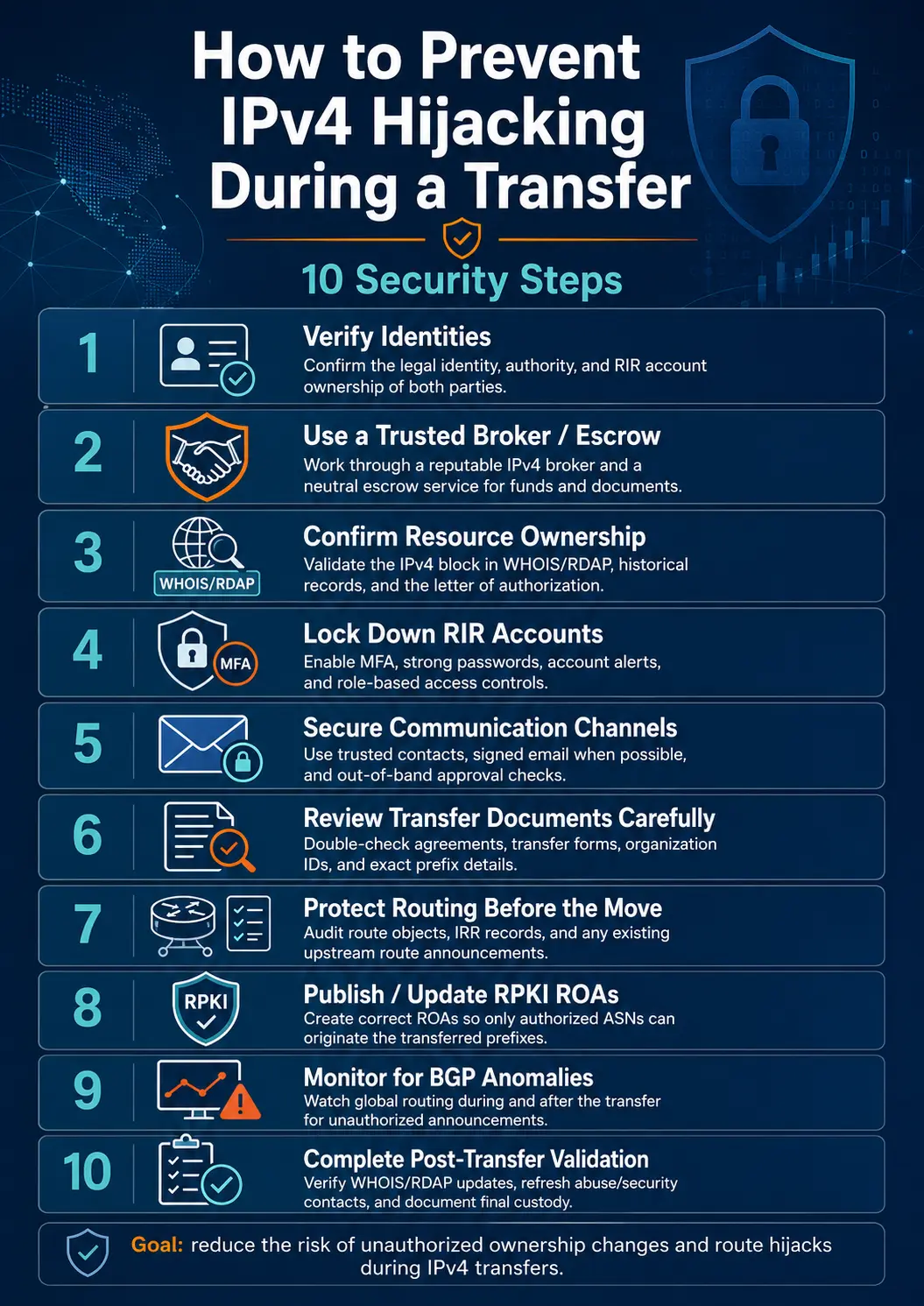
How to Prevent IPv4 Hijacking During a Transfer: 10 Security Steps
Transferring IPv4 address space is not only a commercial and registry process. It is also a sensitive routing operation. During an IPv4 transfer, control of a prefix moves from one organization to another. Registry records, Route Origin Authorizations, Internet Routing Registry objects, upstream-provider filters, reverse DNS settings, and live BGP announcements may all need to change. When these changes are completed in the wrong order—or when identity and authorizationRead more Related Posts How to Prevent IPv4 Hijacking During a Transfer: 10 Security Steps Transferring IPv4 address space is not only a commercial and registry process. It is also a sensitive routing operation. During Why the Cheapest IPv4 Lease May Cost More in the Long Run A low monthly price may look attractive during procurement, but the real cost of leased IPv4 addresses includes much more What Is a /24 IPv4 Subnet and Why Is It Popular for Leasing? A /24 IPv4 subnet is one of the most common block sizes in the IPv4 leasing market. For hosting providers, .related-post {} .related-post .post-list { text-align: left; } .related-post .post-list .item { margin: 5px; padding: 10px; } .related-post .headline { font-size: 18px !important; color: #999999 !important; } .related-post .post-list .item .post_thumb { max-height: 220px; margin: 10px 0px; padding: 0px; display: block; } .related-post .post-list .item .post_title { font-size: 16px; color: #3f3f3f; margin: 10px 0px; padding: 0px; display: block; text-decoration: none; } .related-post .post-list .item .post_excerpt { font-size: 13px; color: #3f3f3f; margin: 10px 0px; padding: 0px; display: block; text-decoration: none; } @media only screen and (min-width: 1024px) { .related-post .post-list .item { width: 30%; } } @media only screen and (min-width: 768px) and (max-width: 1023px) { .related-post .post-list .item { width: 90%; } } @media only screen and (min-width: 0px) and (max-width: 767px) { .related-post .post-list .item { width: 90%; } }
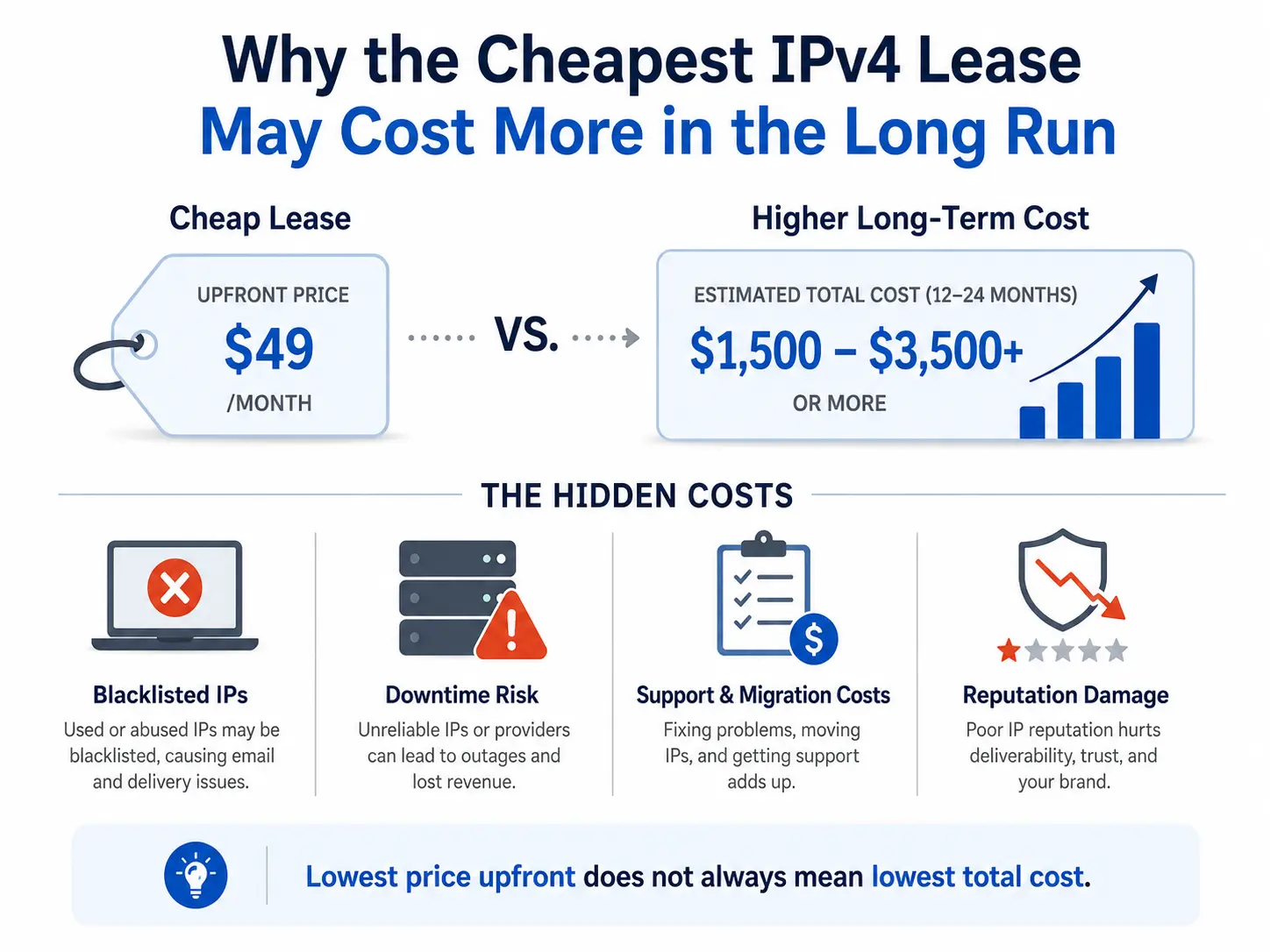
Why the Cheapest IPv4 Lease May Cost More in the Long Run
A low monthly price may look attractive during procurement, but the real cost of leased IPv4 addresses includes much more than the advertised rate. Poor IP reputation, incomplete routing authorisation, deployment delays, weak technical support, incorrect geolocation and uncertain renewal terms can quickly erase the initial saving. For testing or short-lived projects, a basic low-cost IPv4 lease may be sufficient. For production networks, however, businesses should evaluate the totalRead more Related Posts How to Prevent IPv4 Hijacking During a Transfer: 10 Security Steps Transferring IPv4 address space is not only a commercial and registry process. It is also a sensitive routing operation. During Why the Cheapest IPv4 Lease May Cost More in the Long Run A low monthly price may look attractive during procurement, but the real cost of leased IPv4 addresses includes much more What Is a /24 IPv4 Subnet and Why Is It Popular for Leasing? A /24 IPv4 subnet is one of the most common block sizes in the IPv4 leasing market. For hosting providers, .related-post {} .related-post .post-list { text-align: left; } .related-post .post-list .item { margin: 5px; padding: 10px; } .related-post .headline { font-size: 18px !important; color: #999999 !important; } .related-post .post-list .item .post_thumb { max-height: 220px; margin: 10px 0px; padding: 0px; display: block; } .related-post .post-list .item .post_title { font-size: 16px; color: #3f3f3f; margin: 10px 0px; padding: 0px; display: block; text-decoration: none; } .related-post .post-list .item .post_excerpt { font-size: 13px; color: #3f3f3f; margin: 10px 0px; padding: 0px; display: block; text-decoration: none; } @media only screen and (min-width: 1024px) { .related-post .post-list .item { width: 30%; } } @media only screen and (min-width: 768px) and (max-width: 1023px) { .related-post .post-list .item { width: 90%; } } @media only screen and (min-width: 0px) and (max-width: 767px) { .related-post .post-list .item { width: 90%; } }
What causes IPv4 deals to stall after the first agreement
IPv4 deals usually stall after the first agreement because agreeing on price is only the commercial beginning—not operational completion. A buyer and seller may agree on a block and price within hours, but the transaction can still be delayed by unclear ownership, incomplete documents, mismatched Regional Internet Registry requirements, recipient eligibility, reputation concerns, payment conditions, or missing routing authorization. The most common causes are: The seller’s authority over theRead more Related Posts How to Prevent IPv4 Hijacking During a Transfer: 10 Security Steps Transferring IPv4 address space is not only a commercial and registry process. It is also a sensitive routing operation. During Why the Cheapest IPv4 Lease May Cost More in the Long Run A low monthly price may look attractive during procurement, but the real cost of leased IPv4 addresses includes much more What Is a /24 IPv4 Subnet and Why Is It Popular for Leasing? A /24 IPv4 subnet is one of the most common block sizes in the IPv4 leasing market. For hosting providers, .related-post {} .related-post .post-list { text-align: left; } .related-post .post-list .item { margin: 5px; padding: 10px; } .related-post .headline { font-size: 18px !important; color: #999999 !important; } .related-post .post-list .item .post_thumb { max-height: 220px; margin: 10px 0px; padding: 0px; display: block; } .related-post .post-list .item .post_title { font-size: 16px; color: #3f3f3f; margin: 10px 0px; padding: 0px; display: block; text-decoration: none; } .related-post .post-list .item .post_excerpt { font-size: 13px; color: #3f3f3f; margin: 10px 0px; padding: 0px; display: block; text-decoration: none; } @media only screen and (min-width: 1024px) { .related-post .post-list .item { width: 30%; } } @media only screen and (min-width: 768px) and (max-width: 1023px) { .related-post .post-list .item { width: 90%; } } @media only screen and (min-width: 0px) and (max-width: 767px) { .related-post .post-list .item { width: 90%; } }
