What Is a Regional Internet Registry (RIR)?
 Stephanie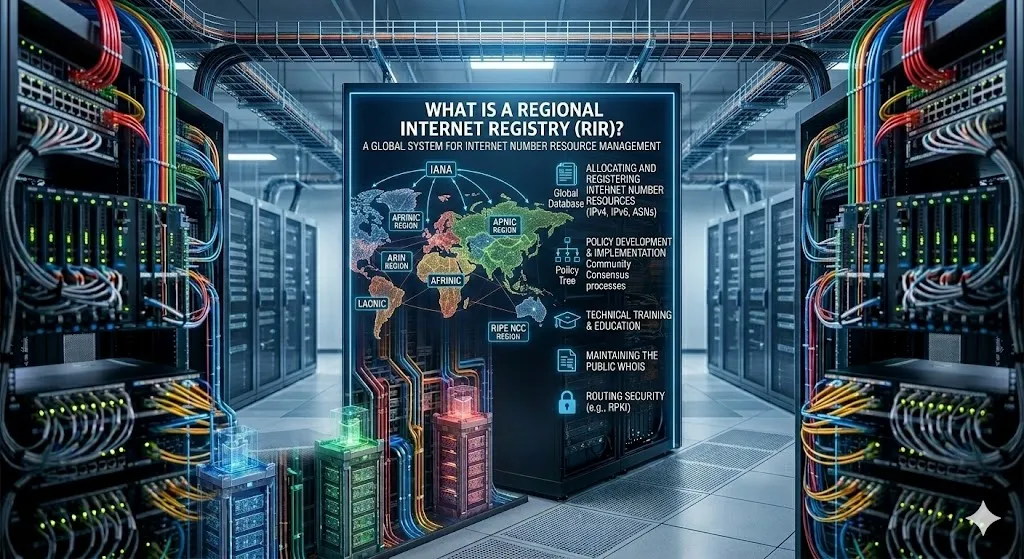
What Is a Regional Internet Registry (RIR)? The Five Global RIRs Explained
Every device and network connected to the public internet needs unique numerical identifiers. Computers, servers, cloud platforms, internet service providers, and enterprise networks rely on IP addresses to exchange data, while network operators use Autonomous System Numbers to advertise routes between independently managed networks.
Table of Contents
These resources cannot be assigned randomly. If two organizations attempted to use the same public IP address range or Autonomous System Number, routing conflicts could disrupt connectivity.
A Regional Internet Registry, commonly abbreviated as RIR, helps prevent this problem by managing and registering internet number resources within a defined geographic region.
There are five Regional Internet Registries worldwide. Together, they form a coordinated system for distributing IPv4 addresses, IPv6 addresses, and Autonomous System Numbers while maintaining registration records and supporting community-based internet policy development.
What Is a Regional Internet Registry?
A Regional Internet Registry is an organization responsible for managing, distributing, and registering internet number resources in a particular part of the world.
The resources managed through the RIR system include:
· IPv4 address space
· IPv6 address space
· Autonomous System Numbers, or ASNs
· Related registration and routing information
· Reverse DNS delegations for allocated address space
RIRs do not ordinarily manage website domain registrations. Domain names and internet number resources are part of different administrative systems. RIRs primarily focus on IP addresses, ASNs, and supporting registration services.
Although each RIR operates independently under its own regional structure and legal framework, the five registries coordinate on matters affecting the global internet. Their cooperation helps ensure that public IP addresses and ASNs remain globally unique.
For more historical background and an extended explanation of their development, see What You Need to Know About Regional Internet Registries.
What Resources Do RIRs Manage?
Regional Internet Registries manage what are collectively known as internet number resources.
IPv4 Addresses
IPv4 addresses use a 32-bit addressing format. An IPv4 address is typically written as four decimal numbers separated by periods, such as:
192.0.2.10
Public IPv4 addresses allow internet-connected systems to be identified and reached. However, the IPv4 system contains a limited address space, and its scarcity has made efficient allocation, registration, transfer, and management increasingly important.
IPv6 Addresses
IPv6 uses a 128-bit address format and provides an enormously larger address space than IPv4. A typical IPv6 address may look like:
2001:db8:1234::10
RIRs allocate IPv6 address blocks to qualifying network operators and organizations according to the policies established in their respective regions.
Autonomous System Numbers
An Autonomous System Number identifies a network or group of networks operating under a consistent external routing policy.
Internet service providers, cloud networks, content delivery networks, telecommunications companies, and large enterprises may use ASNs to exchange routing information through the Border Gateway Protocol, or BGP.
IANA allocates blocks of ASNs to RIRs, which subsequently allocate or assign them under regional policies.
The Five Regional Internet Registries
There are five officially recognized Regional Internet Registries.
RIR | Full Name | Primary Service Region |
AFRINIC | African Network Information Centre | Africa |
APNIC | Asia Pacific Network Information Centre | Asia-Pacific |
ARIN | American Registry for Internet Numbers | Canada, the United States, and parts of the Caribbean and North Atlantic |
LACNIC | Latin America and Caribbean Network Information Centre | Latin America and parts of the Caribbean |
RIPE NCC | Réseaux IP Européens Network Coordination Centre | Europe, the Middle East, and parts of Central Asia |
The boundaries are based on established service regions rather than simple continental divisions. Certain Caribbean territories, for example, fall under different registries. Countries with National Internet Registries may also have an additional national layer within the regional system.
AFRINIC
AFRINIC serves the African region. Its responsibilities include registering and administering IP address space and Autonomous System Numbers, supporting policy development, and providing services to the African internet community.
APNIC
APNIC serves the Asia-Pacific region. Its community includes internet service providers, telecommunications companies, data centers, enterprises, academic networks, government organizations, and National Internet Registries.
ARIN
ARIN serves Canada, the United States, and several Caribbean and North Atlantic territories. It administers internet number resources and provides registration, transfer, routing security, and policy-development services for its region.
LACNIC
LACNIC serves Latin America and parts of the Caribbean. In countries such as Brazil and Mexico, National Internet Registries perform certain resource-management functions within the broader LACNIC system.
RIPE NCC
RIPE NCC serves Europe, the Middle East, and parts of Central Asia. It is important to distinguish RIPE NCC, the Regional Internet Registry, from RIPE, the broader open community of network operators and other participants interested in internet coordination.
How the Internet Number Registry System Works
The internet number registry system follows a coordinated hierarchy:
IANA → RIR → NIR or LIR/ISP → Customer or End User
Step 1: IANA Coordinates the Global Resource Pool
The Internet Assigned Numbers Authority coordinates the global pools of unallocated IP addresses and ASNs.
Rather than assigning ordinary address blocks directly to individual businesses, IANA primarily provides number resources to the five RIRs according to globally agreed policies and documented allocation procedures.
Step 2: RIRs Manage Resources Regionally
Each RIR receives resources for its service region and distributes them according to policies developed by that region’s internet community.
Recipients may include:
· Internet service providers
· Telecommunications operators
· Cloud and hosting companies
· Data centers
· Enterprises
· Government networks
· Educational institutions
· National Internet Registries
· Other eligible network operators
Step 3: Providers Assign Addresses to Customers
An ISP or Local Internet Registry may receive a larger address block and assign smaller portions to its customers.
Some organizations can also obtain provider-independent resources directly from an RIR when they meet the relevant policy, technical, contractual, and documentation requirements.
Step 4: Registration Information Is Maintained
Information about registered resources is published through directory services such as WHOIS and the Registration Data Access Protocol, or RDAP.
These records help users identify the organization associated with an IP address range or ASN, although a registry record does not necessarily identify the individual currently using a particular address.
What Does a Regional Internet Registry Do?
The role of an RIR extends beyond issuing IP addresses.
1. IP Address Allocation and Assignment
RIRs distribute IPv4 and IPv6 resources according to their regional policies. Applicants may need to demonstrate technical requirements, network plans, efficient utilization, or other forms of justification.
The terminology can differ depending on the recipient:
· An allocation is commonly made to an organization that will distribute address space further.
· An assignment is commonly made for use within the recipient’s own network.
· A sub-allocation or reassignment may be made by an ISP or LIR to a customer.
2. ASN Registration
RIRs issue and register Autonomous System Numbers for networks that qualify under applicable regional policies.
An organization may need a public ASN when it operates an independent routing policy, connects to multiple upstream providers, or exchanges routes with other autonomous networks.
3. Registration Database Maintenance
RIR databases contain information related to:
· IP address ranges
· ASNs
· Registered organizations
· Network handles
· Points of contact
· Allocation or assignment status
· Certain routing and reverse DNS records
WHOIS has traditionally been used to access this information. RDAP provides a newer, standardized alternative that returns structured, machine-readable data in JSON format.
4. Reverse DNS Services
RIRs support reverse DNS delegation for allocated IP address space.
Reverse DNS allows a system to look up a hostname associated with an IP address. It is commonly used in network diagnostics, email infrastructure, security analysis, and operational troubleshooting.
5. Transfer Registration
As IPv4 resources have become scarce, transfer markets have developed under RIR-specific rules.
RIRs may review and record eligible transfers, update registration details, and confirm that transactions meet the policies applicable to the relevant region. The RIR generally does not act as the commercial buyer, seller, or broker in the transaction.
6. Routing Security Support
Several RIR services help resource holders improve routing security.
Resource Public Key Infrastructure, or RPKI, allows a resource holder to create a cryptographically verifiable Route Origin Authorization. This indicates which ASN is authorized to originate a particular IP prefix.
RPKI does not prevent every routing incident, but it can help network operators identify and reject invalid route announcements.
7. Training and Technical Support
RIRs frequently provide training, technical documentation, measurement data, fellowships, meetings, and capacity-building programs.
These activities can cover subjects such as:
· IPv6 deployment
· BGP operations
· Routing security
· RPKI
· Network measurement
· Internet governance
· Resource management
· WHOIS and RDAP
· Policy participation
Why Are Regional Internet Registries Important?
Without coordinated registration, the same public IP address or ASN could be assigned to more than one organization. Such conflicts would make reliable routing extremely difficult.
RIRs provide a regional structure that helps preserve uniqueness, registration accuracy, policy transparency, and operational coordination.
They Preserve Globally Unique Resources
Every globally routed public IP prefix and public ASN must be uniquely associated with the appropriate resource holder.
The registry system creates a documented chain of responsibility between IANA, the RIRs, network operators, and downstream users.
They Support Reliable Internet Routing
Internet routing depends on networks advertising identifiable address prefixes through identifiable Autonomous Systems.
Accurate number-resource records make it easier for operators to understand where an address range originated, investigate routing problems, and contact the organization responsible for a network.
They Promote Fair and Documented Distribution
Internet number resources have global value, but operational requirements vary among regions.
The RIR model allows communities to develop policies that reflect regional needs while remaining part of a globally coordinated system.
They Help With Security and Incident Response
Registration data can assist network administrators, cybersecurity teams, researchers, abuse desks, and Computer Security Incident Response Teams when investigating:
· Suspicious traffic
· Route leaks
· Route hijacks
· Spam activity
· Distributed denial-of-service attacks
· Misconfigured networks
· Unauthorized prefix announcements
A WHOIS or RDAP record does not prove that a registered organization caused an incident. It provides an administrative starting point for further investigation.
They Support Internet Development
RIR meetings and training programs bring together network operators, policymakers, researchers, governments, and other stakeholders.
This community activity supports technical knowledge sharing and helps emerging networks participate in the global internet ecosystem.
A complementary discussion is available in Why Regional Internet Registries Matter.
How RIR Policies Are Developed
RIRs are not conventional government regulators.
Resource-management policies are generally developed through open, community-based policy development processes. Participants can propose policy changes, discuss proposals, identify operational consequences, and work toward community consensus.
The process differs slightly among the five registries, but it is generally designed to be:
· Open
· Transparent
· Documented
· Community driven
· Bottom up
· Accessible to affected stakeholders
Participation is not always limited to organizations that already hold IP addresses. Network operators, researchers, civil-society organizations, governments, technical experts, and other interested participants can contribute to policy discussions.
This model helps RIR policies evolve as technology, resource availability, network operations, and regional requirements change. The overall registry system is built around open, multi-stakeholder decision-making rather than unilateral resource control.
RIR vs NIR vs LIR vs IRR
Several internet registry terms sound similar but describe different functions.
Term | Full Name | Main Function |
RIR | Regional Internet Registry | Manages internet number resources within a geographic region |
NIR | National Internet Registry | Performs certain registry functions within a particular country |
LIR | Local Internet Registry | Receives resources and commonly distributes them to customers |
IRR | Internet Routing Registry | Stores routing-policy and route-object information |
IANA | Internet Assigned Numbers Authority | Coordinates global pools and allocates resources primarily to RIRs |
What Is an NIR?
A National Internet Registry performs internet number-resource functions at the country level within the structure of an RIR.
NIR arrangements exist in parts of the APNIC and LACNIC service regions. Their exact responsibilities and procedures vary by country.
What Is an LIR?
A Local Internet Registry is usually an ISP, telecommunications company, hosting provider, or another network organization that receives internet number resources and assigns them to its infrastructure or customers.
An LIR is not one of the five global RIRs.
What Is an IRR?
An Internet Routing Registry contains routing-policy information, including route and route6 objects that associate address prefixes with originating ASNs.
An RIR manages number-resource registration, while an IRR focuses on routing-policy data. Some RIRs operate routing registries, but the two terms are not interchangeable.
How to Find the RIR for an IP Address
You can identify the responsible RIR by performing an RDAP or WHOIS lookup.
Using RDAP
RDAP is generally the preferred modern method because it provides standardized, structured responses.
A lookup can show information such as:
· The IP address range
· The responsible RIR
· The registered organization
· The network name
· The allocation or assignment date
· The resource status
· Contact or abuse information, where published
RDAP supports bootstrapping, which means a query can be directed automatically to the registry responsible for the requested resource.
Important Limitations
Registration information must be interpreted carefully.
The organization shown in an RIR record may be:
· The direct resource holder
· An upstream ISP
· A hosting company
· A cloud provider
· An organization that reassigned the address to a customer
· The holder of a larger block containing the queried IP
The registered country may also describe the resource holder’s administrative location rather than the physical location of the device using the IP address.
For this reason, RIR data should not be treated as precise IP geolocation data.
RIRs, IPv4 Exhaustion, and IP Transfers
IPv4 contains a limited number of addresses. As freely available IPv4 pools have been depleted, many organizations now obtain additional IPv4 capacity through:
· RIR waiting-list mechanisms
· Transfers between qualified resource holders
· ISP assignments
· Cloud or hosting providers
· IPv4 leasing arrangements
· Network acquisition or corporate restructuring
Each RIR maintains its own policies for recognizing and recording eligible transfers.
Depending on the transaction and regions involved, a transfer may require:
· Verification of the source organization
· Verification of the recipient
· Evidence of authority over the resources
· Contractual documentation
· Policy compliance
· Registration updates
· Applicable fees
· Coordination between two RIRs for an inter-RIR transfer
A commercial agreement alone does not automatically update an RIR database. Organizations involved in IPv4 transactions should ensure that registration, routing authorization, reverse DNS, abuse contacts, and RPKI records are handled properly.
For another introductory perspective on RIRs and number-resource management, see What Is a Regional Internet Registry?.
How RIRs Work With IANA, ICANN, and the NRO
RIRs operate within a broader internet coordination ecosystem.
IANA
IANA coordinates the global pools of IP addresses and Autonomous System Numbers and primarily provides unallocated resources to RIRs according to global policies.
IANA does not ordinarily process routine IP address requests from individual businesses or consumers.
ICANN
The Internet Corporation for Assigned Names and Numbers coordinates systems of unique internet identifiers.
The IANA functions are performed by Public Technical Identifiers, an affiliate of ICANN. Within the number-resource system, the operational IANA role is distinct from the regional distribution and policy functions carried out by RIRs.
NRO
The Number Resource Organization was established in 2003 as the coordinating body for the five Regional Internet Registries.
The NRO supports cooperation among RIRs, represents their collective interests in relevant global discussions, and helps coordinate activities involving the internet number-resource system. It does not replace the individual RIRs or normally allocate address space directly to network operators.
Frequently Asked Questions
What does a Regional Internet Registry do?
A Regional Internet Registry manages, distributes, and registers IPv4 addresses, IPv6 addresses, and Autonomous System Numbers within a defined geographic region. It may also provide reverse DNS, routing-security, database, policy-development, training, and transfer-registration services.
How many Regional Internet Registries are there?
There are five: AFRINIC, APNIC, ARIN, LACNIC, and RIPE NCC.
Which Regional Internet Registry covers the United States?
ARIN covers the United States, Canada, and several Caribbean and North Atlantic territories.
Which RIR covers Europe?
RIPE NCC serves Europe, the Middle East, and parts of Central Asia.
Which RIR covers Asia?
APNIC serves the Asia-Pacific region.
Does an RIR manage domain names?
RIRs primarily manage IP addresses and Autonomous System Numbers. Domain registrations are handled through the domain-name registry and registrar system.
Can an individual obtain an IP address directly from an RIR?
Eligibility depends on the policies of the relevant RIR and the type of resource requested. Most individuals receive public IP addresses through an ISP rather than directly from an RIR.
Organizations with qualifying operational requirements may apply for provider-independent resources.
Does an RIR own every IP address it registers?
An RIR administers registration and allocation rights under its policies and agreements. Terms such as ownership, title, allocation, assignment, registration, and right of use can have different technical and legal meanings.
Organizations should review the applicable RIR agreement and obtain appropriate legal advice before treating IP address resources as ordinary physical property.
Is WHOIS the same as RDAP?
No. Both provide access to registration data, but RDAP is a newer standardized protocol that delivers structured JSON responses and supports features such as bootstrapping.
Can an RIR lookup reveal someone’s exact location?
Usually not. RIR data shows registration and resource-management information. It may identify an organization or service region, but it does not reliably reveal the exact physical location of an individual device.
What is the difference between an RIR and an ISP?
An RIR administers number resources for a geographic region. An ISP provides internet connectivity and may receive IP addresses from an RIR or another upstream provider before assigning addresses to customers.
Conclusion
Regional Internet Registries are a fundamental part of the internet’s technical infrastructure.
By coordinating the distribution and registration of IPv4 addresses, IPv6 addresses, and Autonomous System Numbers, RIRs help ensure that internet number resources remain unique, traceable, and usable across the global network.
Their role extends beyond resource allocation. RIRs maintain registration services, support routing security, facilitate transparent policy development, provide technical training, record eligible transfers, and connect regional network communities with the global internet governance system.
Whether you operate an ISP, manage a data center, deploy cloud infrastructure, investigate network incidents, purchase or lease IPv4 resources, or simply want to understand how the internet works, knowing the role of Regional Internet Registries provides essential context for internet addressing and routing.
Related Reading
· What You Need to Know About Regional Internet Registries
· Why Regional Internet Registries Matter
· What Is a Regional Internet Registry?
Related Posts
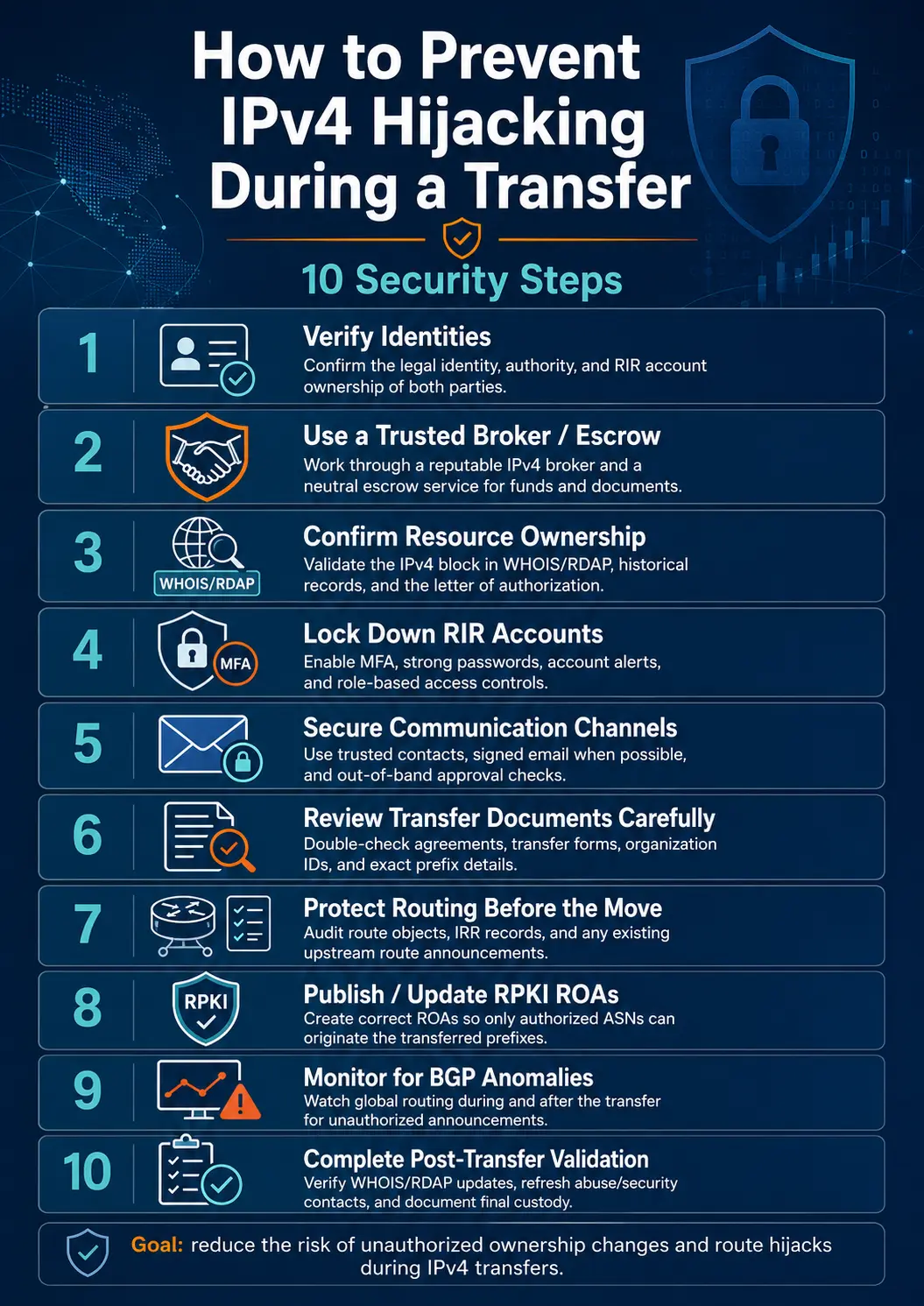
How to Prevent IPv4 Hijacking During a Transfer: 10 Security Steps
Transferring IPv4 address space is not only a commercial and registry process. It is also a sensitive routing operation. During an IPv4 transfer, control of a prefix moves from one organization to another. Registry records, Route Origin Authorizations, Internet Routing Registry objects, upstream-provider filters, reverse DNS settings, and live BGP announcements may all need to change. When these changes are completed in the wrong order—or when identity and authorizationRead more Related Posts How to Prevent IPv4 Hijacking During a Transfer: 10 Security Steps Transferring IPv4 address space is not only a commercial and registry process. It is also a sensitive routing operation. During Why the Cheapest IPv4 Lease May Cost More in the Long Run A low monthly price may look attractive during procurement, but the real cost of leased IPv4 addresses includes much more What Is a /24 IPv4 Subnet and Why Is It Popular for Leasing? A /24 IPv4 subnet is one of the most common block sizes in the IPv4 leasing market. For hosting providers, .related-post {} .related-post .post-list { text-align: left; } .related-post .post-list .item { margin: 5px; padding: 10px; } .related-post .headline { font-size: 18px !important; color: #999999 !important; } .related-post .post-list .item .post_thumb { max-height: 220px; margin: 10px 0px; padding: 0px; display: block; } .related-post .post-list .item .post_title { font-size: 16px; color: #3f3f3f; margin: 10px 0px; padding: 0px; display: block; text-decoration: none; } .related-post .post-list .item .post_excerpt { font-size: 13px; color: #3f3f3f; margin: 10px 0px; padding: 0px; display: block; text-decoration: none; } @media only screen and (min-width: 1024px) { .related-post .post-list .item { width: 30%; } } @media only screen and (min-width: 768px) and (max-width: 1023px) { .related-post .post-list .item { width: 90%; } } @media only screen and (min-width: 0px) and (max-width: 767px) { .related-post .post-list .item { width: 90%; } }
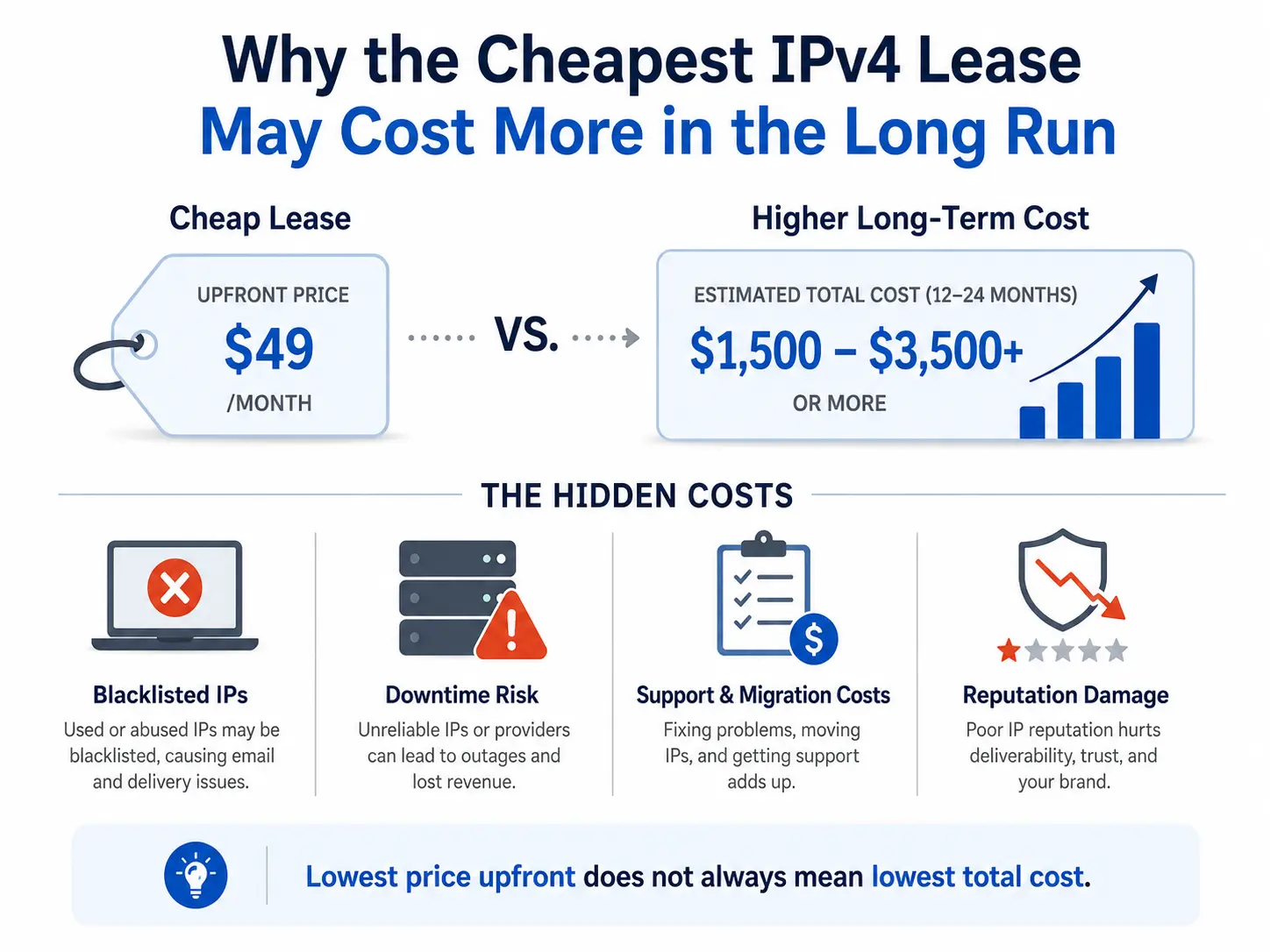
Why the Cheapest IPv4 Lease May Cost More in the Long Run
A low monthly price may look attractive during procurement, but the real cost of leased IPv4 addresses includes much more than the advertised rate. Poor IP reputation, incomplete routing authorisation, deployment delays, weak technical support, incorrect geolocation and uncertain renewal terms can quickly erase the initial saving. For testing or short-lived projects, a basic low-cost IPv4 lease may be sufficient. For production networks, however, businesses should evaluate the totalRead more Related Posts How to Prevent IPv4 Hijacking During a Transfer: 10 Security Steps Transferring IPv4 address space is not only a commercial and registry process. It is also a sensitive routing operation. During Why the Cheapest IPv4 Lease May Cost More in the Long Run A low monthly price may look attractive during procurement, but the real cost of leased IPv4 addresses includes much more What Is a /24 IPv4 Subnet and Why Is It Popular for Leasing? A /24 IPv4 subnet is one of the most common block sizes in the IPv4 leasing market. For hosting providers, .related-post {} .related-post .post-list { text-align: left; } .related-post .post-list .item { margin: 5px; padding: 10px; } .related-post .headline { font-size: 18px !important; color: #999999 !important; } .related-post .post-list .item .post_thumb { max-height: 220px; margin: 10px 0px; padding: 0px; display: block; } .related-post .post-list .item .post_title { font-size: 16px; color: #3f3f3f; margin: 10px 0px; padding: 0px; display: block; text-decoration: none; } .related-post .post-list .item .post_excerpt { font-size: 13px; color: #3f3f3f; margin: 10px 0px; padding: 0px; display: block; text-decoration: none; } @media only screen and (min-width: 1024px) { .related-post .post-list .item { width: 30%; } } @media only screen and (min-width: 768px) and (max-width: 1023px) { .related-post .post-list .item { width: 90%; } } @media only screen and (min-width: 0px) and (max-width: 767px) { .related-post .post-list .item { width: 90%; } }

What causes IPv4 deals to stall after the first agreement
IPv4 deals usually stall after the first agreement because agreeing on price is only the commercial beginning—not operational completion. A buyer and seller may agree on a block and price within hours, but the transaction can still be delayed by unclear ownership, incomplete documents, mismatched Regional Internet Registry requirements, recipient eligibility, reputation concerns, payment conditions, or missing routing authorization. The most common causes are: The seller’s authority over theRead more Related Posts How to Prevent IPv4 Hijacking During a Transfer: 10 Security Steps Transferring IPv4 address space is not only a commercial and registry process. It is also a sensitive routing operation. During Why the Cheapest IPv4 Lease May Cost More in the Long Run A low monthly price may look attractive during procurement, but the real cost of leased IPv4 addresses includes much more What Is a /24 IPv4 Subnet and Why Is It Popular for Leasing? A /24 IPv4 subnet is one of the most common block sizes in the IPv4 leasing market. For hosting providers, .related-post {} .related-post .post-list { text-align: left; } .related-post .post-list .item { margin: 5px; padding: 10px; } .related-post .headline { font-size: 18px !important; color: #999999 !important; } .related-post .post-list .item .post_thumb { max-height: 220px; margin: 10px 0px; padding: 0px; display: block; } .related-post .post-list .item .post_title { font-size: 16px; color: #3f3f3f; margin: 10px 0px; padding: 0px; display: block; text-decoration: none; } .related-post .post-list .item .post_excerpt { font-size: 13px; color: #3f3f3f; margin: 10px 0px; padding: 0px; display: block; text-decoration: none; } @media only screen and (min-width: 1024px) { .related-post .post-list .item { width: 30%; } } @media only screen and (min-width: 768px) and (max-width: 1023px) { .related-post .post-list .item { width: 90%; } } @media only screen and (min-width: 0px) and (max-width: 767px) { .related-post .post-list .item { width: 90%; } }
