What is IP Forwarding?
 Chan
Chan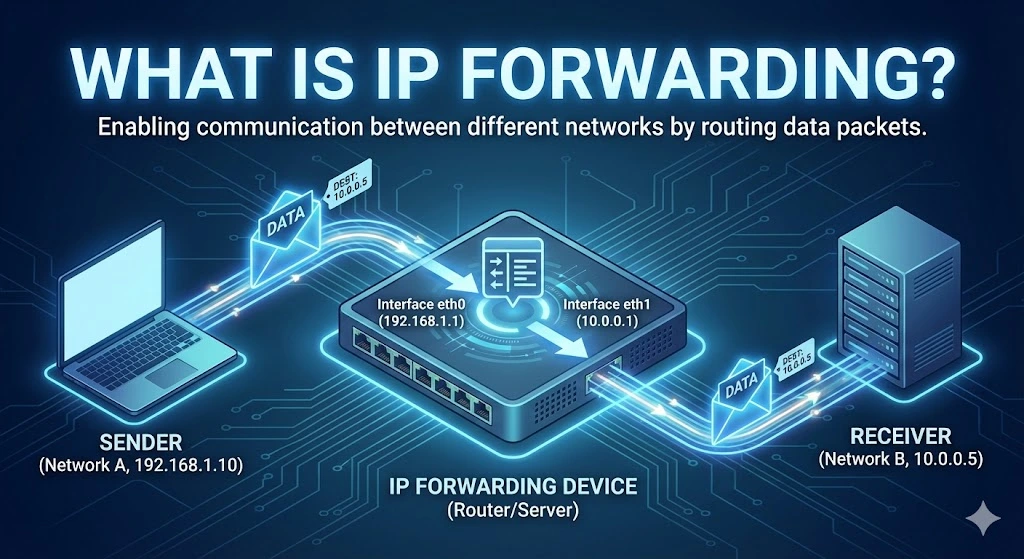
IP forwarding is the process by which a network device, such as a router, forwards or relays IP (Internet Protocol) packets from one network to another. It enables communication between different network segments by directing data packets to their appropriate destination IP addresses. When a device forwards packets that are not destined for its IP address, it acts as a gateway, passing data from one network to another, typically between different subnets or networks.
Table of Contents
IP forwarding is crucial in routers but can also be enabled on computers or other network devices to allow them to act as intermediaries between networks. Without IP forwarding, devices within a local network could not communicate with devices outside their immediate network.
Use Cases of IP Forwarding
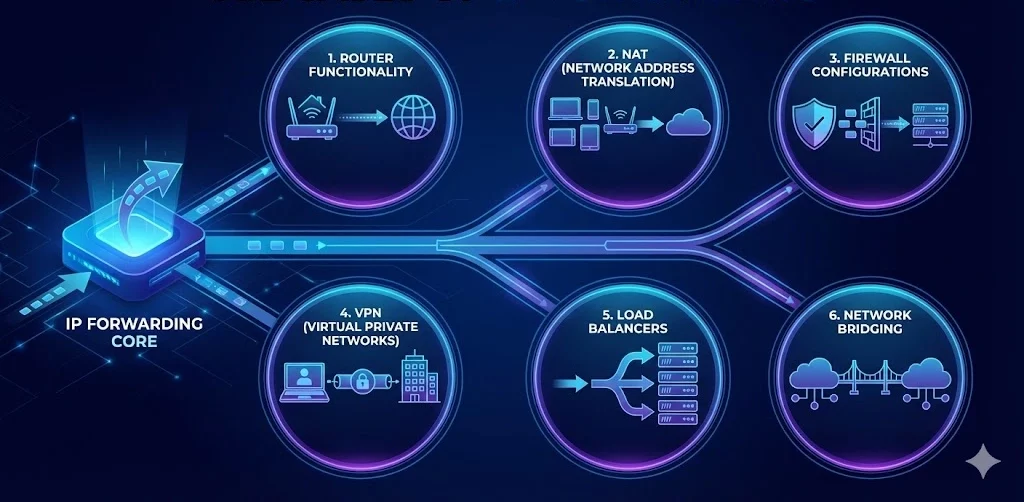
1. Router Functionality
The most common use case for IP forwarding is in routers, which form the backbone of any network communication infrastructure. Routers forward packets between local networks and larger networks, such as the Internet, ensuring data reaches its destination across multiple hops or networks. This is the core functionality of routers in homes, offices, and data centers.
2. Network Address Translation (NAT)
In NAT-enabled environments, IP forwarding is essential. NAT allows multiple devices on a local network to share a single public IP address for Internet access. A router with IP forwarding forwards packets from internal private IP addresses to external IP addresses, enabling communication between internal users and external resources like websites or servers.
3. Firewall Configurations
In enterprise environments, IP forwarding can be part of complex firewall setups, where packets are forwarded through a firewall to reach internal servers, subnets, or specific services. Firewalls can allow or block packets while forwarding them based on rules.
4. Virtual Private Networks (VPNs)
When users connect to a VPN, IP forwarding is used to forward traffic from the user’s local network to a company’s remote servers or internal networks. This ensures secure, encrypted communication across networks, often bypassing geographical or security restrictions.
5. Load Balancers
In large-scale web applications or services, load balancers use IP forwarding to distribute incoming traffic to multiple servers. By forwarding requests to different servers, the load balancer ensures that no single server is overwhelmed, improving reliability and performance.
6. Network Bridging
IP forwarding is also used when creating network bridges between two separate networks. This helps organizations manage traffic and resources more efficiently by forwarding packets between different network segments without creating a unified network.
Purpose of IP Forwarding
I) Network Segmentation
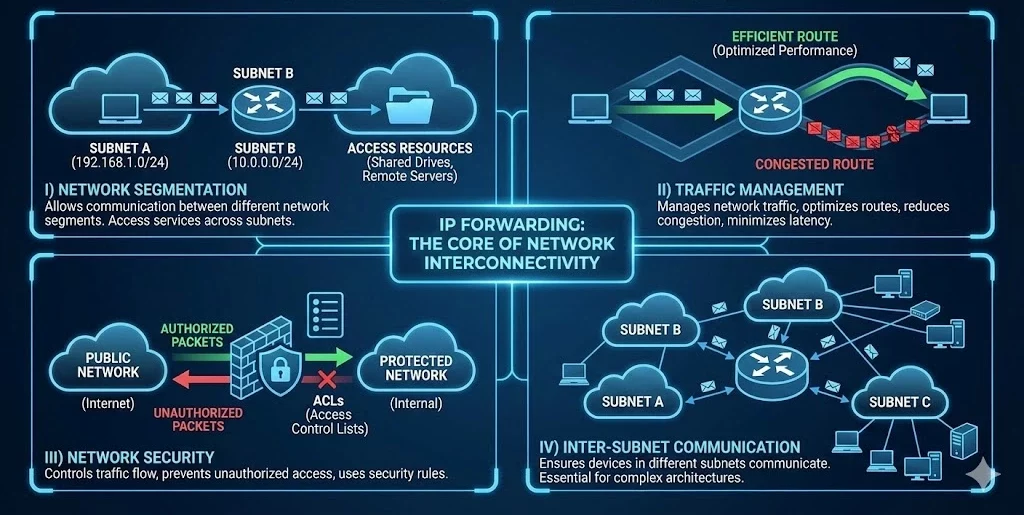
One of the primary purposes of IP forwarding is to allow communication between different network segments or subnets. By forwarding packets, one network can access services, devices, or resources in another network, such as accessing shared drives or using remote servers.
II) Traffic Management
Forwarding packets, routers, and network devices help manage network traffic, ensuring that data takes the most efficient route. This helps optimize network performance, reduces congestion, and minimizes latency in communication.
III) Network Security
IP forwarding also plays a critical role in securing network communication. Firewalls use IP forwarding to control traffic between different networks, ensuring that unauthorized data packets do not enter or leave protected networks. Additionally, IP forwarding is often used in conjunction with network security rules, such as access control lists (ACLs), to regulate traffic.
IV) Inter-Subnet Communication
In large networks, subnets are used to divide network traffic into smaller, more manageable segments. IP forwarding ensures that devices in different subnets can still communicate with each other, which is essential for larger organizations with complex network architectures.
How IP Forwarding Works
When a packet is received by a device (e.g., a router), it checks the destination IP address to determine whether the packet is meant for itself or another device. If the packet is not intended for the router itself, the device uses its routing table to determine the best path to forward the packet. The packet is then passed to the next device along the route until it reaches its destination.
In simple terms:
-
- A data packet is received by a router or device with IP forwarding enabled.
- The device checks the destination IP address of the packet.
- If the packet is not meant for the device, the routing table is consulted to find the next hop.
- The packet is forwarded to the next device or network.
- The process continues until the packet reaches its intended destination.
FAQs
How do I enable IP forwarding on Linux?
To enable IP forwarding temporarily, run the command sysctl -w net.ipv4.ip_forward=1 in your terminal. To make it permanent, edit the /etc/sysctl.conf file and add or uncomment the line net.ipv4.ip_forward = 1, then run sysctl -p to apply the changes.
Is IP forwarding a security risk?
Yes, if not configured correctly. Enabling IP forwarding turns a device into a router. If you don’t have proper firewall rules (iptables/nftables) in place, malicious actors could use your device to route traffic between networks you intended to keep separate, potentially leading to Man-in-the-Middle (MITM) attacks or unauthorized access to private subnets.
What is the difference between IP forwarding and routing?
While often used interchangeably, they are distinct steps. Routing is the decision-making process where the device looks at its routing table to decide where to send a packet (like planning a route on a map). IP Forwarding is the actual physical action of moving the packet from one network interface to another based on that decision (like actually driving the car).
Related Posts
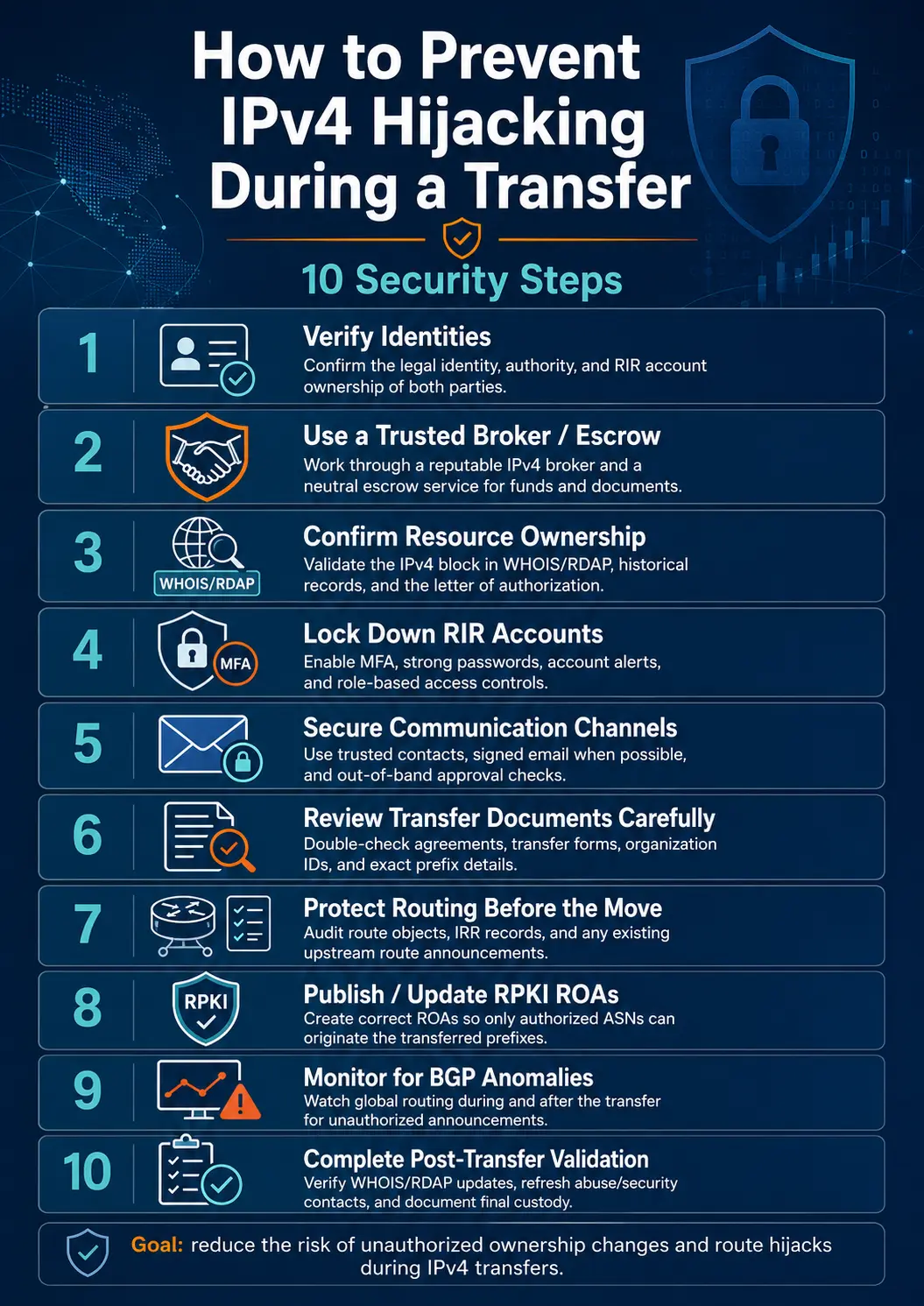
How to Prevent IPv4 Hijacking During a Transfer: 10 Security Steps
Transferring IPv4 address space is not only a commercial and registry process. It is also a sensitive routing operation. During an IPv4 transfer, control of a prefix moves from one organization to another. Registry records, Route Origin Authorizations, Internet Routing Registry objects, upstream-provider filters, reverse DNS settings, and live BGP announcements may all need to change. When these changes are completed in the wrong order—or when identity and authorizationRead more Related Posts How to Prevent IPv4 Hijacking During a Transfer: 10 Security Steps Transferring IPv4 address space is not only a commercial and registry process. It is also a sensitive routing operation. During Why the Cheapest IPv4 Lease May Cost More in the Long Run A low monthly price may look attractive during procurement, but the real cost of leased IPv4 addresses includes much more What Is a /24 IPv4 Subnet and Why Is It Popular for Leasing? A /24 IPv4 subnet is one of the most common block sizes in the IPv4 leasing market. For hosting providers, .related-post {} .related-post .post-list { text-align: left; } .related-post .post-list .item { margin: 5px; padding: 10px; } .related-post .headline { font-size: 18px !important; color: #999999 !important; } .related-post .post-list .item .post_thumb { max-height: 220px; margin: 10px 0px; padding: 0px; display: block; } .related-post .post-list .item .post_title { font-size: 16px; color: #3f3f3f; margin: 10px 0px; padding: 0px; display: block; text-decoration: none; } .related-post .post-list .item .post_excerpt { font-size: 13px; color: #3f3f3f; margin: 10px 0px; padding: 0px; display: block; text-decoration: none; } @media only screen and (min-width: 1024px) { .related-post .post-list .item { width: 30%; } } @media only screen and (min-width: 768px) and (max-width: 1023px) { .related-post .post-list .item { width: 90%; } } @media only screen and (min-width: 0px) and (max-width: 767px) { .related-post .post-list .item { width: 90%; } }
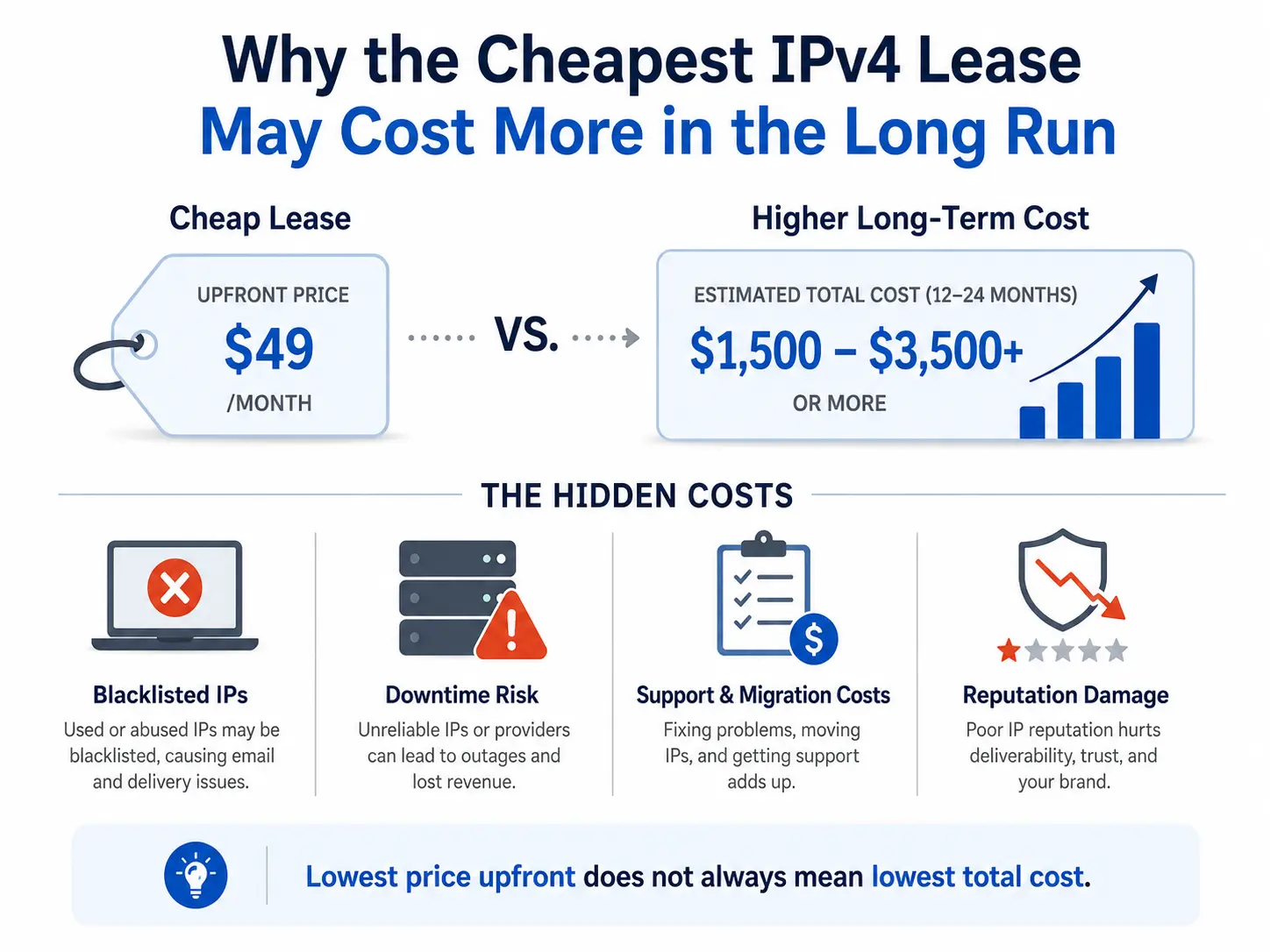
Why the Cheapest IPv4 Lease May Cost More in the Long Run
A low monthly price may look attractive during procurement, but the real cost of leased IPv4 addresses includes much more than the advertised rate. Poor IP reputation, incomplete routing authorisation, deployment delays, weak technical support, incorrect geolocation and uncertain renewal terms can quickly erase the initial saving. For testing or short-lived projects, a basic low-cost IPv4 lease may be sufficient. For production networks, however, businesses should evaluate the totalRead more Related Posts How to Prevent IPv4 Hijacking During a Transfer: 10 Security Steps Transferring IPv4 address space is not only a commercial and registry process. It is also a sensitive routing operation. During Why the Cheapest IPv4 Lease May Cost More in the Long Run A low monthly price may look attractive during procurement, but the real cost of leased IPv4 addresses includes much more What Is a /24 IPv4 Subnet and Why Is It Popular for Leasing? A /24 IPv4 subnet is one of the most common block sizes in the IPv4 leasing market. For hosting providers, .related-post {} .related-post .post-list { text-align: left; } .related-post .post-list .item { margin: 5px; padding: 10px; } .related-post .headline { font-size: 18px !important; color: #999999 !important; } .related-post .post-list .item .post_thumb { max-height: 220px; margin: 10px 0px; padding: 0px; display: block; } .related-post .post-list .item .post_title { font-size: 16px; color: #3f3f3f; margin: 10px 0px; padding: 0px; display: block; text-decoration: none; } .related-post .post-list .item .post_excerpt { font-size: 13px; color: #3f3f3f; margin: 10px 0px; padding: 0px; display: block; text-decoration: none; } @media only screen and (min-width: 1024px) { .related-post .post-list .item { width: 30%; } } @media only screen and (min-width: 768px) and (max-width: 1023px) { .related-post .post-list .item { width: 90%; } } @media only screen and (min-width: 0px) and (max-width: 767px) { .related-post .post-list .item { width: 90%; } }
What causes IPv4 deals to stall after the first agreement
IPv4 deals usually stall after the first agreement because agreeing on price is only the commercial beginning—not operational completion. A buyer and seller may agree on a block and price within hours, but the transaction can still be delayed by unclear ownership, incomplete documents, mismatched Regional Internet Registry requirements, recipient eligibility, reputation concerns, payment conditions, or missing routing authorization. The most common causes are: The seller’s authority over theRead more Related Posts How to Prevent IPv4 Hijacking During a Transfer: 10 Security Steps Transferring IPv4 address space is not only a commercial and registry process. It is also a sensitive routing operation. During Why the Cheapest IPv4 Lease May Cost More in the Long Run A low monthly price may look attractive during procurement, but the real cost of leased IPv4 addresses includes much more What Is a /24 IPv4 Subnet and Why Is It Popular for Leasing? A /24 IPv4 subnet is one of the most common block sizes in the IPv4 leasing market. For hosting providers, .related-post {} .related-post .post-list { text-align: left; } .related-post .post-list .item { margin: 5px; padding: 10px; } .related-post .headline { font-size: 18px !important; color: #999999 !important; } .related-post .post-list .item .post_thumb { max-height: 220px; margin: 10px 0px; padding: 0px; display: block; } .related-post .post-list .item .post_title { font-size: 16px; color: #3f3f3f; margin: 10px 0px; padding: 0px; display: block; text-decoration: none; } .related-post .post-list .item .post_excerpt { font-size: 13px; color: #3f3f3f; margin: 10px 0px; padding: 0px; display: block; text-decoration: none; } @media only screen and (min-width: 1024px) { .related-post .post-list .item { width: 30%; } } @media only screen and (min-width: 768px) and (max-width: 1023px) { .related-post .post-list .item { width: 90%; } } @media only screen and (min-width: 0px) and (max-width: 767px) { .related-post .post-list .item { width: 90%; } }
