What Is IPv4 Address Exhaustion? Causes, Business Impact, and Practical Solutions
 admin
admin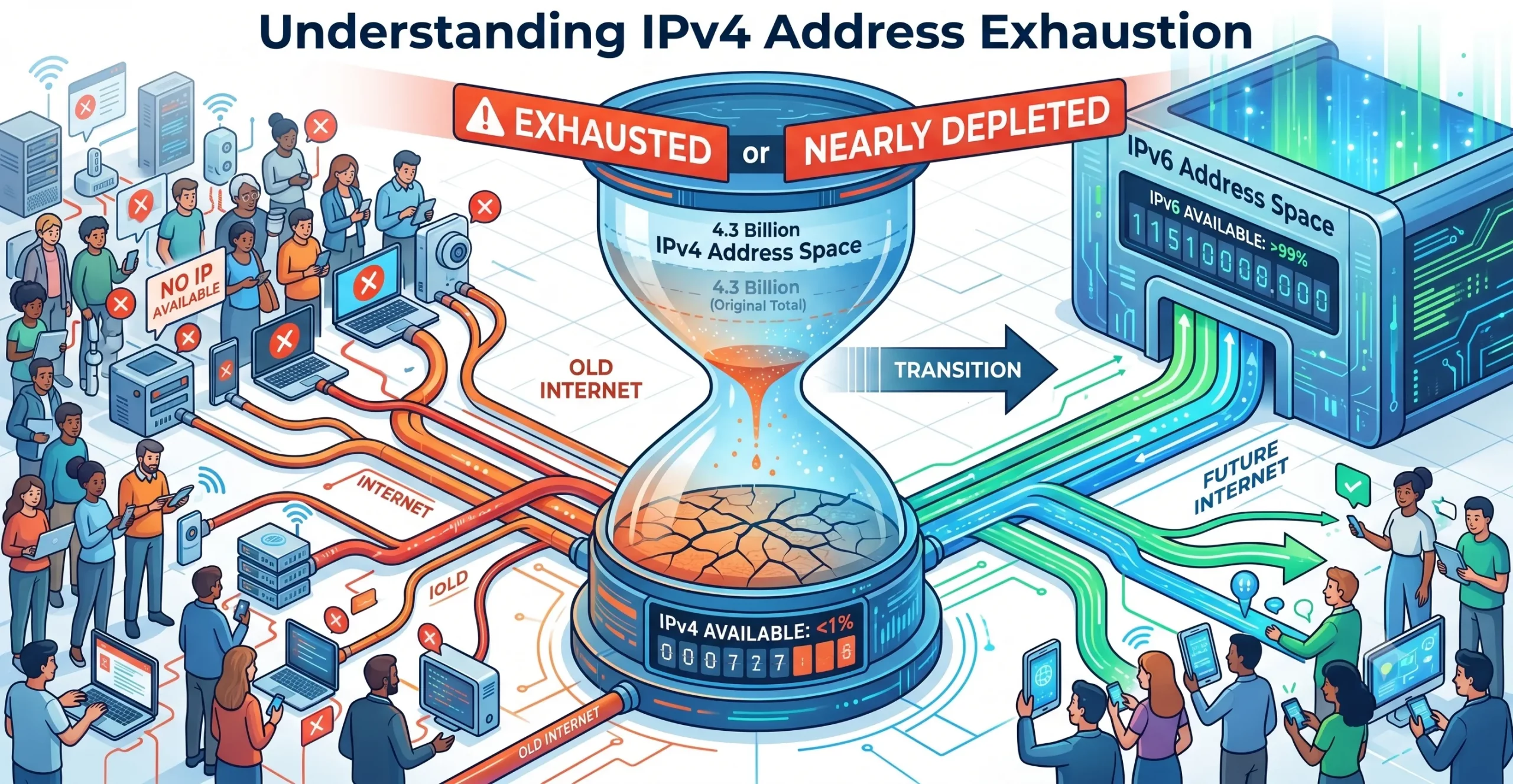
IPv4 address exhaustion refers to the depletion of freely available IPv4 addresses from the original global allocation pools. IPv4 uses a 32-bit address format, which provides about 4.3 billion possible addresses. That number was large enough in the early internet era, but it became limited as the internet expanded into cloud services, mobile networks, data centres, SaaS platforms, IoT, and global digital infrastructure.
Table of Contents
However, IPv4 exhaustion does not mean IPv4 has disappeared. IPv4 remains widely used across the internet. Businesses still buy IPv4, sell IPv4, lease IPv4, and operate IPv4 networks every day.
The practical issue is simple: new IPv4 addresses are no longer freely available in the same way they once were. Businesses that need IPv4 must now plan carefully, whether through transfers, marketplace purchases, or managed IPv4 leasing.
At i.lease, businesses can Buy IP, Sell IP, or use IPv4 Leasing to support infrastructure growth, continuity, and flexible access to address space.
What is IPv4 address exhaustion?
IPv4 address exhaustion means that the original supply of freely available IPv4 addresses has been depleted across the global internet registry system. IPv4 addresses are still in use, but new blocks are no longer widely available through simple allocation from Regional Internet Registries.
IPv4 uses a 32-bit addressing system. This creates about 4.3 billion possible addresses. In the early days of the internet, that seemed more than enough. Today, the internet supports billions of users, servers, mobile devices, cloud platforms, applications, and connected systems.
As demand increased, the available IPv4 pool became limited. This created a secondary market where organizations buy, sell, transfer, and lease IPv4 address space.
This is why IPv4 exhaustion should not be understood as “IPv4 is no longer useful.” A more accurate way to understand it is this: the original free allocation model has changed, but IPv4 remains active, valuable, and operationally important.
Evidence of IPv4 Address Exhaustion
IPv4 exhaustion is documented by IANA, the Number Resource Organization, and Regional Internet Registries. IPv4 uses a 32-bit address format, which provides about 4.3 billion possible addresses. As internet demand grew through cloud services, mobile networks, hosting, SaaS platforms, data centres, and connected devices, this fixed supply became insufficient for global demand.
The global IPv4 exhaustion milestone occurred on 3 February 2011, when IANA allocated the final IPv4 address blocks to the five Regional Internet Registries. The Number Resource Organization announced that the central free pool of available IPv4 addresses was fully depleted on that date.
Regional exhaustion followed in stages. APNIC reached its Final /8 IPv4 address block on 15 April 2011, bringing the Asia Pacific region into the final stage of IPv4 exhaustion. ARIN issued the final IPv4 addresses in its free pool on 24 September 2015. RIPE NCC made its final /22 IPv4 allocation from its available pool on 25 November 2019 and stated that it had run out of IPv4 addresses.
AFRINIC entered IPv4 Exhaustion Phase 2 on 13 January 2020 after an IPv4 approval left no more than a /11 of non-reserved space available in its Final /8 pool.
These milestones show that IPv4 exhaustion does not mean IPv4 disappeared. It means the original free allocation model changed. IPv4 remains active, transferable, leasable, and operationally important for businesses that still need public IPv4 connectivity.
| Milestone | Date | What happened |
|---|---|---|
| IANA central IPv4 free pool depleted | 3 February 2011 | IANA allocated the final IPv4 blocks to the five Regional Internet Registries. |
| APNIC reached Final /8 | 15 April 2011 | Asia Pacific entered the final stage of IPv4 exhaustion. |
| ARIN IPv4 free pool depleted | 24 September 2015 | ARIN issued the final IPv4 addresses in its free pool. |
| RIPE NCC ran out of IPv4 addresses | 25 November 2019 | RIPE NCC made its final /22 allocation from its available IPv4 pool. |
| AFRINIC entered Exhaustion Phase 2 | 13 January 2020 | AFRINIC entered Phase 2 after remaining non-reserved space dropped to no more than a /11. |
Supporting references:
- Number Resource Organization: IPv4 Free Pool Depleted
- APNIC: APNIC reaches final /8 IPv4 address block
- ARIN: ARIN IPv4 Free Pool Reaches Zero
- RIPE NCC: RIPE NCC has run out of IPv4 Addresses
- AFRINIC: AFRINIC enters IPv4 Exhaustion Phase 2
Why did IPv4 addresses run out?
IPv4 addresses ran out because the internet grew far beyond the scale expected when IPv4 was designed. More businesses, networks, devices, and online services needed public address space.
Several factors contributed to IPv4 exhaustion:
- Rapid internet growth worldwide
- Expansion of cloud computing and hosting
- Growth of mobile networks and connected devices
- Demand from data centres and SaaS platforms
- Large historical allocations made before modern conservation policies
- Slower-than-expected global transition to IPv6
IPv4 exhaustion is therefore not only a technical issue. It is also a business planning issue. Companies that need public IPv4 connectivity must now think about cost, availability, transfer process, routing, reputation, and continuity.
Does IPv4 exhaustion mean IPv4 is dead?
No. IPv4 exhaustion does not mean IPv4 is dead. It means the free supply of new IPv4 addresses is exhausted or highly restricted.
IPv4 is still widely used for websites, hosting, email, VPNs, enterprise networks, ISPs, data centres, cloud platforms, and customer-facing services. Many businesses still depend on IPv4 because not all users, systems, and networks are fully IPv6-ready.
This is an important distinction. IPv4 exhaustion created a market, not an immediate replacement. IPv4 addresses continue to support real infrastructure, customers, and revenue.
In practical business terms, IPv4 has moved beyond a low-value administrative record. It functions as an operational resource for networks that depend on public reachability, routing, compatibility, and service continuity.
How IPv4 exhaustion affects businesses
IPv4 exhaustion affects businesses because public IPv4 addresses are still needed, but they are harder to obtain through traditional allocation.
Common business impacts include:
- Higher planning cost: Businesses must budget for IPv4 purchases, leasing, or transfer services.
- Longer sourcing process: Finding clean and usable IPv4 space can take time.
- Reputation checks: Companies must check whether IP ranges have blacklist, spam, or abuse history.
- Routing preparation: IPv4 blocks must be announced and routed correctly.
- IPv6 transition pressure: Businesses may need to support both IPv4 and IPv6 at the same time.
- Continuity risk: Poorly sourced or poorly managed IP space can affect service availability.
For infrastructure-heavy businesses, IPv4 availability can influence deployment timelines, customer onboarding, regional expansion, and service continuity.
IPv4 exhaustion and IPv6 adoption
IPv6 was developed to provide a much larger address space and support long-term internet growth. It is important for future network planning, especially as more devices and services come online.
However, IPv6 has not fully replaced IPv4. Many businesses still operate in dual-stack environments, where IPv4 and IPv6 run together. This allows them to support IPv6-ready users while maintaining compatibility with IPv4 users and systems.
For i.lease, the balanced message is important: IPv6 matters for the future, but IPv4 still matters for present-day operations. Businesses should prepare for IPv6 without assuming IPv4 can be removed too early.
Business options after IPv4 exhaustion
After IPv4 exhaustion, businesses usually have three main options:
- Buy IPv4 addresses for long-term control
- Sell unused IPv4 addresses to unlock asset value
- Lease IPv4 addresses for flexible access without a large upfront purchase
The best option depends on the company’s budget, timeline, infrastructure plan, and operational needs.
Practical note from i.lease
IPv4 exhaustion does not mean IPv4 is unusable. It means businesses need a more structured way to access, transfer, lease, or monetize IPv4 address space. Before buying or leasing IPv4, review IP reputation, routing readiness, registry requirements, LOA support, and contract terms. Public IPv4 addresses support real infrastructure, so continuity and source quality matter.
Buy IPv4 addresses
Buying IPv4 addresses may be suitable for organizations that need long-term control over address space. This can include data centres, hosting providers, telecom networks, cloud platforms, SaaS companies, and enterprises with stable infrastructure needs.
Businesses can Buy IP Address through i.lease when they need structured access to IPv4 address blocks, transfer support, and marketplace guidance.
Before buying IPv4 addresses, businesses should check seller authority, registry transfer requirements, IP reputation, routing readiness, escrow protection, and documentation.
Sell IPv4 addresses
Some organizations hold unused or underused IPv4 resources. Because IPv4 remains valuable in the market, these organizations may choose to sell address space and convert it into capital.
Organizations can Sell IP Address through i.lease if they want to monetize unused IPv4 blocks through a structured process.
Sellers should prepare accurate registry records, proof of control, block-size information, reputation checks, and transfer eligibility details. A clean and well-documented IPv4 block is easier for buyers to evaluate.
Lease IPv4 Addresses
IPv4 leasing is often useful for businesses that need flexibility. Instead of buying address space outright, a company can lease IPv4 addresses for hosting, VPN services, data centres, cloud infrastructure, enterprise connectivity, or temporary projects.
i.lease provides IPv4 Leasing for businesses that need managed access to IPv4 resources without committing to a full purchase.
Leasing may be suitable when:
- The business needs IPv4 quickly
- The project is temporary or scalable
- The company wants lower upfront cost
- The network needs IPv4 continuity during IPv6 transition
- The business prefers managed support for documentation and setup
IPv4 leasing should not be described only as “cheap IP rental.” For businesses, leasing is also a continuity tool. It helps organizations access operational address space while managing cost, routing, reputation, and flexibility.
Final thoughts
IPv4 address exhaustion means the original free supply of IPv4 addresses has been depleted. But IPv4 itself remains active and important. Businesses still use IPv4 for hosting, cloud infrastructure, VPNs, data centres, email, SaaS platforms, and customer-facing services.
The practical response is not to ignore IPv6 or panic about IPv4. Businesses should understand their actual network needs, prepare for IPv6 where appropriate, and secure IPv4 access where operational continuity still depends on it.
Frequent Asked Questions
What is IPv4 address exhaustion?
IPv4 address exhaustion means the original supply of freely available IPv4 addresses has been depleted. IPv4 addresses are still used, but businesses usually need to buy, transfer, or lease them through structured channels.
Why did IPv4 addresses run out?
IPv4 uses a 32-bit address format, which provides about 4.3 billion possible addresses. Global internet growth, cloud platforms, mobile networks, hosting, and connected devices increased demand beyond the original supply.
Is IPv4 still used today?
Yes. IPv4 is still widely used for websites, hosting, email, VPNs, data centres, cloud services, ISPs, and enterprise networks.
Does IPv6 solve IPv4 exhaustion?
IPv6 provides a much larger address space, but it has not fully replaced IPv4. Many businesses still need IPv4 and IPv6 together in dual-stack environments.
Can businesses still buy IPv4 addresses?
Yes. Businesses can buy IP Addresses through marketplace and transfer processes if they need long-term IPv4 address control.
Can companies sell Unused IPv4 addresses?
Yes. Organizations with unused or underused IPv4 blocks can sell IP to monetize their address space.
Is IPv4 leasing a good option after IPv4 exhaustion?
IPv4 leasing can be useful for businesses that need flexible access to IPv4 addresses without buying them outright. i.lease provides IPv4 leasing for managed IPv4 access.
What should I check before buying or leasing IPv4?
You should check IP reputation, blacklist history, routing readiness, LOA support, registry requirements, contract terms, acceptable-use rules, and provider reliability.
Related Posts
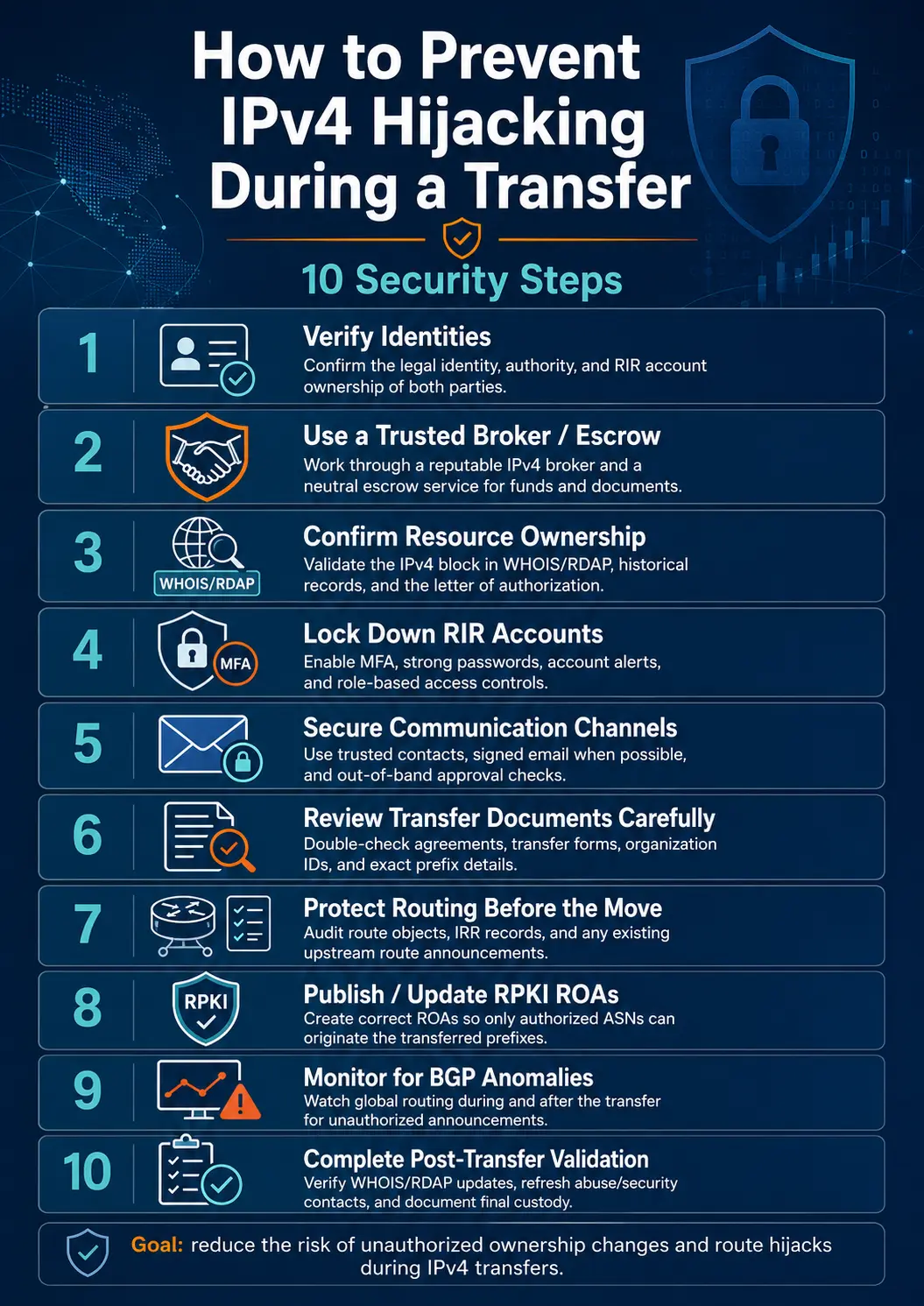
How to Prevent IPv4 Hijacking During a Transfer: 10 Security Steps
Transferring IPv4 address space is not only a commercial and registry process. It is also a sensitive routing operation. During an IPv4 transfer, control of a prefix moves from one organization to another. Registry records, Route Origin Authorizations, Internet Routing Registry objects, upstream-provider filters, reverse DNS settings, and live BGP announcements may all need to change. When these changes are completed in the wrong order—or when identity and authorizationRead more Related Posts How to Prevent IPv4 Hijacking During a Transfer: 10 Security Steps Transferring IPv4 address space is not only a commercial and registry process. It is also a sensitive routing operation. During Why the Cheapest IPv4 Lease May Cost More in the Long Run A low monthly price may look attractive during procurement, but the real cost of leased IPv4 addresses includes much more What Is a /24 IPv4 Subnet and Why Is It Popular for Leasing? A /24 IPv4 subnet is one of the most common block sizes in the IPv4 leasing market. For hosting providers, .related-post {} .related-post .post-list { text-align: left; } .related-post .post-list .item { margin: 5px; padding: 10px; } .related-post .headline { font-size: 18px !important; color: #999999 !important; } .related-post .post-list .item .post_thumb { max-height: 220px; margin: 10px 0px; padding: 0px; display: block; } .related-post .post-list .item .post_title { font-size: 16px; color: #3f3f3f; margin: 10px 0px; padding: 0px; display: block; text-decoration: none; } .related-post .post-list .item .post_excerpt { font-size: 13px; color: #3f3f3f; margin: 10px 0px; padding: 0px; display: block; text-decoration: none; } @media only screen and (min-width: 1024px) { .related-post .post-list .item { width: 30%; } } @media only screen and (min-width: 768px) and (max-width: 1023px) { .related-post .post-list .item { width: 90%; } } @media only screen and (min-width: 0px) and (max-width: 767px) { .related-post .post-list .item { width: 90%; } }
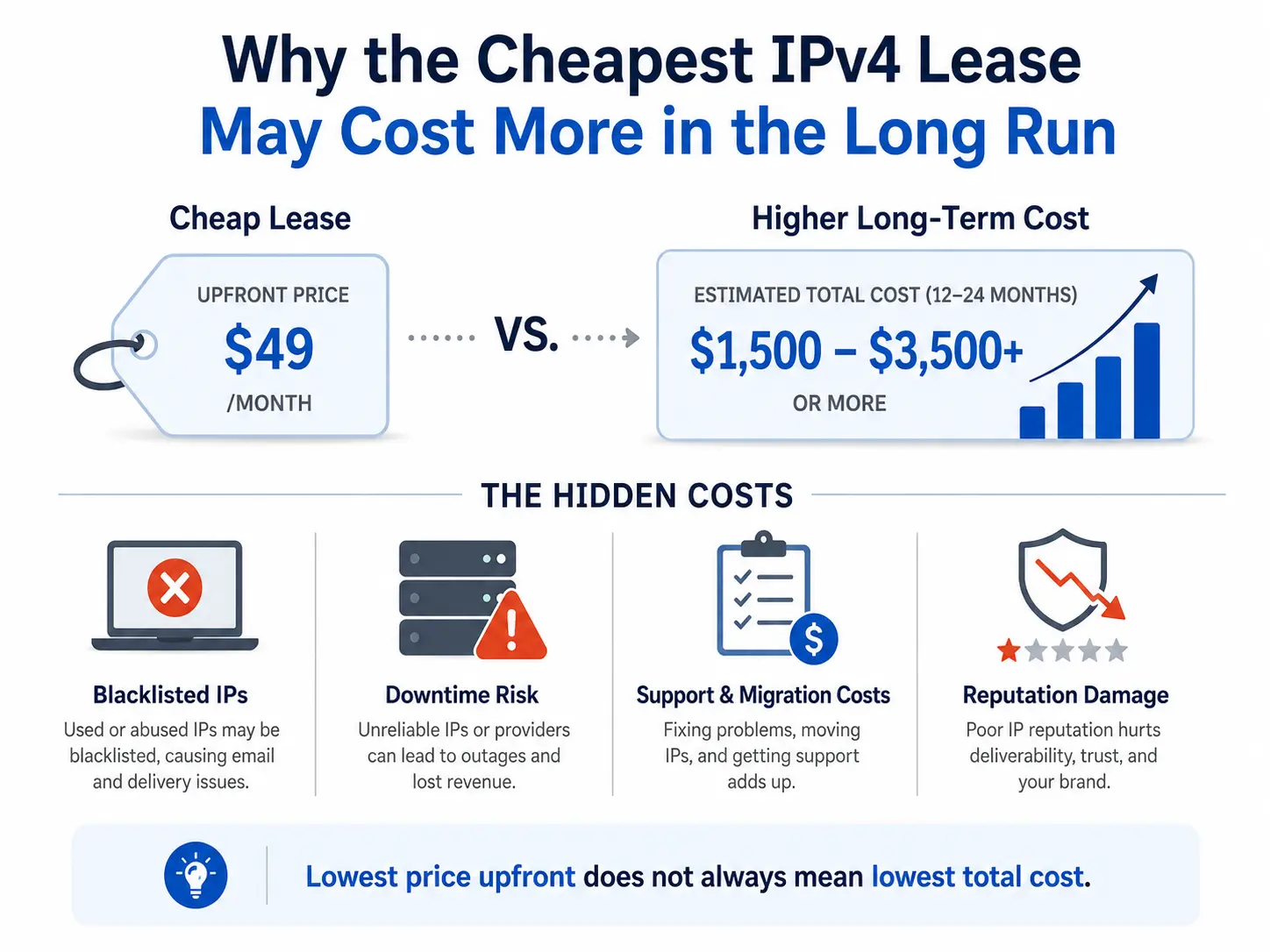
Why the Cheapest IPv4 Lease May Cost More in the Long Run
A low monthly price may look attractive during procurement, but the real cost of leased IPv4 addresses includes much more than the advertised rate. Poor IP reputation, incomplete routing authorisation, deployment delays, weak technical support, incorrect geolocation and uncertain renewal terms can quickly erase the initial saving. For testing or short-lived projects, a basic low-cost IPv4 lease may be sufficient. For production networks, however, businesses should evaluate the totalRead more Related Posts How to Prevent IPv4 Hijacking During a Transfer: 10 Security Steps Transferring IPv4 address space is not only a commercial and registry process. It is also a sensitive routing operation. During Why the Cheapest IPv4 Lease May Cost More in the Long Run A low monthly price may look attractive during procurement, but the real cost of leased IPv4 addresses includes much more What Is a /24 IPv4 Subnet and Why Is It Popular for Leasing? A /24 IPv4 subnet is one of the most common block sizes in the IPv4 leasing market. For hosting providers, .related-post {} .related-post .post-list { text-align: left; } .related-post .post-list .item { margin: 5px; padding: 10px; } .related-post .headline { font-size: 18px !important; color: #999999 !important; } .related-post .post-list .item .post_thumb { max-height: 220px; margin: 10px 0px; padding: 0px; display: block; } .related-post .post-list .item .post_title { font-size: 16px; color: #3f3f3f; margin: 10px 0px; padding: 0px; display: block; text-decoration: none; } .related-post .post-list .item .post_excerpt { font-size: 13px; color: #3f3f3f; margin: 10px 0px; padding: 0px; display: block; text-decoration: none; } @media only screen and (min-width: 1024px) { .related-post .post-list .item { width: 30%; } } @media only screen and (min-width: 768px) and (max-width: 1023px) { .related-post .post-list .item { width: 90%; } } @media only screen and (min-width: 0px) and (max-width: 767px) { .related-post .post-list .item { width: 90%; } }
What causes IPv4 deals to stall after the first agreement
IPv4 deals usually stall after the first agreement because agreeing on price is only the commercial beginning—not operational completion. A buyer and seller may agree on a block and price within hours, but the transaction can still be delayed by unclear ownership, incomplete documents, mismatched Regional Internet Registry requirements, recipient eligibility, reputation concerns, payment conditions, or missing routing authorization. The most common causes are: The seller’s authority over theRead more Related Posts How to Prevent IPv4 Hijacking During a Transfer: 10 Security Steps Transferring IPv4 address space is not only a commercial and registry process. It is also a sensitive routing operation. During Why the Cheapest IPv4 Lease May Cost More in the Long Run A low monthly price may look attractive during procurement, but the real cost of leased IPv4 addresses includes much more What Is a /24 IPv4 Subnet and Why Is It Popular for Leasing? A /24 IPv4 subnet is one of the most common block sizes in the IPv4 leasing market. For hosting providers, .related-post {} .related-post .post-list { text-align: left; } .related-post .post-list .item { margin: 5px; padding: 10px; } .related-post .headline { font-size: 18px !important; color: #999999 !important; } .related-post .post-list .item .post_thumb { max-height: 220px; margin: 10px 0px; padding: 0px; display: block; } .related-post .post-list .item .post_title { font-size: 16px; color: #3f3f3f; margin: 10px 0px; padding: 0px; display: block; text-decoration: none; } .related-post .post-list .item .post_excerpt { font-size: 13px; color: #3f3f3f; margin: 10px 0px; padding: 0px; display: block; text-decoration: none; } @media only screen and (min-width: 1024px) { .related-post .post-list .item { width: 30%; } } @media only screen and (min-width: 768px) and (max-width: 1023px) { .related-post .post-list .item { width: 90%; } } @media only screen and (min-width: 0px) and (max-width: 767px) { .related-post .post-list .item { width: 90%; } }
