The backbone of the Internet: Common Internet Infrastructure
 Chan
Chan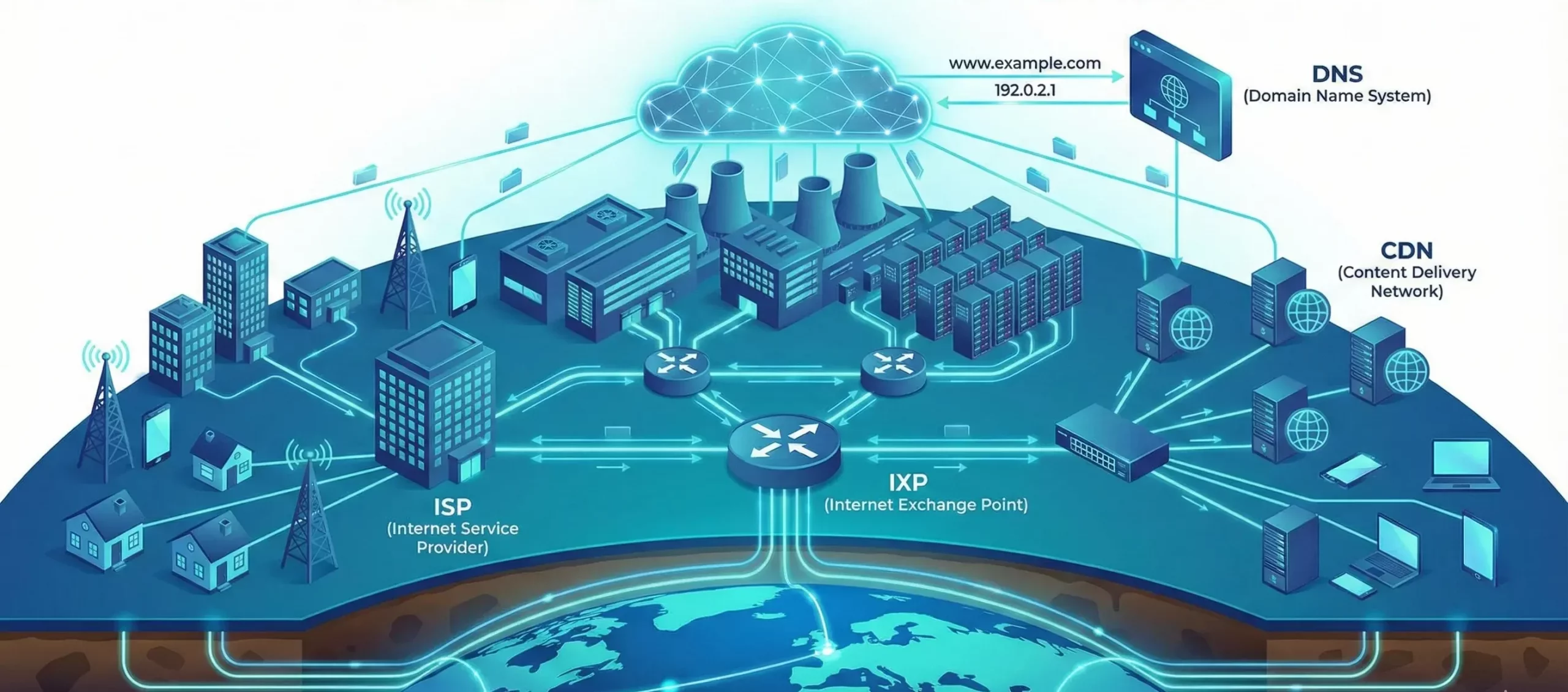
The Internet is essential to modern life, connecting billions of people and devices worldwide. But have you ever wondered what makes it work? The Internet relies on a complex infrastructure of physical and digital components that work together seamlessly. Let’s dive into the key elements that power the global web.
Table of Contents
Physical Internet Infrastructure: The Internet’s Highway
The Internet relies on physical hardware to transmit data across the globe. These include:
- Fiber-Optic Cables – The backbone of Internet connectivity, carrying data at high speeds across cities, countries, and even oceans.
- Submarine Cables – Underwater fiber-optic cables that connect continents, ensuring global data exchange.
- Data Centers – Large facilities housing servers that store, process, and distribute data for websites, apps, and cloud services.
- Internet Exchange Points (IXPs) – Critical hubs where different networks interconnect, improving efficiency and reducing data transmission delays.
- Satellite Networks – Used to provide Internet access in remote areas where fiber or traditional cables are not feasible.
Networking Components: Brains Behind Connectivity
Beyond the physical hardware, various networking devices help route and manage Internet traffic:
- Routers – Direct data packets between different networks, determining the best path for transmission.
- Switches – Connect devices within a local network, facilitating internal communication.
- Modems – Convert digital signals for transmission over telephone or fiber-optic lines.
- Load Balancers – Distribute incoming traffic across multiple servers to prevent overload and enhance performance.
Internet Service Providers (ISPs): The Gateway to the Web
ISPs are companies that provide Internet access to users. They operate on different levels:
- Tier 1 ISPs – Large global providers that form the core Internet backbone.
- Tier 2 ISPs – Regional providers that connect to Tier 1 networks.
- Tier 3 ISPs – Local ISPs that deliver Internet services directly to homes and businesses.
Protocols and Standards: The Language of the Internet
To ensure smooth communication, the Internet operates on standardized protocols:
- Transmission Control Protocol/Internet Protocol (TCP/IP) – The foundation of data exchange, ensuring information is sent and received accurately.
- Domain Name System (DNS) – Translates human-readable web addresses (e.g., google.com) into machine-readable IP addresses.
- Hypertext Transfer Protocol (HTTP/HTTPS) – Governs web browsing and data exchange over the web.
- Border Gateway Protocol (BGP) – Helps ISPs determine the best path for routing Internet traffic.
- Simple Mail Transfer Protocol (SMTP) – Enables email communication between servers.
Cloud Computing & Content Delivery: Speeding Up the Web
With increasing demand for speed and efficiency, cloud services and content delivery networks (CDNs) play a major role:
- Cloud Services (AWS, Google Cloud, Azure) – Offer storage, computing power, and infrastructure over the Internet.
- Content Delivery Networks (CDNs) – Store cached content across global servers to reduce load times and improve website performance.
Cybersecurity & Governance: Keeping the Internet Safe
To maintain security and stability, various systems and organizations manage Internet governance:
- Firewalls – Protect networks by filtering unauthorized traffic.
- Virtual Private Networks (VPNs) – Encrypt Internet connections to enhance privacy and security.
- Regulatory Bodies (ICANN, IETF, ITU) – Oversee domain name registration, protocol development, and global Internet policies.
Final Thoughts: Internet Infrastructure
The Internet is more than just websites and social media; it’s a vast and intricate system powered by physical and digital infrastructure. From fiber-optic cables to cloud computing, every component plays a crucial role in keeping the world connected. As technology evolves, so will the Internet’s backbone, paving the way for faster and more efficient global communication.
Trusted IPv4 Leasing for Business Growth
Get enterprise-grade IPv4 space quickly, with seamless deployment and end-to-end management.
Get Started with i.leaseArticles connexes

Primauté du code en cours d’exécution : pourquoi la location d’adresses IPv4 doit être jugée sur la base de preuves opérationnelles
La location IPv4 commence souvent par une question simple : Ce fournisseur peut-il nous fournir les adresses ? Mais pour les entreprises qui dépendent de l’IPv4 pour l’hébergement, le VPN, le SaaS, le cloud, les télécommunications, la sécurité, la livraison d’e-mails ou les plateformes destinées aux clients, cette question ne suffit pas. Une meilleure question est : Cette structure IPv4 peut-elle prouver qu’elle fonctionne sur le plan opérationnel ?Read more Related Posts La Running-Code Primacy: por qué el arrendamiento de IPv4 debe juzgarse mediante pruebas operativas El arrendamiento de IPv4 suele comenzar con una pregunta simple: ¿Puede este proveedor darnos las direcciones? Pero para las empresas Read more Risques liés au renouvellement d’IPv4 : quand le manque de responsabilisation se transforme en trahison du code en cours d’exécution La plupart des entreprises entrent sur le marché IPv4 avec un objectif simple. Elles ont besoin d’adresses. Peut-être en ont-elles Read more Pourquoi la plupart des entreprises sont exposées accidentellement au risque d’échec d’attribution d’adresse IPv4 La rareté de l’IPv4 est largement comprise. Ce que de nombreuses entreprises sous-estiment encore, c’est le risque de continuité lié Read more .related-post {} .related-post .post-list { text-align: left; } .related-post .post-list .item { margin: 5px; padding: 10px; } .related-post .headline { font-size: 18px !important; color: #999999 !important; } .related-post .post-list .item .post_thumb { max-height: 220px; margin: 10px 0px; padding: 0px; display: block; } .related-post .post-list .item .post_title { font-size: 16px; color: #3f3f3f; margin: 10px 0px; padding: 0px; display: block; text-decoration: none; } .related-post .post-list .item .post_excerpt { font-size: 13px; color: #3f3f3f; margin: 10px 0px; padding: 0px; display: block; text-decoration: none; } @media only screen and (min-width: 1024px) { .related-post .post-list .item { width: 30%; } } @media only screen and (min-width: 768px) and (max-width: 1023px) { .related-post .post-list .item { width: 90%; } } @media only screen and (min-width: 0px) and (max-width: 767px) { .related-post .post-list .item { width: 90%; } }
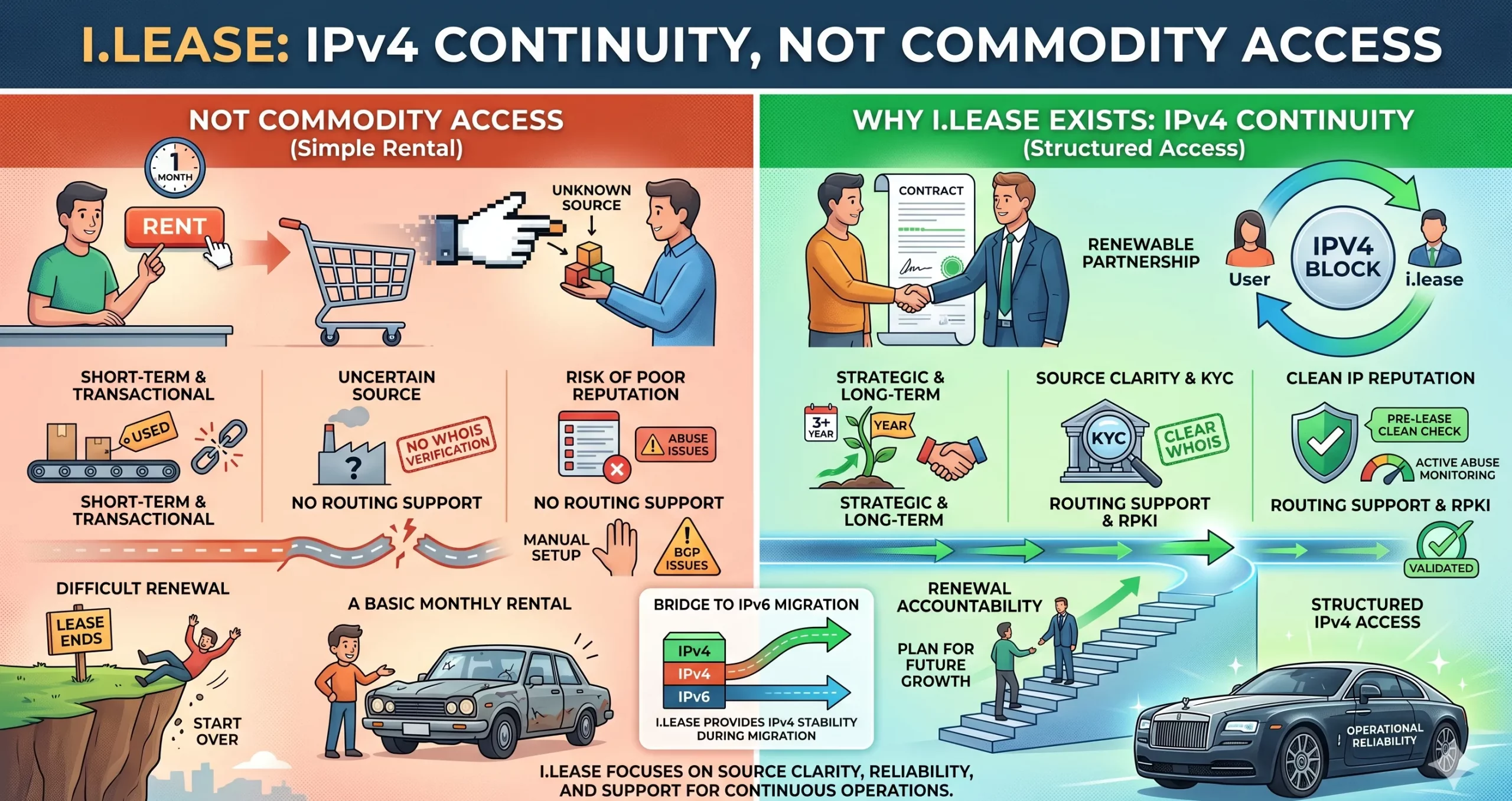
Risques liés au renouvellement d’IPv4 : quand le manque de responsabilisation se transforme en trahison du code en cours d’exécution
La plupart des entreprises entrent sur le marché IPv4 avec un objectif simple. Elles ont besoin d’adresses. Peut-être en ont-elles besoin pour l’hébergement. Peut-être en ont-elles besoin pour une infrastructure VPN. Peut-être en ont-elles besoin pour des services cloud, des plateformes SaaS, l’expansion télécom, des systèmes e-mail, des outils de cybersécurité ou des applications destinées aux clients. Elles recherchent donc un fournisseur IPv4. Elles comparent les prix. Elles vérifientRead more Related Posts Risk Placement in IPv4 Transactions: What Enterprises Should Know The IPv4 market has quietly evolved into a structured secondary asset class. As global IPv4 exhaustion continues, enterprises, ISPs, and Read more Understanding Operational Risk in IPv4 Address Markets IPv4 has long stopped being a simple technical identifier system. It has become a constrained, priced, and operationally embedded infrastructure Read more Primauté du code en cours d’exécution : pourquoi la location d’adresses IPv4 doit être jugée sur la base de preuves opérationnelles La location IPv4 commence souvent par une question simple :Ce fournisseur peut-il nous fournir les adresses ?Mais pour les entreprises Read more .related-post {} .related-post .post-list { text-align: left; } .related-post .post-list .item { margin: 5px; padding: 10px; } .related-post .headline { font-size: 18px !important; color: #999999 !important; } .related-post .post-list .item .post_thumb { max-height: 220px; margin: 10px 0px; padding: 0px; display: block; } .related-post .post-list .item .post_title { font-size: 16px; color: #3f3f3f; margin: 10px 0px; padding: 0px; display: block; text-decoration: none; } .related-post .post-list .item .post_excerpt { font-size: 13px; color: #3f3f3f; margin: 10px 0px; padding: 0px; display: block; text-decoration: none; } @media only screen and (min-width: 1024px) { .related-post .post-list .item { width: 30%; } } @media only screen and (min-width: 768px) and (max-width: 1023px) { .related-post .post-list .item { width: 90%; } } @media only screen and (min-width: 0px) and (max-width: 767px) { .related-post .post-list .item { width: 90%; } }
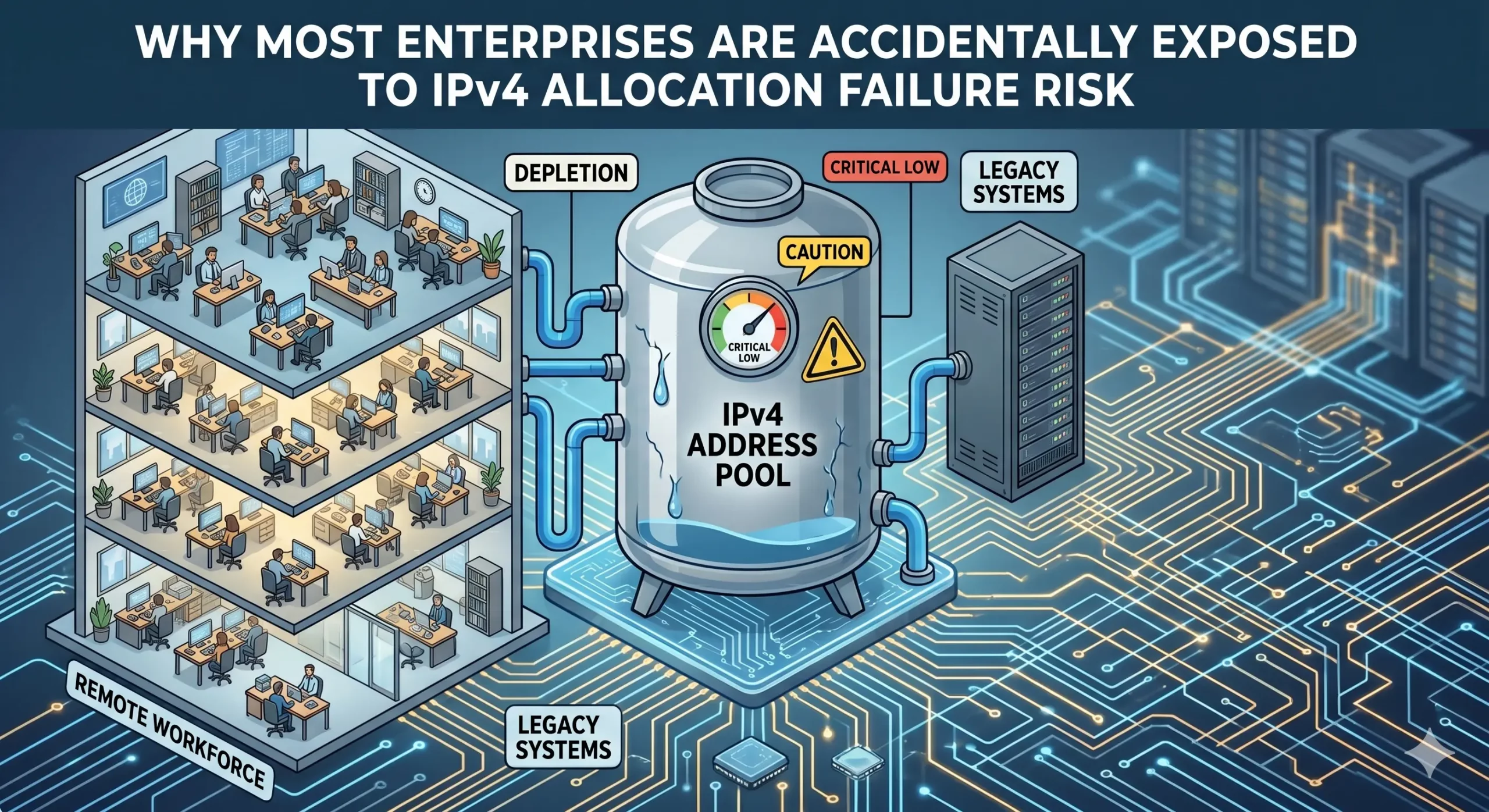
Pourquoi la plupart des entreprises sont exposées accidentellement au risque d’échec d’attribution d’adresse IPv4
La rareté de l’IPv4 est largement comprise. Ce que de nombreuses entreprises sous-estiment encore, c’est le risque de continuité lié à la manière dont les ressources d’adressage sont gouvernées et maintenues. Les entreprises maintiennent souvent une utilisation opérationnelle des ressources IPv4 sans disposer d’une visibilité complète sur les conditions de continuité qui soutiennent ces allocations. La dépendance croissante à la location, aux transferts et aux infrastructures gérées par desRead more Related Posts Risk Placement in IPv4 Transactions: What Enterprises Should Know The IPv4 market has quietly evolved into a structured secondary asset class. As global IPv4 exhaustion continues, enterprises, ISPs, and Read more Understanding Operational Risk in IPv4 Address Markets IPv4 has long stopped being a simple technical identifier system. It has become a constrained, priced, and operationally embedded infrastructure Read more Primauté du code en cours d’exécution : pourquoi la location d’adresses IPv4 doit être jugée sur la base de preuves opérationnelles La location IPv4 commence souvent par une question simple :Ce fournisseur peut-il nous fournir les adresses ?Mais pour les entreprises Read more .related-post {} .related-post .post-list { text-align: left; } .related-post .post-list .item { margin: 5px; padding: 10px; } .related-post .headline { font-size: 18px !important; color: #999999 !important; } .related-post .post-list .item .post_thumb { max-height: 220px; margin: 10px 0px; padding: 0px; display: block; } .related-post .post-list .item .post_title { font-size: 16px; color: #3f3f3f; margin: 10px 0px; padding: 0px; display: block; text-decoration: none; } .related-post .post-list .item .post_excerpt { font-size: 13px; color: #3f3f3f; margin: 10px 0px; padding: 0px; display: block; text-decoration: none; } @media only screen and (min-width: 1024px) { .related-post .post-list .item { width: 30%; } } @media only screen and (min-width: 768px) and (max-width: 1023px) { .related-post .post-list .item { width: 90%; } } @media only screen and (min-width: 0px) and (max-width: 767px) { .related-post .post-list .item { width: 90%; } }
