The Role of BYOIP in Preventing IP Blocking
 Stephanie
In today’s digital landscape, businesses and organizations rely heavily on seamless connectivity and secure access to online resources. However, IP blocking has become a common challenge, often disrupting operations, limiting access to critical platforms, and even affecting business continuity. One innovative solution to this problem is Bring Your Own IP (BYOIP), a strategy that allows organizations to retain control over their IP addresses and mitigate the risks associated with IP blocking.
Table of Contents
Understanding IP Blocking
P blocking is a security mechanism used by websites, services, and network administrators to restrict access from specific IP addresses. This can happen for various reasons, including:
- Geolocation Restrictions: Some services block IPs from certain regions to comply with regulatory requirements or content licensing agreements.
- Security Measures: Websites and APIs often block IPs that exhibit suspicious activity, such as excessive login attempts or high-frequency requests.
- Spam Prevention: Email service providers may blacklist IPs suspected of sending spam or malicious content.
- Traffic Management: Some platforms impose rate limits or block certain IPs to prevent abuse or overload on their servers.
For businesses that rely on uninterrupted online access, IP blocking can be highly disruptive, leading to operational inefficiencies and potential revenue loss.
What is BYOIP?
Bring Your Own IP (BYOIP) is a networking strategy that enables businesses to bring their own pre-owned, provider-independent IP addresses to cloud service providers, content delivery networks (CDNs), or internet service providers (ISPs). Instead of using dynamically assigned IPs from third-party providers, organizations retain full control over their IP space.
Major cloud providers such as AWS, Azure, and Google Cloud support BYOIP, allowing businesses to migrate and advertise their IP addresses over the provider’s infrastructure. This ensures continuity of services without the risk of frequently changing or blocked IPs.
How BYOIP Helps Prevent IP Blocking
- Consistency and Reputation Management
- Businesses that use dynamically assigned IPs from cloud providers often inherit the history and reputation of those addresses. A previously misused IP may be blacklisted, causing disruptions. BYOIP allows companies to maintain a consistent, trusted IP address, reducing the risk of being flagged as suspicious.
- Avoiding Blacklisted or Shared IPs
- Many public cloud services assign shared IPs to multiple users. If another user engages in malicious activities, the IP may get blacklisted, affecting all users assigned to it. With BYOIP, businesses operate on clean, dedicated IPs that they fully control.
- Bypassing Regional Blocks
- Organizations operating in multiple regions may face geolocation-based restrictions. BYOIP enables them to maintain IPs that are recognized across global networks, ensuring continuous access to services regardless of location.
- Seamless Failover and Business Continuity
- If a business needs to migrate between service providers or regions, BYOIP ensures that their IP addresses remain the same, minimizing disruptions. This is particularly useful for SaaS companies, financial institutions, and global enterprises that depend on stable networking.
Implementing BYOIP for Your Organization
To take advantage of BYOIP, businesses should follow these steps:
- Acquire a Provider-Independent IP Address Range: Obtain IP addresses from a Regional Internet Registry (RIR) such as ARIN, RIPE NCC, or APNIC.
- Set Up Routing and Announcements: Work with a cloud provider or ISP to advertise your IP range using Border Gateway Protocol (BGP).
- Ensure Compliance with Cloud Providers: Each cloud platform has specific BYOIP requirements, so businesses must align their IP migration strategy with provider guidelines.
- Monitor and Maintain Reputation: Regularly check IP health using tools like Spamhaus and MXToolbox to ensure that the address remains in good standing.
Conclusion
As businesses continue to navigate the complexities of online connectivity, BYOIP emerges as a powerful solution to mitigate IP blocking risks. By providing greater control, security, and operational stability, BYOIP ensures that organizations can maintain access to critical services without interruptions. Whether for cloud migrations, security management, or global networking, adopting a BYOIP strategy is a forward-thinking move for any enterprise looking to safeguard its digital presence.
Trusted IPv4 Leasing for Business Growth
Get enterprise-grade IPv4 space quickly, with seamless deployment and end-to-end management.
Get Started with i.leaseArticles connexes

Primauté du code en cours d’exécution : pourquoi la location d’adresses IPv4 doit être jugée sur la base de preuves opérationnelles
La location IPv4 commence souvent par une question simple : Ce fournisseur peut-il nous fournir les adresses ? Mais pour les entreprises qui dépendent de l’IPv4 pour l’hébergement, le VPN, le SaaS, le cloud, les télécommunications, la sécurité, la livraison d’e-mails ou les plateformes destinées aux clients, cette question ne suffit pas. Une meilleure question est : Cette structure IPv4 peut-elle prouver qu’elle fonctionne sur le plan opérationnel ?Read more Related Posts La Running-Code Primacy: por qué el arrendamiento de IPv4 debe juzgarse mediante pruebas operativas El arrendamiento de IPv4 suele comenzar con una pregunta simple: ¿Puede este proveedor darnos las direcciones? Pero para las empresas Read more Risques liés au renouvellement d’IPv4 : quand le manque de responsabilisation se transforme en trahison du code en cours d’exécution La plupart des entreprises entrent sur le marché IPv4 avec un objectif simple. Elles ont besoin d’adresses. Peut-être en ont-elles Read more Pourquoi la plupart des entreprises sont exposées accidentellement au risque d’échec d’attribution d’adresse IPv4 La rareté de l’IPv4 est largement comprise. Ce que de nombreuses entreprises sous-estiment encore, c’est le risque de continuité lié Read more .related-post {} .related-post .post-list { text-align: left; } .related-post .post-list .item { margin: 5px; padding: 10px; } .related-post .headline { font-size: 18px !important; color: #999999 !important; } .related-post .post-list .item .post_thumb { max-height: 220px; margin: 10px 0px; padding: 0px; display: block; } .related-post .post-list .item .post_title { font-size: 16px; color: #3f3f3f; margin: 10px 0px; padding: 0px; display: block; text-decoration: none; } .related-post .post-list .item .post_excerpt { font-size: 13px; color: #3f3f3f; margin: 10px 0px; padding: 0px; display: block; text-decoration: none; } @media only screen and (min-width: 1024px) { .related-post .post-list .item { width: 30%; } } @media only screen and (min-width: 768px) and (max-width: 1023px) { .related-post .post-list .item { width: 90%; } } @media only screen and (min-width: 0px) and (max-width: 767px) { .related-post .post-list .item { width: 90%; } }
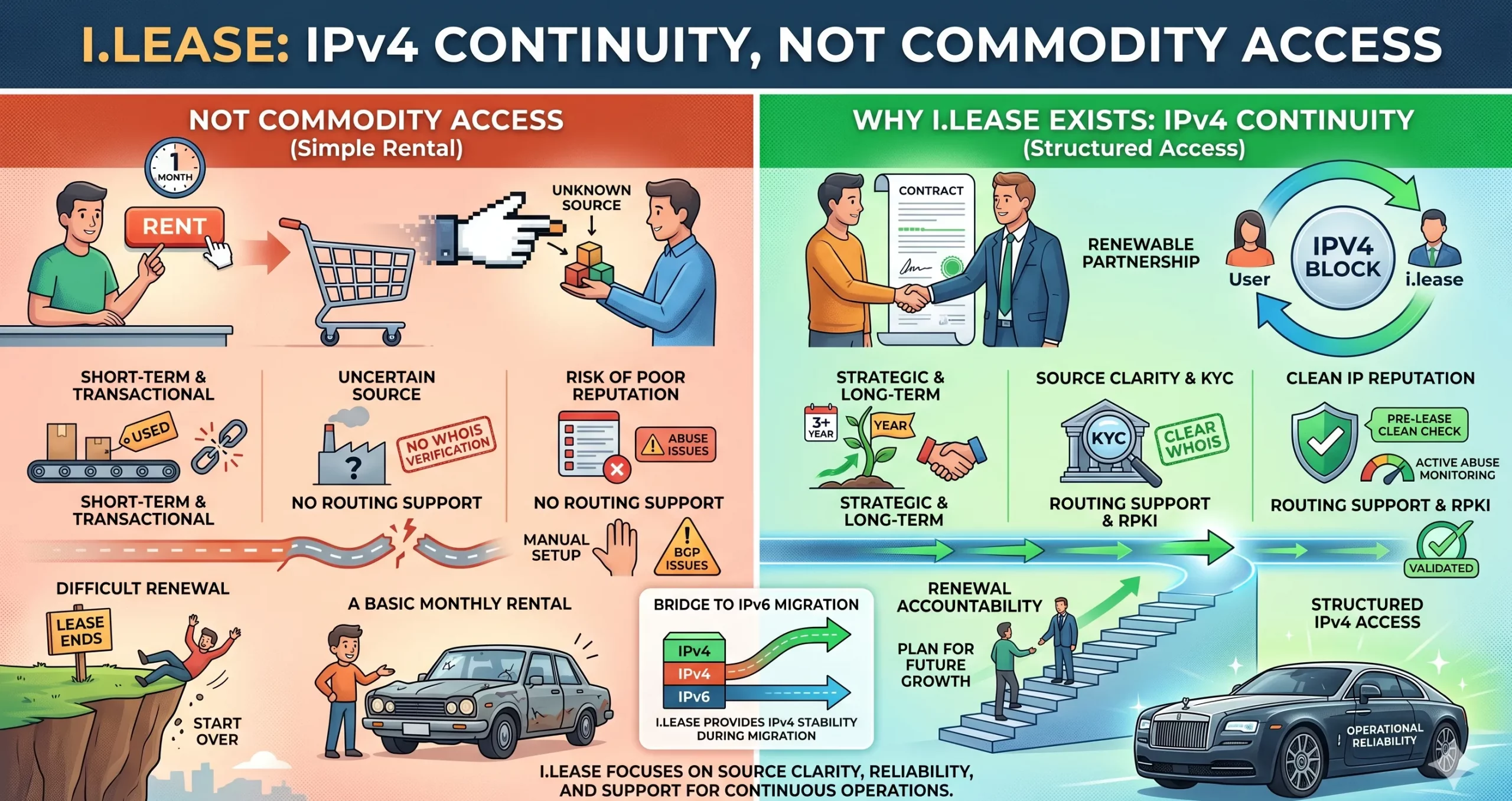
Risques liés au renouvellement d’IPv4 : quand le manque de responsabilisation se transforme en trahison du code en cours d’exécution
La plupart des entreprises entrent sur le marché IPv4 avec un objectif simple. Elles ont besoin d’adresses. Peut-être en ont-elles besoin pour l’hébergement. Peut-être en ont-elles besoin pour une infrastructure VPN. Peut-être en ont-elles besoin pour des services cloud, des plateformes SaaS, l’expansion télécom, des systèmes e-mail, des outils de cybersécurité ou des applications destinées aux clients. Elles recherchent donc un fournisseur IPv4. Elles comparent les prix. Elles vérifientRead more Related Posts Risk Placement in IPv4 Transactions: What Enterprises Should Know The IPv4 market has quietly evolved into a structured secondary asset class. As global IPv4 exhaustion continues, enterprises, ISPs, and Read more Understanding Operational Risk in IPv4 Address Markets IPv4 has long stopped being a simple technical identifier system. It has become a constrained, priced, and operationally embedded infrastructure Read more Primauté du code en cours d’exécution : pourquoi la location d’adresses IPv4 doit être jugée sur la base de preuves opérationnelles La location IPv4 commence souvent par une question simple :Ce fournisseur peut-il nous fournir les adresses ?Mais pour les entreprises Read more .related-post {} .related-post .post-list { text-align: left; } .related-post .post-list .item { margin: 5px; padding: 10px; } .related-post .headline { font-size: 18px !important; color: #999999 !important; } .related-post .post-list .item .post_thumb { max-height: 220px; margin: 10px 0px; padding: 0px; display: block; } .related-post .post-list .item .post_title { font-size: 16px; color: #3f3f3f; margin: 10px 0px; padding: 0px; display: block; text-decoration: none; } .related-post .post-list .item .post_excerpt { font-size: 13px; color: #3f3f3f; margin: 10px 0px; padding: 0px; display: block; text-decoration: none; } @media only screen and (min-width: 1024px) { .related-post .post-list .item { width: 30%; } } @media only screen and (min-width: 768px) and (max-width: 1023px) { .related-post .post-list .item { width: 90%; } } @media only screen and (min-width: 0px) and (max-width: 767px) { .related-post .post-list .item { width: 90%; } }

Pourquoi la plupart des entreprises sont exposées accidentellement au risque d’échec d’attribution d’adresse IPv4
La rareté de l’IPv4 est largement comprise. Ce que de nombreuses entreprises sous-estiment encore, c’est le risque de continuité lié à la manière dont les ressources d’adressage sont gouvernées et maintenues. Les entreprises maintiennent souvent une utilisation opérationnelle des ressources IPv4 sans disposer d’une visibilité complète sur les conditions de continuité qui soutiennent ces allocations. La dépendance croissante à la location, aux transferts et aux infrastructures gérées par desRead more Related Posts Risk Placement in IPv4 Transactions: What Enterprises Should Know The IPv4 market has quietly evolved into a structured secondary asset class. As global IPv4 exhaustion continues, enterprises, ISPs, and Read more Understanding Operational Risk in IPv4 Address Markets IPv4 has long stopped being a simple technical identifier system. It has become a constrained, priced, and operationally embedded infrastructure Read more Primauté du code en cours d’exécution : pourquoi la location d’adresses IPv4 doit être jugée sur la base de preuves opérationnelles La location IPv4 commence souvent par une question simple :Ce fournisseur peut-il nous fournir les adresses ?Mais pour les entreprises Read more .related-post {} .related-post .post-list { text-align: left; } .related-post .post-list .item { margin: 5px; padding: 10px; } .related-post .headline { font-size: 18px !important; color: #999999 !important; } .related-post .post-list .item .post_thumb { max-height: 220px; margin: 10px 0px; padding: 0px; display: block; } .related-post .post-list .item .post_title { font-size: 16px; color: #3f3f3f; margin: 10px 0px; padding: 0px; display: block; text-decoration: none; } .related-post .post-list .item .post_excerpt { font-size: 13px; color: #3f3f3f; margin: 10px 0px; padding: 0px; display: block; text-decoration: none; } @media only screen and (min-width: 1024px) { .related-post .post-list .item { width: 30%; } } @media only screen and (min-width: 768px) and (max-width: 1023px) { .related-post .post-list .item { width: 90%; } } @media only screen and (min-width: 0px) and (max-width: 767px) { .related-post .post-list .item { width: 90%; } }
