Are Host and IP Addresses the same?
 Chan
Chan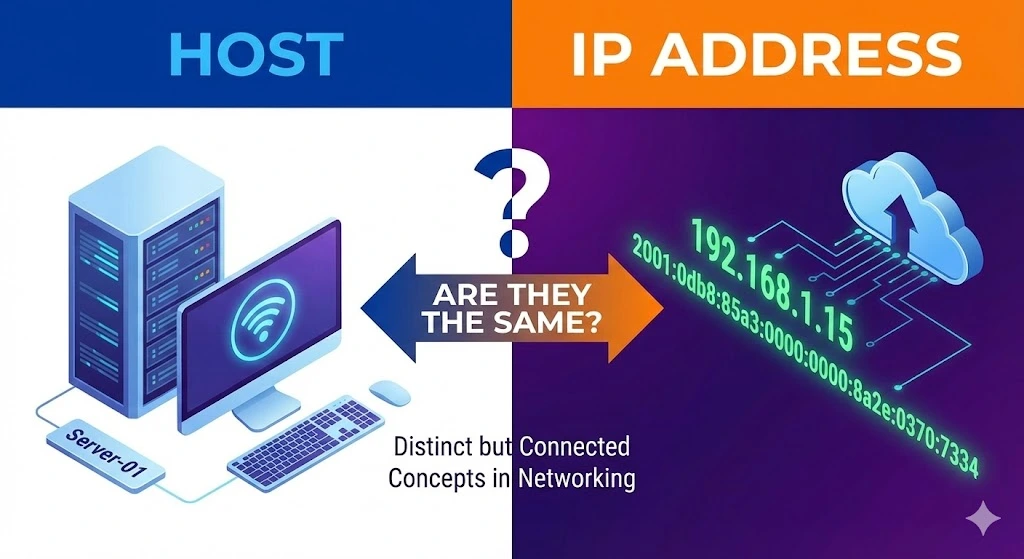
When learning the complexities of networking, you might encounter terms like “host” and “IP address” used frequently. These terms are fundamental to how devices communicate over the internet. While they are related, host and IP addresses are not the same. This article aims to clarify the differences and relationships between a host and an IP address, providing a comprehensive understanding of each term and their roles in network communication.
Table of Contents
What are IP Addresses?
IP Address (Internet Protocol Address) is a unique identifier assigned to each device connected to a network that uses the Internet Protocol for communication. Think of an IP address as a digital address that helps to locate and identify devices on a network. IP addresses are crucial for routing and delivering data to the correct destination.
Types of IP Addresses
IPv4 Addresses
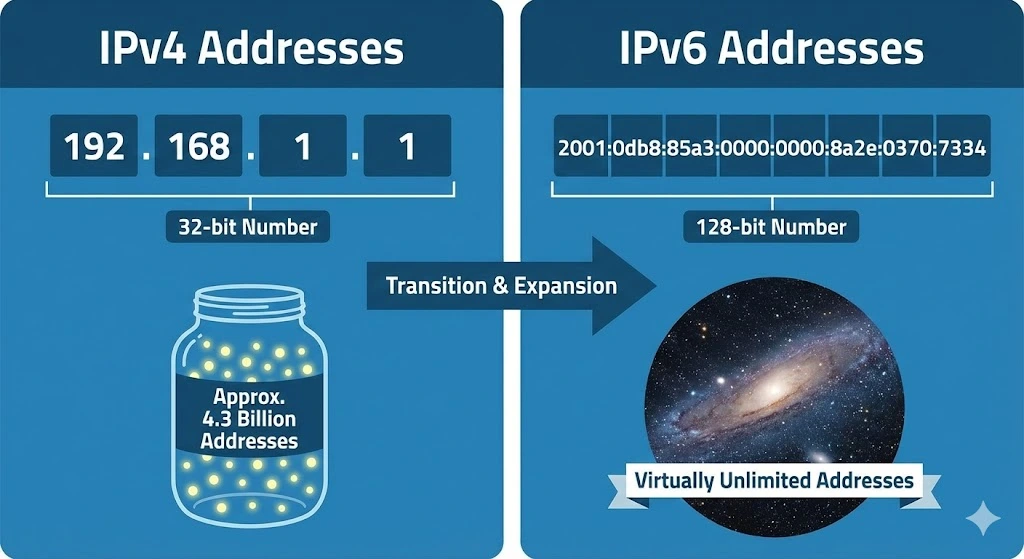
These are the most commonly used IP addresses, consisting of four sets of numbers separated by periods (e.g., 192.168.1.1). IPv4 addresses are 32-bit numbers, allowing for approximately 4.3 billion unique addresses.
IPv6 Addresses
Due to the exhaustion of IPv4 addresses, IPv6 was introduced. An IPv6 address is 128 bits long, written as eight groups of four hexadecimal digits separated by colons (e.g., 2001:0db8:85a3:0000:0000:8a2e:0370:7334). IPv6 supports a virtually unlimited number of unique addresses.
Understanding Hosts
Host refers to any device connected to a network that can send and receive data. This includes computers, servers, smartphones, and other connected devices. Each host on a network requires a unique IP address to communicate with other hosts.
A host is more than just an IP address; it encompasses the entire device, including its hardware, software, and network interfaces. Hosts can be identified by their IP addresses, but they also have additional identifying information such as hostnames.
Hostnames and Domain Names
While IP addresses are numerical, hostnames are human-readable names assigned to devices. Hostnames make it easier for users to remember and access devices on a network. For example, instead of typing an IP address like 192.0.2.1, users can type a hostname like “example.com.”
Domain Name System (DNS) is the system that translates hostnames into IP addresses. When you enter a hostname into your browser, DNS servers resolve it to the corresponding IP address, allowing your device to connect to the correct host.
Key Differences Between Hosts and IP Addresses
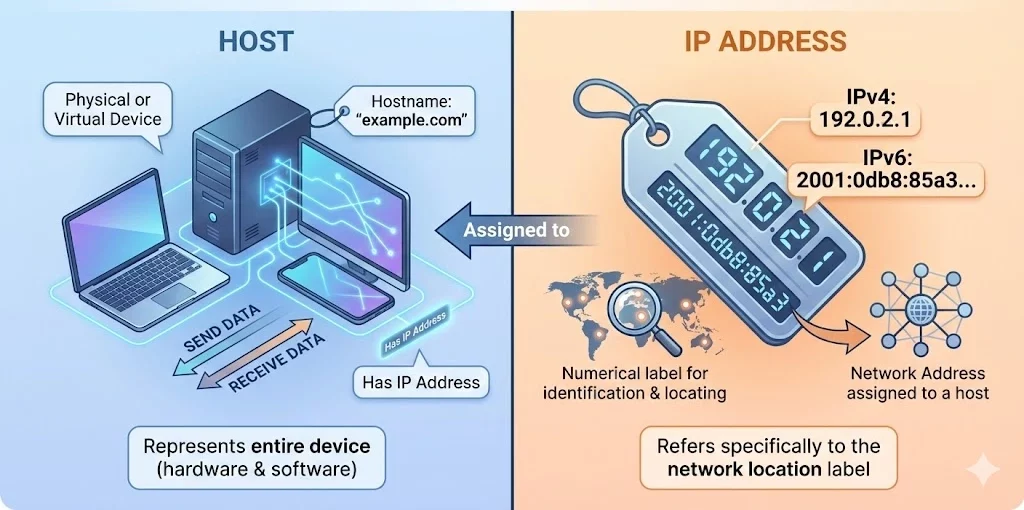
Host: A physical or virtual device on a network (e.g., a computer, server, or smartphone). It Engages in network communication by sending and receiving data. Hosts can be represented by a hostname (e.g., “example.com”) and have an IP address. It represents the entire device, including hardware and software.
IP Address: A numerical label assigned to a host for identification and communication. It serves as an address for locating and identifying a host within a network. It typically has a numerical value (e.g., 192.0.2.1 for IPv4 or 2001:0db8:85a3:0000:0000:8a2e:0370:7334 for IPv6) and refers specifically to the network address assigned to a host.
Practical Example
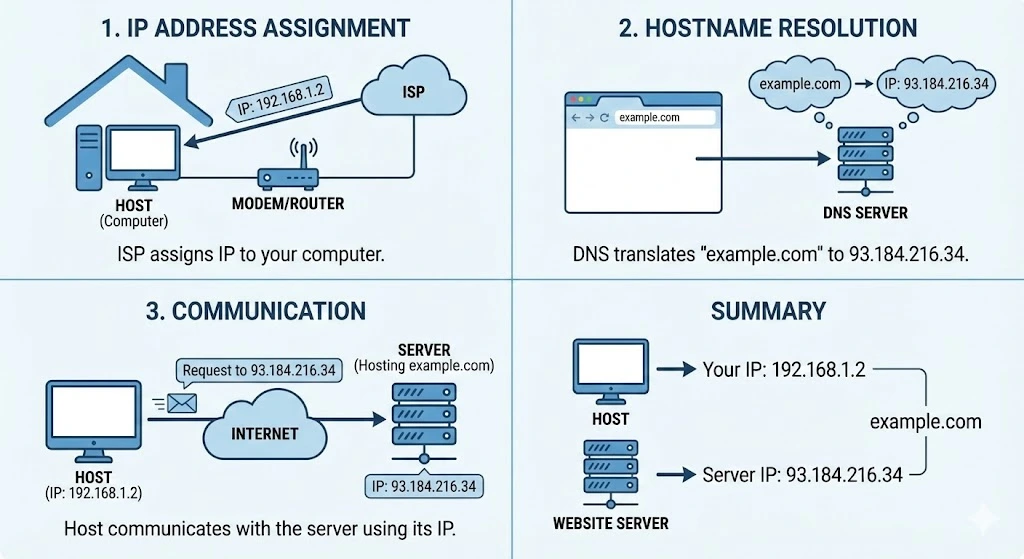
Consider a scenario where you have a computer connected to a home network. This computer (host) needs to access a website.
Here’s how it works:
IP Address Assignment: Your internet service provider (ISP) assigns an IP address to your computer, such as 192.168.1.2.
Hostname Resolution: You type “example.com” into your web browser. DNS translates this hostname to its IP address, say 93.184.216.34.
Communication: Your computer (host) uses its IP address to communicate with the server hosting “example.com” by requesting 93.184.216.34.
In this example, the computer is the host, and 192.168.1.2 is its IP address. The hostname “example.com” is resolved to the IP address 93.184.216.34, which identifies the website hosting server.
In summary, while hosts and IP addresses are closely related, they are not the same. An IP address is a unique identifier for a host on a network, enabling communication between devices. A host encompasses the entire device, including its hardware, software, and network interfaces, and can be identified by an IP address and a hostname. Understanding these distinctions is crucial for anyone involved in networking and Internet communications.
Trusted IPv4 Leasing for Business Growth
Get enterprise-grade IPv4 space quickly, with seamless deployment and end-to-end management.
Get Started with i.leaseFAQs
Can a host have multiple IP addresses?
Yes. A single host (like a web server or a computer) can be assigned multiple IP addresses. This is common for servers hosting multiple websites or devices connected to multiple networks
Does every IP address correspond to a host?
Not necessarily. While most IP addresses are assigned to hosts (devices), some are used for network functions, such as Broadcast addresses (used to send data to all devices on a network) or Network addresses (used to identify the network itself), which do not represent a specific single host.
Is a Domain Name the same as a Host Name?
They are related but distinct. A Hostname is the name of a specific device (e.g., server1), while a Domain Name identifies the larger network or entity (e.g., google.com). A Fully Qualified Domain Name (FQDN) combines them (e.g., server1.google.com) to precisely locate a host on the internet.
Related Posts

Risk Placement in IPv4 Transactions: What Enterprises Should Know
The IPv4 market has quietly evolved into a structured secondary asset class. As global IPv4 exhaustion continues, enterprises, ISPs, and brokers now routinely engage in buying, leasing, and transferring IPv4 address blocks. Alongside this growth, one topic has become increasingly important—but still under-discussed: risk placement in IPv4 transactions. For organizations participating in this market, especially through platforms such as i.lease, understanding how risk is identified, allocated, and mitigated isRead more Related Posts La Running-Code Primacy: por qué el arrendamiento de IPv4 debe juzgarse mediante pruebas operativas El arrendamiento de IPv4 suele comenzar con una pregunta simple: ¿Puede este proveedor darnos las direcciones? Pero para las empresas Read more Risques liés au renouvellement d’IPv4 : quand le manque de responsabilisation se transforme en trahison du code en cours d’exécution La plupart des entreprises entrent sur le marché IPv4 avec un objectif simple. Elles ont besoin d’adresses. Peut-être en ont-elles Read more Pourquoi la plupart des entreprises sont exposées accidentellement au risque d’échec d’attribution d’adresse IPv4 La rareté de l’IPv4 est largement comprise. Ce que de nombreuses entreprises sous-estiment encore, c’est le risque de continuité lié Read more .related-post {} .related-post .post-list { text-align: left; } .related-post .post-list .item { margin: 5px; padding: 10px; } .related-post .headline { font-size: 18px !important; color: #999999 !important; } .related-post .post-list .item .post_thumb { max-height: 220px; margin: 10px 0px; padding: 0px; display: block; } .related-post .post-list .item .post_title { font-size: 16px; color: #3f3f3f; margin: 10px 0px; padding: 0px; display: block; text-decoration: none; } .related-post .post-list .item .post_excerpt { font-size: 13px; color: #3f3f3f; margin: 10px 0px; padding: 0px; display: block; text-decoration: none; } @media only screen and (min-width: 1024px) { .related-post .post-list .item { width: 30%; } } @media only screen and (min-width: 768px) and (max-width: 1023px) { .related-post .post-list .item { width: 90%; } } @media only screen and (min-width: 0px) and (max-width: 767px) { .related-post .post-list .item { width: 90%; } }

Understanding Operational Risk in IPv4 Address Markets
IPv4 has long stopped being a simple technical identifier system. It has become a constrained, priced, and operationally embedded infrastructure asset class. “In the IPv4 market, execution is not paperwork. Execution is continuity under registry-layer uncertainty.”https://heng.lu/on-why-i-lease-exists-and-why-the-broker-question-is-really-a-registry-risk-question/ Yet most of the industry still speaks about it as if it were a straightforward marketplace problem: buyers, sellers, brokers, escrow, transfer, done. That framing is increasingly outdated. The real structure of riskRead more Related Posts La Running-Code Primacy: por qué el arrendamiento de IPv4 debe juzgarse mediante pruebas operativas El arrendamiento de IPv4 suele comenzar con una pregunta simple: ¿Puede este proveedor darnos las direcciones? Pero para las empresas Read more Risques liés au renouvellement d’IPv4 : quand le manque de responsabilisation se transforme en trahison du code en cours d’exécution La plupart des entreprises entrent sur le marché IPv4 avec un objectif simple. Elles ont besoin d’adresses. Peut-être en ont-elles Read more Pourquoi la plupart des entreprises sont exposées accidentellement au risque d’échec d’attribution d’adresse IPv4 La rareté de l’IPv4 est largement comprise. Ce que de nombreuses entreprises sous-estiment encore, c’est le risque de continuité lié Read more .related-post {} .related-post .post-list { text-align: left; } .related-post .post-list .item { margin: 5px; padding: 10px; } .related-post .headline { font-size: 18px !important; color: #999999 !important; } .related-post .post-list .item .post_thumb { max-height: 220px; margin: 10px 0px; padding: 0px; display: block; } .related-post .post-list .item .post_title { font-size: 16px; color: #3f3f3f; margin: 10px 0px; padding: 0px; display: block; text-decoration: none; } .related-post .post-list .item .post_excerpt { font-size: 13px; color: #3f3f3f; margin: 10px 0px; padding: 0px; display: block; text-decoration: none; } @media only screen and (min-width: 1024px) { .related-post .post-list .item { width: 30%; } } @media only screen and (min-width: 768px) and (max-width: 1023px) { .related-post .post-list .item { width: 90%; } } @media only screen and (min-width: 0px) and (max-width: 767px) { .related-post .post-list .item { width: 90%; } }

Why most enterprises are accidentally exposed to IPv4 allocation failure risk
IPv4 scarcity is widely understood. What many enterprises still underestimate is the continuity risk surrounding how address resources are governed and maintained. Enterprises often maintain operational use of IPv4 resources without full visibility into the continuity conditions supporting those allocations. The growing reliance on leasing, transfers, and provider-managed infrastructure is reshaping IPv4 Allocation into a long-term governance issue. IPv4 Allocation has quietly become a continuity issue For many enterpriseRead more Related Posts La Running-Code Primacy: por qué el arrendamiento de IPv4 debe juzgarse mediante pruebas operativas El arrendamiento de IPv4 suele comenzar con una pregunta simple: ¿Puede este proveedor darnos las direcciones? Pero para las empresas Read more Por qué la mayoría de las empresas están expuestas accidentalmente al riesgo de fallo en la asignación de IPv4 La escasez de IPv4 es ampliamente comprendida. Lo que muchas empresas aún subestiman es el riesgo de continuidad relacionado con Read more Riesgo de renovación de IPv4: Cuando la falta de rendición de cuentas se convierte en traición al código en ejecución ¿Quién es realmente responsable de mantener vivo este acceso IPv4? No quién lo vendió.No quién lo presentó.No quién emitió la Read more .related-post {} .related-post .post-list { text-align: left; } .related-post .post-list .item { margin: 5px; padding: 10px; } .related-post .headline { font-size: 18px !important; color: #999999 !important; } .related-post .post-list .item .post_thumb { max-height: 220px; margin: 10px 0px; padding: 0px; display: block; } .related-post .post-list .item .post_title { font-size: 16px; color: #3f3f3f; margin: 10px 0px; padding: 0px; display: block; text-decoration: none; } .related-post .post-list .item .post_excerpt { font-size: 13px; color: #3f3f3f; margin: 10px 0px; padding: 0px; display: block; text-decoration: none; } @media only screen and (min-width: 1024px) { .related-post .post-list .item { width: 30%; } } @media only screen and (min-width: 768px) and (max-width: 1023px) { .related-post .post-list .item { width: 90%; } } @media only screen and (min-width: 0px) and (max-width: 767px) { .related-post .post-list .item { width: 90%; } }
