BYOIP vs IP Leasing: Which is better for your Business?
 Stephanie
- BYOIP offers greater control and potential cost savings for businesses with existing IP assets.
- IP leasing provides flexibility and lower upfront costs, ideal for businesses with fluctuating needs.
Table of Contents
In today’s digital landscape, businesses face critical decisions regarding their IP address management, especially when migrating to cloud services. Two prevalent options are Bring Your Own IP (BYOIP) and IP leasing. Each approach has its advantages and considerations, depending on your organization’s specific needs and resources.
Understanding BYOIP and IP Leasing
Also read: How BYOIP Helps Prevent IP Spoofing and Fraud
What is BYOIP?
BYOIP allows businesses to migrate their existing IP addresses to cloud providers. This approach ensures continuity, maintains established IP reputations, and offers greater control over IP management. Leading cloud providers like AWS, Google Cloud, and Microsoft Azure support BYOIP, enabling seamless integration of your IP addresses into their infrastructure.
The benefits of BYOIP include the ability to retain ownership of your trusted IP addresses, helping you avoid the time and complexity involved in building a new online reputation. It also enhances security by allowing the seamless transfer of existing security policies tied to specific IP addresses into cloud environments. From a compliance standpoint, BYOIP supports adherence to industry-specific regulations and data sovereignty laws, which is crucial for businesses operating in regulated sectors. Additionally, it ensures a smooth and uninterrupted transition to cloud services without the need to change IP addresses. Overall, BYOIP offers greater control over online security and reputation management, giving businesses the ability to operate with consistency and trust across their digital infrastructure. However, implementing BYOIP can involve technical complexities, such as configuring Route Origin Authorizations (ROAs) and updating Registry Data Access Protocol (RDAP) records.
Exploring IP Leasing
IP Leasing involves renting IP addresses from a provider for a specified period. This approach is particularly beneficial for businesses that require flexibility or have short-term projects.
The advantages of IP leasing include cost-effectiveness, as it requires lower upfront investment compared to purchasing IP addresses outright. This makes it an attractive option for businesses with limited capital or short-term operational needs. Leasing also provides flexibility, allowing organisations to scale IP resources up or down in response to changing demands without the long-term commitment of ownership. Additionally, many leasing platforms offer simplified IP management services, handling the technical and administrative complexities on behalf of the client, which helps reduce the workload on internal IT teams and streamlines overall network operations. However, leasing IP addresses means you do not own them, which can limit control and long-term planning. Additionally, recurring costs can accumulate over time.
Also read: IPv4 Investment – The New Investment Opportunity
Also read: About IPv6 Security Considerations
Cost considerations
BYOIP: While there may be initial costs associated with configuring and integrating your IP addresses into the cloud, BYOIP can lead to long-term savings, especially if you already own IP addresses. For instance, AWS charges $0.005 per hour for each public IPv4 address. By bringing your own IPs, you can avoid these charges.
IP leasing: Leasing IP addresses can be more affordable upfront. For example, leasing a /24 IPv4 block (256 addresses) might cost around $1,636 annually, compared to purchasing the same block for approximately $10,000. However, over several years, leasing costs can surpass the one-time purchase price.
Operational control and flexibility
BYOIP offers greater control over your IP addresses, allowing you to manage configurations, security policies, and compliance requirements directly. This control is crucial for businesses with specific regulatory obligations or those that require consistent IP reputations.
IP leasing, on the other hand, provides flexibility, making it easier to adapt to changing business needs. It’s ideal for startups or projects with uncertain durations, where long-term IP ownership isn’t necessary.
Security and compliance
BYOIP: Retaining your IP addresses ensures continuity in security policies and compliance measures. It simplifies audits and helps maintain trust with clients and partners.
IP leasing: While leasing can meet security and compliance needs, it may require additional steps to align leased IPs with your existing policies. Ensuring the leased IPs have a clean history is also essential to avoid reputational risks.
Making the right choice for your business
When deciding between BYOIP and IP leasing, several factors should be considered. If your organisation already owns IP addresses, BYOIP can be a more cost-effective solution while also offering greater control over IP management. For businesses facing budget constraints or working on short-term projects, leasing may be the more practical choice due to its lower upfront costs. In sectors with strict regulatory requirements, BYOIP is often preferred as it allows for better control and compliance with data governance standards. Meanwhile, companies that require the ability to quickly scale their IP resources may find leasing advantageous, as it provides the flexibility needed to adapt to changing operational demands.
FAQs
What is the minimum IP block size for BYOIP on AWS?
AWS requires a minimum of a /24 IPv4 block (256 addresses) for BYOIP.
Can I lease IP addresses and use them with BYOIP?
Yes, some providers allow you to lease IP addresses and integrate them into your cloud infrastructure using BYOIP.
Are there any additional fees associated with BYOIP?
While BYOIP can help avoid certain charges, there may be costs related to configuring and maintaining your IP addresses within the cloud environment.
How does IP leasing impact my IP reputation?
Leased IP addresses may have a history that could affect their reputation. It’s essential to verify the cleanliness of leased IPs to avoid deliverability or trust issues.
Is BYOIP supported by all cloud providers?
Most major cloud providers, including AWS, Google Cloud, and Microsoft Azure, support BYOIP. However, specific requirements and processes may vary.
Related Posts
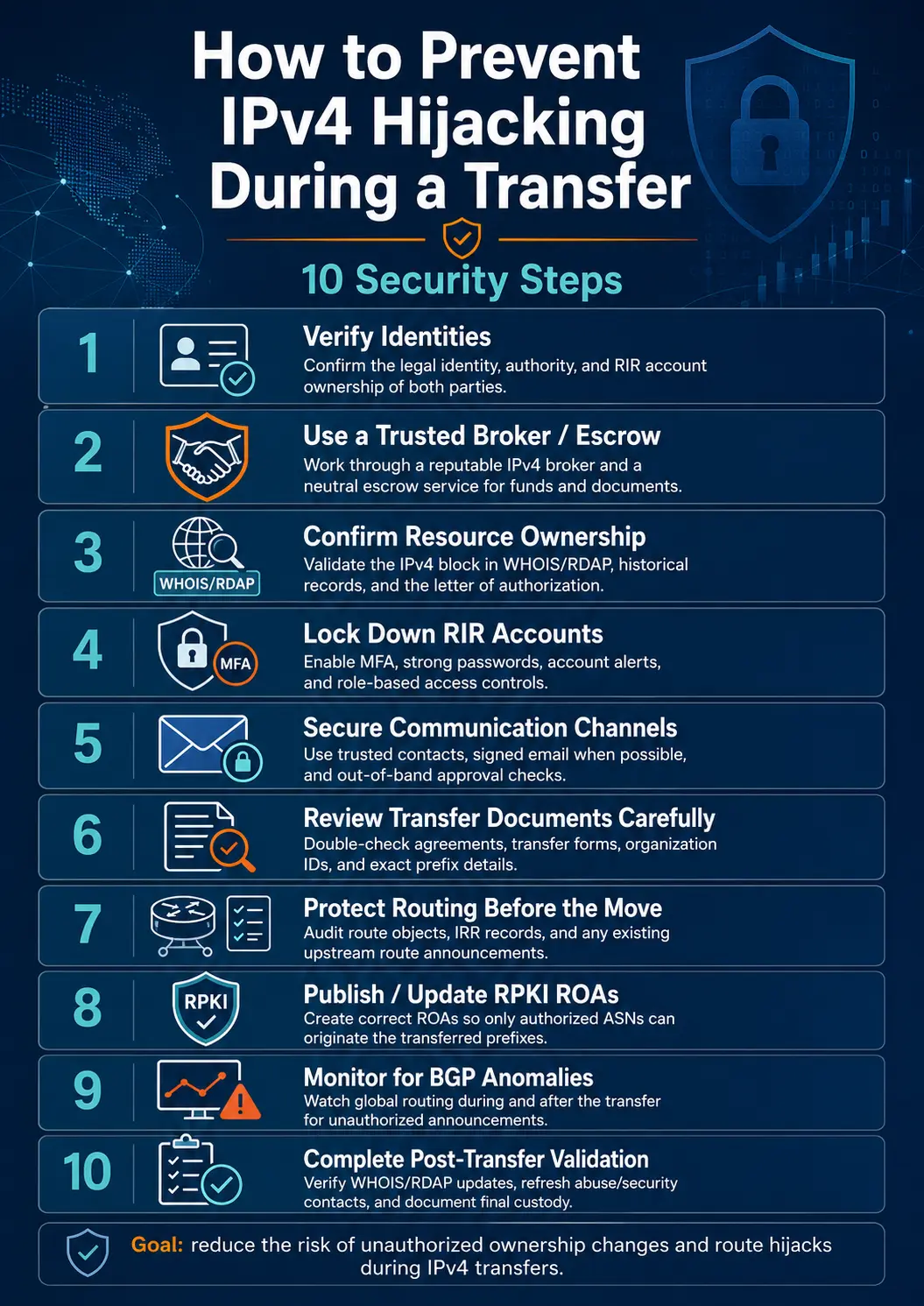
How to Prevent IPv4 Hijacking During a Transfer: 10 Security Steps
Transferring IPv4 address space is not only a commercial and registry process. It is also a sensitive routing operation. During an IPv4 transfer, control of a prefix moves from one organization to another. Registry records, Route Origin Authorizations, Internet Routing Registry objects, upstream-provider filters, reverse DNS settings, and live BGP announcements may all need to change. When these changes are completed in the wrong order—or when identity and authorizationRead more Related Posts How to Prevent IPv4 Hijacking During a Transfer: 10 Security Steps Transferring IPv4 address space is not only a commercial and registry process. It is also a sensitive routing operation. During Why the Cheapest IPv4 Lease May Cost More in the Long Run A low monthly price may look attractive during procurement, but the real cost of leased IPv4 addresses includes much more What Is a /24 IPv4 Subnet and Why Is It Popular for Leasing? A /24 IPv4 subnet is one of the most common block sizes in the IPv4 leasing market. For hosting providers, .related-post {} .related-post .post-list { text-align: left; } .related-post .post-list .item { margin: 5px; padding: 10px; } .related-post .headline { font-size: 18px !important; color: #999999 !important; } .related-post .post-list .item .post_thumb { max-height: 220px; margin: 10px 0px; padding: 0px; display: block; } .related-post .post-list .item .post_title { font-size: 16px; color: #3f3f3f; margin: 10px 0px; padding: 0px; display: block; text-decoration: none; } .related-post .post-list .item .post_excerpt { font-size: 13px; color: #3f3f3f; margin: 10px 0px; padding: 0px; display: block; text-decoration: none; } @media only screen and (min-width: 1024px) { .related-post .post-list .item { width: 30%; } } @media only screen and (min-width: 768px) and (max-width: 1023px) { .related-post .post-list .item { width: 90%; } } @media only screen and (min-width: 0px) and (max-width: 767px) { .related-post .post-list .item { width: 90%; } }
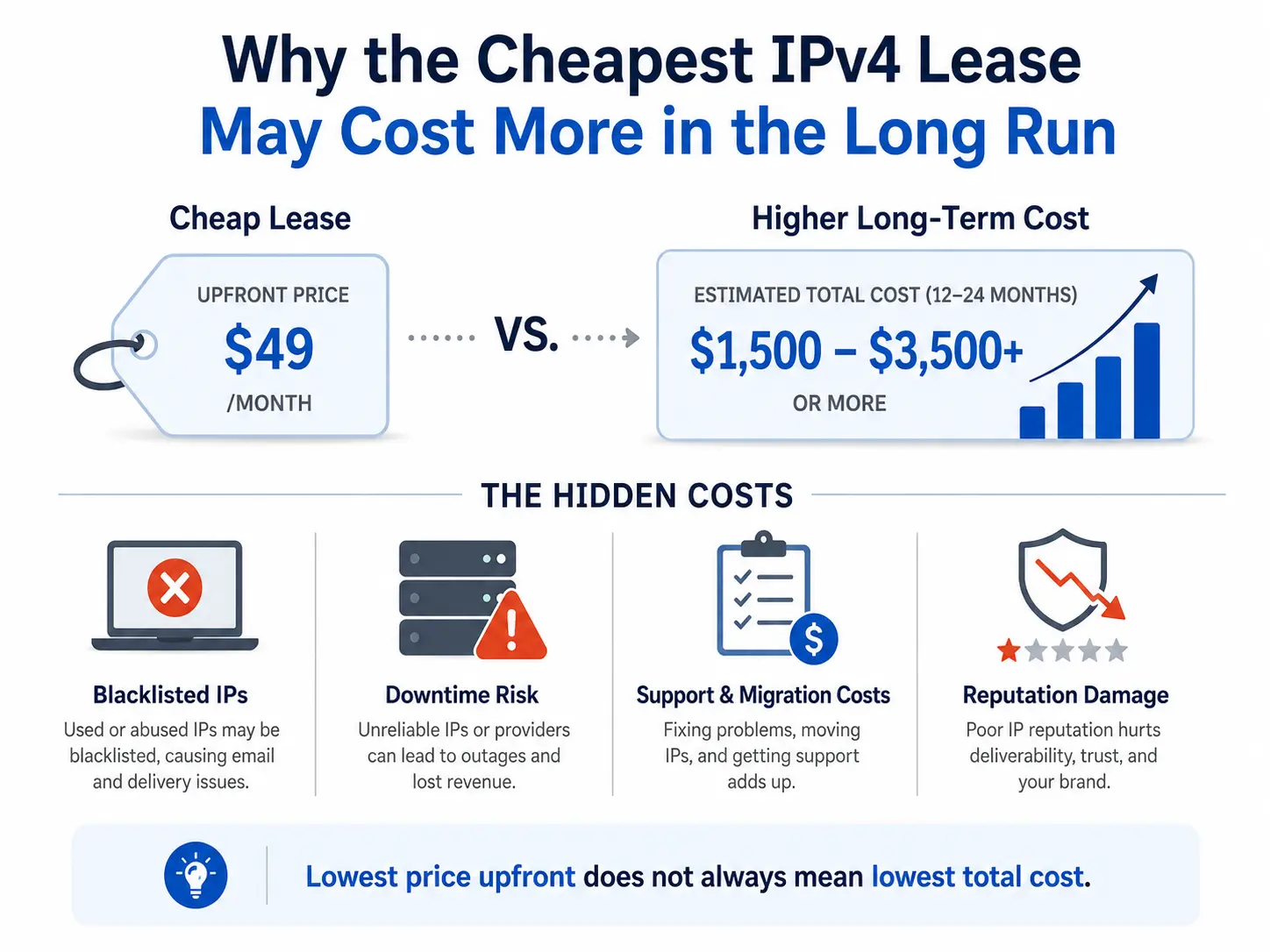
Why the Cheapest IPv4 Lease May Cost More in the Long Run
A low monthly price may look attractive during procurement, but the real cost of leased IPv4 addresses includes much more than the advertised rate. Poor IP reputation, incomplete routing authorisation, deployment delays, weak technical support, incorrect geolocation and uncertain renewal terms can quickly erase the initial saving. For testing or short-lived projects, a basic low-cost IPv4 lease may be sufficient. For production networks, however, businesses should evaluate the totalRead more Related Posts How to Prevent IPv4 Hijacking During a Transfer: 10 Security Steps Transferring IPv4 address space is not only a commercial and registry process. It is also a sensitive routing operation. During Why the Cheapest IPv4 Lease May Cost More in the Long Run A low monthly price may look attractive during procurement, but the real cost of leased IPv4 addresses includes much more What Is a /24 IPv4 Subnet and Why Is It Popular for Leasing? A /24 IPv4 subnet is one of the most common block sizes in the IPv4 leasing market. For hosting providers, .related-post {} .related-post .post-list { text-align: left; } .related-post .post-list .item { margin: 5px; padding: 10px; } .related-post .headline { font-size: 18px !important; color: #999999 !important; } .related-post .post-list .item .post_thumb { max-height: 220px; margin: 10px 0px; padding: 0px; display: block; } .related-post .post-list .item .post_title { font-size: 16px; color: #3f3f3f; margin: 10px 0px; padding: 0px; display: block; text-decoration: none; } .related-post .post-list .item .post_excerpt { font-size: 13px; color: #3f3f3f; margin: 10px 0px; padding: 0px; display: block; text-decoration: none; } @media only screen and (min-width: 1024px) { .related-post .post-list .item { width: 30%; } } @media only screen and (min-width: 768px) and (max-width: 1023px) { .related-post .post-list .item { width: 90%; } } @media only screen and (min-width: 0px) and (max-width: 767px) { .related-post .post-list .item { width: 90%; } }
What causes IPv4 deals to stall after the first agreement
IPv4 deals usually stall after the first agreement because agreeing on price is only the commercial beginning—not operational completion. A buyer and seller may agree on a block and price within hours, but the transaction can still be delayed by unclear ownership, incomplete documents, mismatched Regional Internet Registry requirements, recipient eligibility, reputation concerns, payment conditions, or missing routing authorization. The most common causes are: The seller’s authority over theRead more Related Posts How to Prevent IPv4 Hijacking During a Transfer: 10 Security Steps Transferring IPv4 address space is not only a commercial and registry process. It is also a sensitive routing operation. During Why the Cheapest IPv4 Lease May Cost More in the Long Run A low monthly price may look attractive during procurement, but the real cost of leased IPv4 addresses includes much more What Is a /24 IPv4 Subnet and Why Is It Popular for Leasing? A /24 IPv4 subnet is one of the most common block sizes in the IPv4 leasing market. For hosting providers, .related-post {} .related-post .post-list { text-align: left; } .related-post .post-list .item { margin: 5px; padding: 10px; } .related-post .headline { font-size: 18px !important; color: #999999 !important; } .related-post .post-list .item .post_thumb { max-height: 220px; margin: 10px 0px; padding: 0px; display: block; } .related-post .post-list .item .post_title { font-size: 16px; color: #3f3f3f; margin: 10px 0px; padding: 0px; display: block; text-decoration: none; } .related-post .post-list .item .post_excerpt { font-size: 13px; color: #3f3f3f; margin: 10px 0px; padding: 0px; display: block; text-decoration: none; } @media only screen and (min-width: 1024px) { .related-post .post-list .item { width: 30%; } } @media only screen and (min-width: 768px) and (max-width: 1023px) { .related-post .post-list .item { width: 90%; } } @media only screen and (min-width: 0px) and (max-width: 767px) { .related-post .post-list .item { width: 90%; } }
