How the IPv4 shortage has reshaped RIR allocation policies
 Stephanie
- RIRs transitioned to strict “soft‑landing” policies and limited final allocations to prevent hoarding and extend IPv4 availability.
- Transfer markets, wait‑lists, and equitable distribution mechanisms now dominate scarcity-era policy landscapes.
The impact of IPv4 exhaustion on RIR policy
The depletion of IPv4 address space prompted all Regional Internet Registries (RIRs) to overhaul their allocation strategies. When the final five /8 blocks were delivered by IANA in 2011, RIRs shifted from needs-based allocation to scarcity-management modes. To ensure the limited remaining resources lasted longer, they introduced strict caps on the allocation sizes and tightened criteria for qualifying organisations.
Table of Contents
Transfer markets and reclaimed space
With scarcity driving demand, RIRs formalised IPv4 transfer policies and reclamation rules. Transfers between organisations became vital for reallocating unused resources. In the post-exhaustion era, RIRs maintain strict transfer registries to preserve transparency and prevent speculative trading. Networks also return or relinquish unused blocks, which are added to exhausted pools managed via new waiting‑list procedures.
Non-discrimination and needs-based verification
Due to the risk of unfair accumulation during time of scarcity, RIRs insisted on proof of actual deployment or justified need before approving allocations. RIPE’s policy, for example, specifically reinforces “fairness” over economic advantage, ensuring that address space is not unfairly excluded from emerging players. ARIN introduced standardized approval timeframes to streamline fairness across new requests.
Why these changes matter
The shift to scarcity-aware policy protects smaller operators and ensures a baseline of IP access for newcomers. By capping allocations and enforcing fairness, RIRs have prevented early depletion from disadvantaging less-resourced networks. The formalisation of address transfer markets and policy-backed reclamation mechanisms has helped preserve the integrity and utility of IPv4 resources even as IPv6 adoption advance.
Trusted IPv4 Leasing for Business Growth
Get enterprise-grade IPv4 space quickly, with seamless deployment and end-to-end management.
Get Started with i.leaseFAQs
Who manages IPv4 allocation globally?
Five RIRs are given large IPv4 blocks by IANA, and each is in charge of overseeing address distribution in its own area. After exhaustion, allocations shifted to a scarcity-management model.
How does a soft‑landing policy work?
Soft‑landing means strict limits per member—such as one /22—when an RIR reaches its last /8, protecting fairness and prolonging availability.
How are unused IPv4 addresses recycled?
RIRs reclaim inactive or returned addresses, add them to waiting‑list pools, and redistribute them under regulated transfer or allocation procedures.
Why do policies emphasize “fairness”?
Policies such as RIPE’s require proof of intended usage and guard against exclusionary trading, ensuring smaller or new networks are not shut out.
Are transfer policies still active today?
Yes. Once exhaustion began, RIRs implemented structured transfer markets, allowing resource holders to transfer IPv4 blocks under regulatory oversight.
Related Blogs
Related Posts
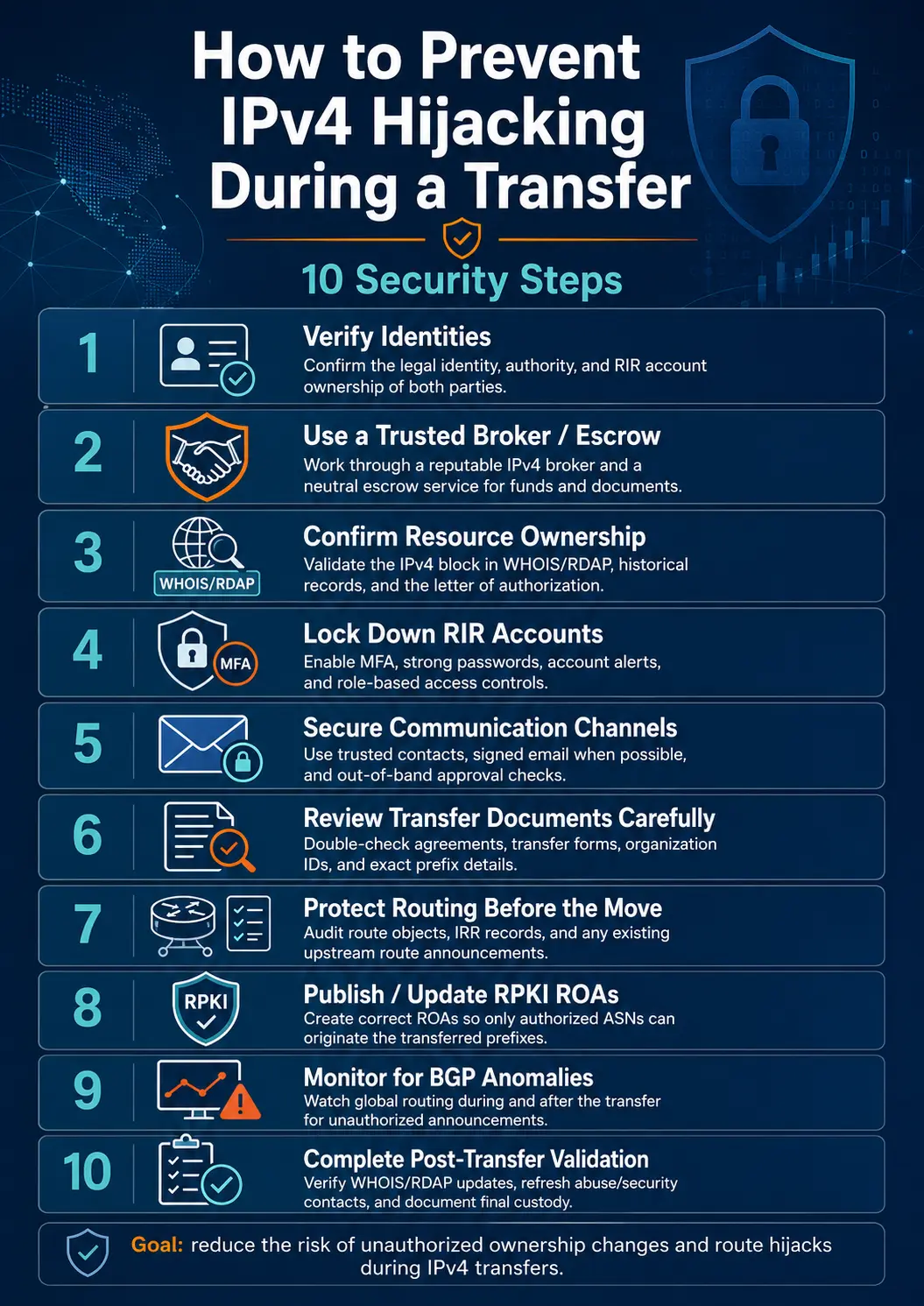
How to Prevent IPv4 Hijacking During a Transfer: 10 Security Steps
Transferring IPv4 address space is not only a commercial and registry process. It is also a sensitive routing operation. During an IPv4 transfer, control of a prefix moves from one organization to another. Registry records, Route Origin Authorizations, Internet Routing Registry objects, upstream-provider filters, reverse DNS settings, and live BGP announcements may all need to change. When these changes are completed in the wrong order—or when identity and authorizationRead more Related Posts How to Prevent IPv4 Hijacking During a Transfer: 10 Security Steps Transferring IPv4 address space is not only a commercial and registry process. It is also a sensitive routing operation. During Why the Cheapest IPv4 Lease May Cost More in the Long Run A low monthly price may look attractive during procurement, but the real cost of leased IPv4 addresses includes much more What Is a /24 IPv4 Subnet and Why Is It Popular for Leasing? A /24 IPv4 subnet is one of the most common block sizes in the IPv4 leasing market. For hosting providers, .related-post {} .related-post .post-list { text-align: left; } .related-post .post-list .item { margin: 5px; padding: 10px; } .related-post .headline { font-size: 18px !important; color: #999999 !important; } .related-post .post-list .item .post_thumb { max-height: 220px; margin: 10px 0px; padding: 0px; display: block; } .related-post .post-list .item .post_title { font-size: 16px; color: #3f3f3f; margin: 10px 0px; padding: 0px; display: block; text-decoration: none; } .related-post .post-list .item .post_excerpt { font-size: 13px; color: #3f3f3f; margin: 10px 0px; padding: 0px; display: block; text-decoration: none; } @media only screen and (min-width: 1024px) { .related-post .post-list .item { width: 30%; } } @media only screen and (min-width: 768px) and (max-width: 1023px) { .related-post .post-list .item { width: 90%; } } @media only screen and (min-width: 0px) and (max-width: 767px) { .related-post .post-list .item { width: 90%; } }
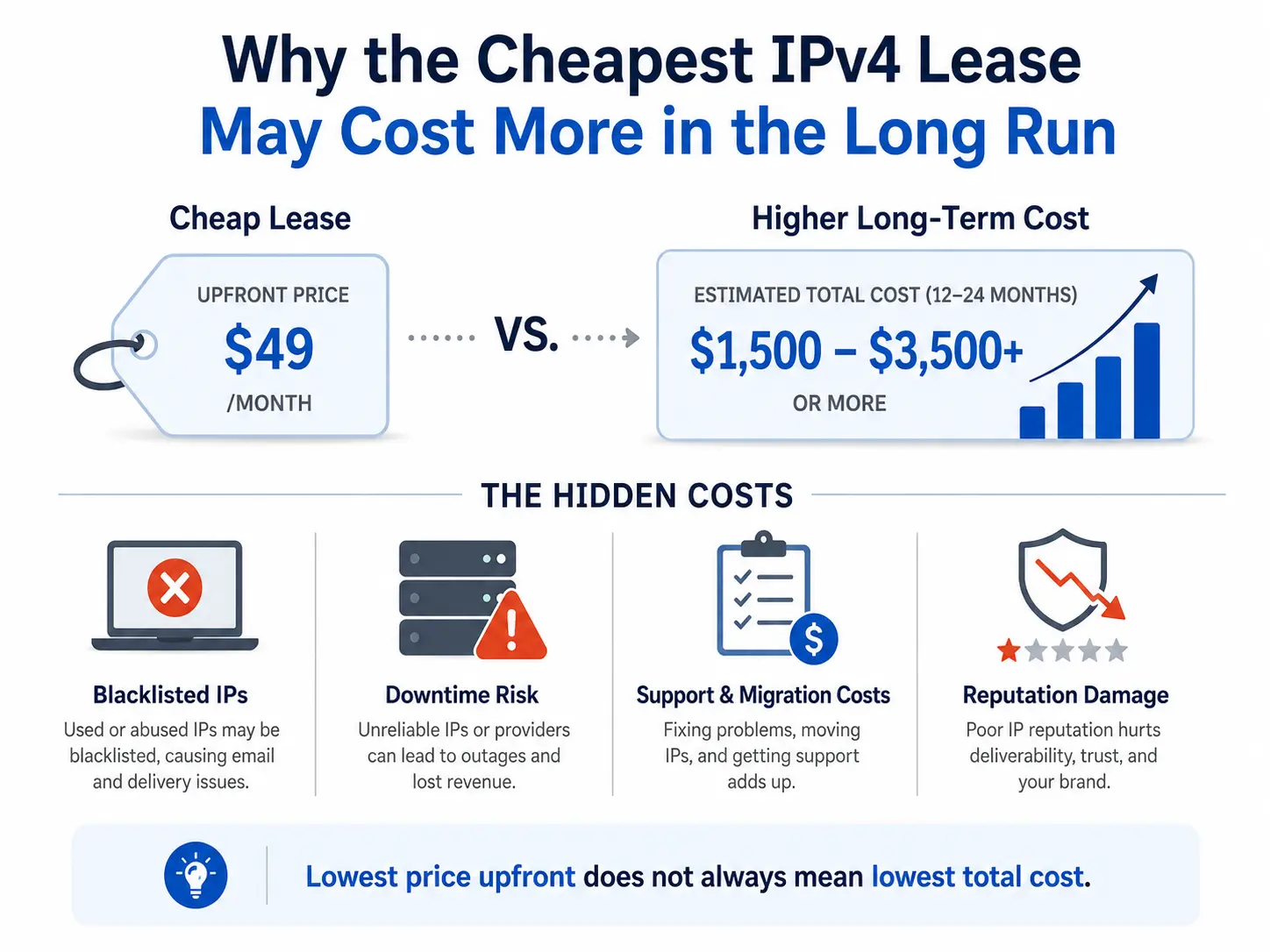
Why the Cheapest IPv4 Lease May Cost More in the Long Run
A low monthly price may look attractive during procurement, but the real cost of leased IPv4 addresses includes much more than the advertised rate. Poor IP reputation, incomplete routing authorisation, deployment delays, weak technical support, incorrect geolocation and uncertain renewal terms can quickly erase the initial saving. For testing or short-lived projects, a basic low-cost IPv4 lease may be sufficient. For production networks, however, businesses should evaluate the totalRead more Related Posts How to Prevent IPv4 Hijacking During a Transfer: 10 Security Steps Transferring IPv4 address space is not only a commercial and registry process. It is also a sensitive routing operation. During Why the Cheapest IPv4 Lease May Cost More in the Long Run A low monthly price may look attractive during procurement, but the real cost of leased IPv4 addresses includes much more What Is a /24 IPv4 Subnet and Why Is It Popular for Leasing? A /24 IPv4 subnet is one of the most common block sizes in the IPv4 leasing market. For hosting providers, .related-post {} .related-post .post-list { text-align: left; } .related-post .post-list .item { margin: 5px; padding: 10px; } .related-post .headline { font-size: 18px !important; color: #999999 !important; } .related-post .post-list .item .post_thumb { max-height: 220px; margin: 10px 0px; padding: 0px; display: block; } .related-post .post-list .item .post_title { font-size: 16px; color: #3f3f3f; margin: 10px 0px; padding: 0px; display: block; text-decoration: none; } .related-post .post-list .item .post_excerpt { font-size: 13px; color: #3f3f3f; margin: 10px 0px; padding: 0px; display: block; text-decoration: none; } @media only screen and (min-width: 1024px) { .related-post .post-list .item { width: 30%; } } @media only screen and (min-width: 768px) and (max-width: 1023px) { .related-post .post-list .item { width: 90%; } } @media only screen and (min-width: 0px) and (max-width: 767px) { .related-post .post-list .item { width: 90%; } }
What causes IPv4 deals to stall after the first agreement
IPv4 deals usually stall after the first agreement because agreeing on price is only the commercial beginning—not operational completion. A buyer and seller may agree on a block and price within hours, but the transaction can still be delayed by unclear ownership, incomplete documents, mismatched Regional Internet Registry requirements, recipient eligibility, reputation concerns, payment conditions, or missing routing authorization. The most common causes are: The seller’s authority over theRead more Related Posts How to Prevent IPv4 Hijacking During a Transfer: 10 Security Steps Transferring IPv4 address space is not only a commercial and registry process. It is also a sensitive routing operation. During Why the Cheapest IPv4 Lease May Cost More in the Long Run A low monthly price may look attractive during procurement, but the real cost of leased IPv4 addresses includes much more What Is a /24 IPv4 Subnet and Why Is It Popular for Leasing? A /24 IPv4 subnet is one of the most common block sizes in the IPv4 leasing market. For hosting providers, .related-post {} .related-post .post-list { text-align: left; } .related-post .post-list .item { margin: 5px; padding: 10px; } .related-post .headline { font-size: 18px !important; color: #999999 !important; } .related-post .post-list .item .post_thumb { max-height: 220px; margin: 10px 0px; padding: 0px; display: block; } .related-post .post-list .item .post_title { font-size: 16px; color: #3f3f3f; margin: 10px 0px; padding: 0px; display: block; text-decoration: none; } .related-post .post-list .item .post_excerpt { font-size: 13px; color: #3f3f3f; margin: 10px 0px; padding: 0px; display: block; text-decoration: none; } @media only screen and (min-width: 1024px) { .related-post .post-list .item { width: 30%; } } @media only screen and (min-width: 768px) and (max-width: 1023px) { .related-post .post-list .item { width: 90%; } } @media only screen and (min-width: 0px) and (max-width: 767px) { .related-post .post-list .item { width: 90%; } }
