IPv4 Renewal Risk: When Weak Accountability Becomes Running-Code Betrayal
 Stephanie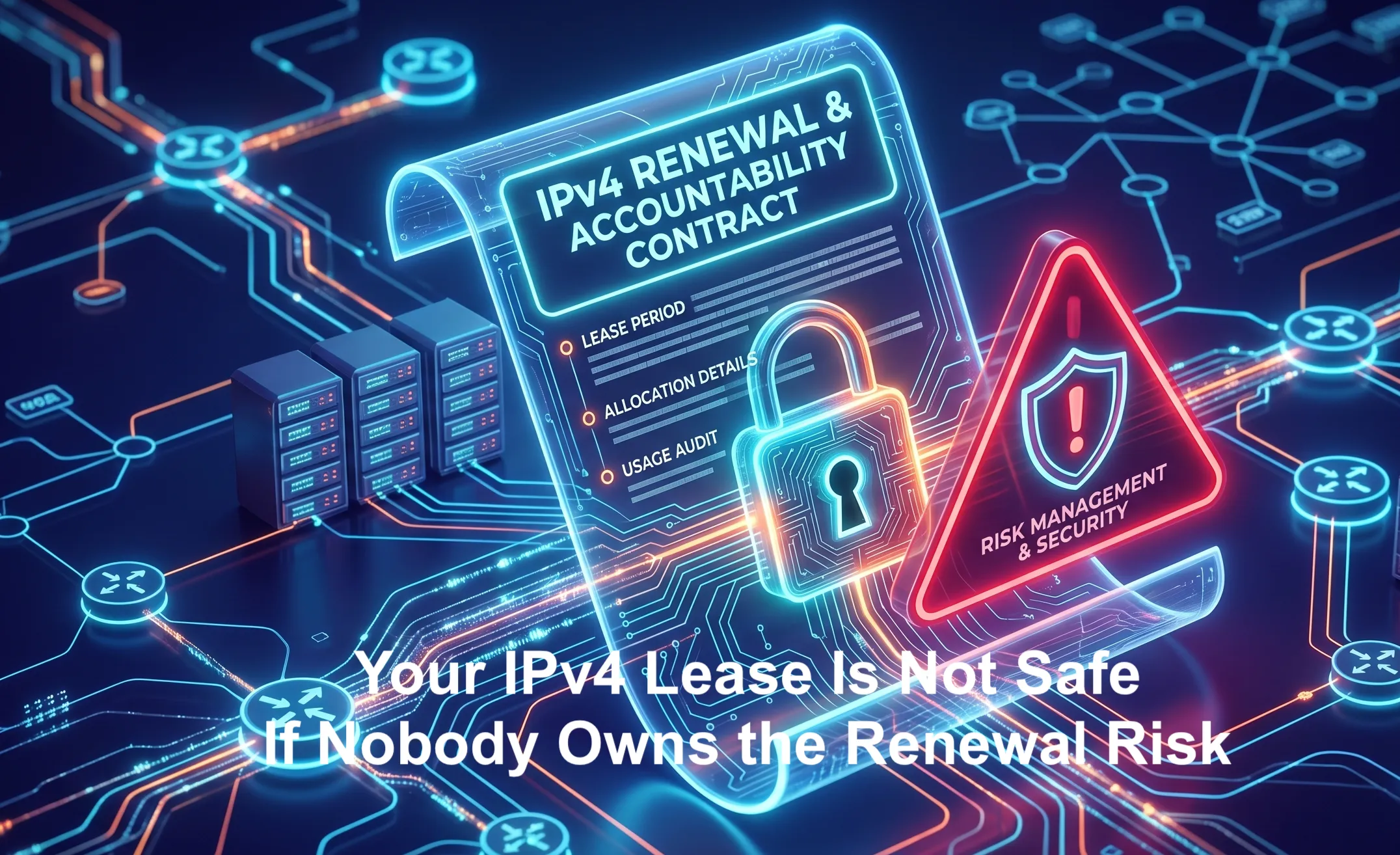
Who is actually responsible for keeping this IPv4 access alive?
Table of Contents
Not who sold it.
Not who introduced it.
Not who issued the invoice.
Not who sent the first LOA.
Who owns the renewal risk when the relationship becomes stressed, the upstream source changes position, the documentation is questioned, or the provider chain no longer responds?
For businesses that depend on IPv4 for hosting, SaaS, VPN, telecom, cloud, security, email delivery, or customer access, this is not a small administrative issue.
It is a continuity issue.
And when renewal accountability is weak, your IPv4 lease can become a hidden countdown.
Why IPv4 Renewal Risk Is Easy to Ignore
Most companies check whether an IPv4 block works today.
- They check whether the IPs are routable.
- They check whether the block is clean.
- They check whether the price is acceptable.
- They check whether the provider can deliver quickly.
Those checks matter.
But they are not enough.
IPv4 risk often appears later, after the business has already built services around the addresses. By then, the IPs may be tied to customer accounts, firewall rules, mail reputation, whitelisting, DNS records, application infrastructure, compliance records, and internal operating procedures.
At that stage, changing IPs is no longer simple.
It can mean downtime, customer complaints, reputation loss, engineering workload, and contract disruption.
That is why renewal matters.
The first month of an IPv4 lease proves only that access was arranged.
The renewal period proves whether the structure is reliable.
A weak provider can look strong during onboarding. The real test comes when the lease must be renewed, defended, documented, extended, or escalated.
The Dangerous Difference Between Access and Continuity
IPv4 access means you can use the addresses now.
IPv4 continuity means you can keep using them with confidence.
Many companies confuse the two.
Access is short-term.
Continuity is structural.
Access answers:
- Can I route these IPs today?
- Can I deploy servers now?
- Can I receive an LOA?
- Can I start using the block?
Continuity asks deeper questions:
- Who controls the source relationship?
- Who handles renewal accountability?
- Who supports routing changes?
- Who responds if documentation is challenged?
- Who absorbs upstream pressure before it reaches the customer?
- Who has the legal, operational, and registry-aware capacity to protect continuity?
This difference matters because IPv4 is no longer a casual technical input. It supports real business activity, customer access, revenue, infrastructure, and operational continuity. The registry layer and recognition layer can sit above valuable network resources, while operators and customers carry the real business consequences if continuity is disrupted.
That is why the cheapest IPv4 lease is not always the safest IPv4 lease.
The real question is not only:
Can this provider give me IPs?
The real question is:
Can this provider keep me protected when renewal becomes complicated?
Renewal Risk and Running-Code Betrayal
IPv4 renewal risk becomes serious when administrative process, provider delay, or unclear accountability begins to endanger infrastructure that is already running.
This is the practical business meaning of Running-Code Betrayal: the network may already be live, customers may already depend on it, and applications may already be built around the addresses, but renewal uncertainty can still place that running infrastructure at risk.
For businesses, this is not an abstract governance issue. If a leased IPv4 block supports hosting, VPN access, SaaS platforms, email delivery, cloud workloads, security systems, telecom services, or customer-facing applications, renewal failure can become an operational event.
The danger is that the address may appear stable while the responsibility behind it is not. A provider may have arranged access at the beginning, but if it cannot clearly support renewal, routing authorization, documentation, escalation, or upstream coordination, the customer may still be exposed.
In some cases, weak renewal structures also create a form of Double Extraction: the business pays for IPv4 access, but still carries the real cost when renewal failure, routing disruption, emergency migration, or customer-facing downtime occurs.
That is why a working IPv4 block is not enough. The provider structure must also protect the running network when renewal, routing, documentation, or escalation issues appear.
What Happens When Renewal Accountability Breaks
Renewal failure does not always begin with a dramatic shutdown.
It often begins quietly.
A provider delays response.
An upstream party asks for new documents.
A routing authorization is not renewed on time.
A contract term becomes unclear.
A broker says they need to “check with the source.”
The source says they need to “check internally.”
The customer waits.
Meanwhile, the customer’s network is already depending on the IPs.
This is where fear becomes practical.
A company may think it has leased IPv4 capacity. In reality, it may have leased a dependency chain where nobody clearly owns the final responsibility.
When that happens, the customer becomes the shock absorber.
The provider may apologize.
The broker may blame the source.
The source may blame policy.
The registry layer may remain distant.
But the customer carries the outage, migration cost, SLA pressure, and business disruption.
That is the renewal-accountability trap.
The business depends on the addresses.
But the responsibility is scattered across parties.
Also Read: Who Really Controls Your IPv4 Future
Why Broker-Chain IPv4 Leasing Can Become Fragile
Broker-chain leasing can work when everything is calm.
But stress exposes structure.
In a weak broker-chain model, the party selling the lease may not fully control the address source, the renewal path, the routing authority, or the escalation channel.
This creates several risks.
1. The seller may not control renewal
The company you pay may not be the party with final control over the IPv4 block.
That means renewal depends on another party’s willingness, records, internal decision-making, and legal position.
2. Routing support may be indirect
If routing authorization needs to be updated, corrected, or reissued, the request may move through several parties.
Every additional party adds delay.
3. Documentation may be incomplete
IPv4 leasing often depends on authorization, reputation checks, routing coordination, and usage records. If documentation is weak, renewal can become harder.
4. Escalation may be unclear
When something goes wrong, the customer needs a clear escalation owner.
Broker-chain structures can blur responsibility.
5. Business risk remains with the customer
The customer is the one whose services depend on continuity.
If the chain breaks, the customer is usually the one forced to migrate, explain downtime, or absorb customer impact.
This is why IPv4 sourcing should not be treated as a normal commodity purchase.
IPv4 is not only an address.
It is a continuity dependency.
The Questions Buyers Should Ask Before Leasing IPv4
Before leasing IPv4, businesses should ask more than “how much per IP?”
They should ask:
- Who controls the source of the IPv4 block?
- Who is responsible for renewal?
- Who provides routing authorization?
- Who handles LOA or ROA support?
- What happens if the upstream source changes position?
- What happens if the registry record is questioned?
- Who responds if there is an abuse, reputation, or documentation issue?
- Can the provider support continuity beyond the first invoice?
- Is this a direct structure or a broker-chain dependency?
- If renewal fails, who carries the real business cost?
That final question is the most important.
Because in many weak IPv4 leasing structures, the customer carries the cost.
Why First-Party IPv4 Continuity Matters
First-party IPv4 leasing is not just a marketing phrase.
It means the customer is not relying on an unknown chain of disconnected parties. It means the IPv4 capacity, routing support, renewal accountability, customer relationship, and escalation path are aligned under a clearer operating structure.
This is the direction i.lease should emphasize.
The product is not merely “available IPv4.”
The product is:
IPv4 access with clearer source control, routing support, renewal accountability, and continuity planning.
This is where i.lease is different from ordinary broker-style sourcing.
i.lease is built around structured IPv4 access for businesses that cannot afford uncertainty around routing, renewal, documentation, and continuity.
For customers, this matters because the biggest IPv4 risk is often invisible at the start.
A weak structure can look cheap.
A weak structure can look fast.
A weak structure can work for months.
Then renewal arrives.
And suddenly the company learns whether it leased IPv4 continuity — or only temporary access.
How i.lease Helps Reduce Renewal Uncertainty
i.lease helps businesses approach IPv4 leasing, buying, and selling with a continuity-first mindset.
That means the discussion should not stop at price and block size.
It should include:
- source clarity
- routing support
- renewal accountability
- documentation readiness
- escalation responsibility
- provider-chain transparency
- operational continuity planning
For companies that need stable IPv4 access, this is essential.
A business may be able to survive a small price difference.
It may not survive a sudden IP migration, customer-facing outage, failed renewal, or routing disruption after its services are already built on the block.
That is why the safer IPv4 question is not:
Where can I get the cheapest IPs?
The safer question is:
Which structure gives my business the clearest continuity path?
i.lease helps businesses answer that question before the risk becomes urgent.
Final Thought
IPv4 renewal risk is dangerous because it hides behind normal operation.
Your IPs may route today.
Your services may work today.
Your provider may respond today.
Your invoice may look normal today.
But continuity is not proven when everything is calm.
Continuity is proven when renewal must happen, when documentation is needed, when routing support is required, when the upstream chain is tested, and when your business needs someone to take responsibility.
If nobody clearly owns that responsibility, your company may be the one absorbing the risk.
IPv4 leasing should not be treated as a simple monthly rental.
It should be treated as a business-continuity decision.
Before your next IPv4 lease renewal, ask one question:
If this structure breaks, who protects the network?
If the answer is unclear, the risk is already inside your business.
Also Read: Can Your Business Survive a US$100 IPv4 Liability Gap?
Also Read: Your IPv4 Looks Stable — Until the Provider Chain Breaks
Frequent Asked Questions
What is IPv4 renewal risk?
IPv4 renewal risk is the possibility that a company may lose access, face delay, or suffer uncertainty when renewing leased IPv4 addresses. It can happen when the provider chain, source control, routing authorization, or documentation process is unclear.
Why is IPv4 renewal more important than initial delivery?
Initial delivery only proves that the IPs can be used at the start. Renewal proves whether the provider structure can support long-term continuity. Many risks only appear after the business has already built services around the IP block.
Is cheap IPv4 leasing always risky?
Not always. However, very cheap IPv4 leasing can hide weak source control, unclear renewal accountability, poor routing support, or broker-chain dependency. Businesses should evaluate structure, not only price.
What should companies check before leasing IPv4?
Companies should check source clarity, renewal terms, routing support, LOA or ROA handling, abuse-response process, escalation responsibility, and whether the provider directly controls the continuity structure or depends on third-party chains.
How does i.lease help with IPv4 continuity?
i.lease helps businesses access IPv4 through a structured approach focused on source clarity, routing support, renewal accountability, and operational reliability. The goal is not only to provide IPv4 addresses, but to reduce hidden continuity risk.
Related Posts
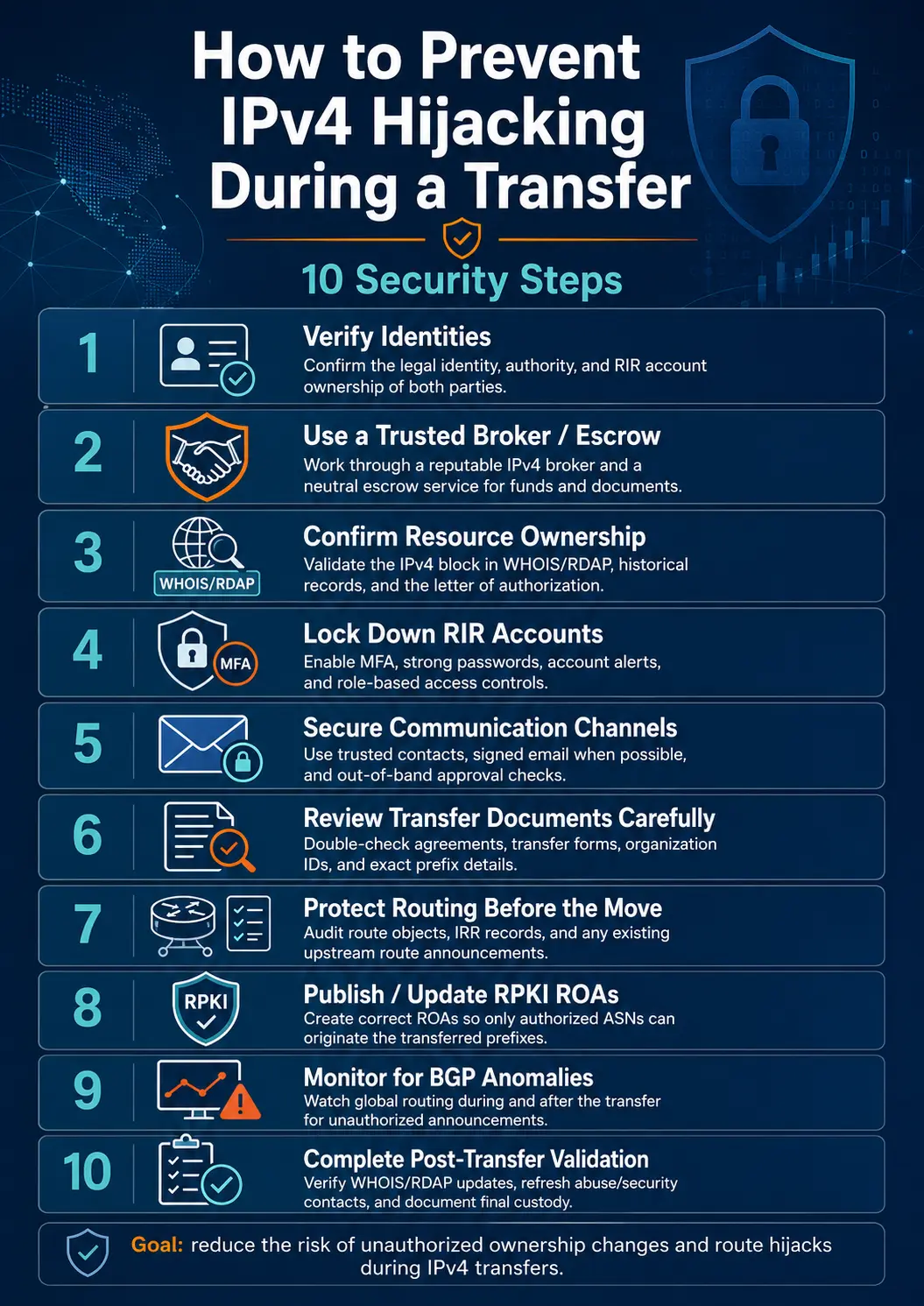
How to Prevent IPv4 Hijacking During a Transfer: 10 Security Steps
Transferring IPv4 address space is not only a commercial and registry process. It is also a sensitive routing operation. During an IPv4 transfer, control of a prefix moves from one organization to another. Registry records, Route Origin Authorizations, Internet Routing Registry objects, upstream-provider filters, reverse DNS settings, and live BGP announcements may all need to change. When these changes are completed in the wrong order—or when identity and authorizationRead more Related Posts How to Prevent IPv4 Hijacking During a Transfer: 10 Security Steps Transferring IPv4 address space is not only a commercial and registry process. It is also a sensitive routing operation. During Why the Cheapest IPv4 Lease May Cost More in the Long Run A low monthly price may look attractive during procurement, but the real cost of leased IPv4 addresses includes much more What Is a /24 IPv4 Subnet and Why Is It Popular for Leasing? A /24 IPv4 subnet is one of the most common block sizes in the IPv4 leasing market. For hosting providers, .related-post {} .related-post .post-list { text-align: left; } .related-post .post-list .item { margin: 5px; padding: 10px; } .related-post .headline { font-size: 18px !important; color: #999999 !important; } .related-post .post-list .item .post_thumb { max-height: 220px; margin: 10px 0px; padding: 0px; display: block; } .related-post .post-list .item .post_title { font-size: 16px; color: #3f3f3f; margin: 10px 0px; padding: 0px; display: block; text-decoration: none; } .related-post .post-list .item .post_excerpt { font-size: 13px; color: #3f3f3f; margin: 10px 0px; padding: 0px; display: block; text-decoration: none; } @media only screen and (min-width: 1024px) { .related-post .post-list .item { width: 30%; } } @media only screen and (min-width: 768px) and (max-width: 1023px) { .related-post .post-list .item { width: 90%; } } @media only screen and (min-width: 0px) and (max-width: 767px) { .related-post .post-list .item { width: 90%; } }
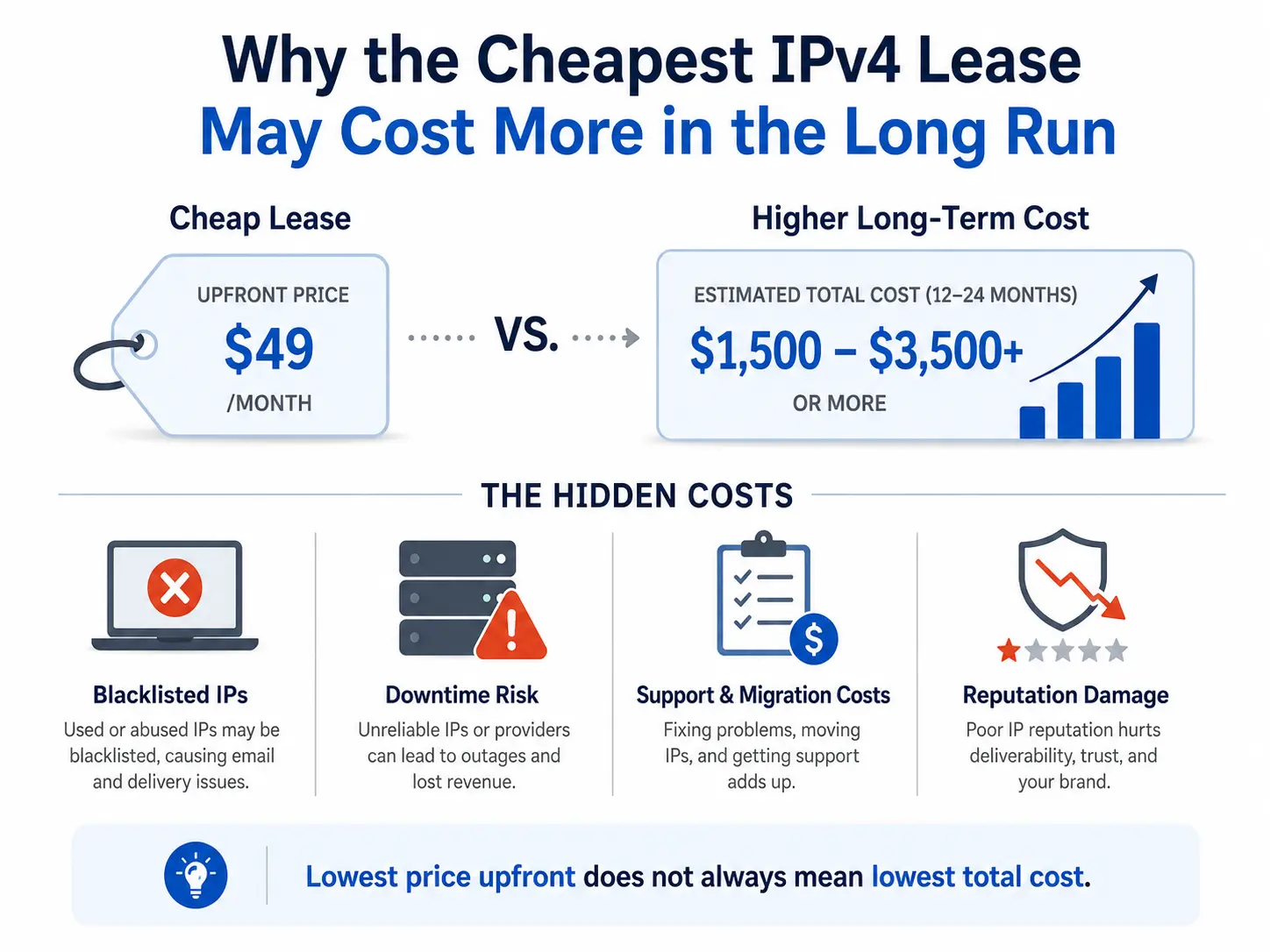
Why the Cheapest IPv4 Lease May Cost More in the Long Run
A low monthly price may look attractive during procurement, but the real cost of leased IPv4 addresses includes much more than the advertised rate. Poor IP reputation, incomplete routing authorisation, deployment delays, weak technical support, incorrect geolocation and uncertain renewal terms can quickly erase the initial saving. For testing or short-lived projects, a basic low-cost IPv4 lease may be sufficient. For production networks, however, businesses should evaluate the totalRead more Related Posts How to Prevent IPv4 Hijacking During a Transfer: 10 Security Steps Transferring IPv4 address space is not only a commercial and registry process. It is also a sensitive routing operation. During Why the Cheapest IPv4 Lease May Cost More in the Long Run A low monthly price may look attractive during procurement, but the real cost of leased IPv4 addresses includes much more What Is a /24 IPv4 Subnet and Why Is It Popular for Leasing? A /24 IPv4 subnet is one of the most common block sizes in the IPv4 leasing market. For hosting providers, .related-post {} .related-post .post-list { text-align: left; } .related-post .post-list .item { margin: 5px; padding: 10px; } .related-post .headline { font-size: 18px !important; color: #999999 !important; } .related-post .post-list .item .post_thumb { max-height: 220px; margin: 10px 0px; padding: 0px; display: block; } .related-post .post-list .item .post_title { font-size: 16px; color: #3f3f3f; margin: 10px 0px; padding: 0px; display: block; text-decoration: none; } .related-post .post-list .item .post_excerpt { font-size: 13px; color: #3f3f3f; margin: 10px 0px; padding: 0px; display: block; text-decoration: none; } @media only screen and (min-width: 1024px) { .related-post .post-list .item { width: 30%; } } @media only screen and (min-width: 768px) and (max-width: 1023px) { .related-post .post-list .item { width: 90%; } } @media only screen and (min-width: 0px) and (max-width: 767px) { .related-post .post-list .item { width: 90%; } }
What causes IPv4 deals to stall after the first agreement
IPv4 deals usually stall after the first agreement because agreeing on price is only the commercial beginning—not operational completion. A buyer and seller may agree on a block and price within hours, but the transaction can still be delayed by unclear ownership, incomplete documents, mismatched Regional Internet Registry requirements, recipient eligibility, reputation concerns, payment conditions, or missing routing authorization. The most common causes are: The seller’s authority over theRead more Related Posts How to Prevent IPv4 Hijacking During a Transfer: 10 Security Steps Transferring IPv4 address space is not only a commercial and registry process. It is also a sensitive routing operation. During Why the Cheapest IPv4 Lease May Cost More in the Long Run A low monthly price may look attractive during procurement, but the real cost of leased IPv4 addresses includes much more What Is a /24 IPv4 Subnet and Why Is It Popular for Leasing? A /24 IPv4 subnet is one of the most common block sizes in the IPv4 leasing market. For hosting providers, .related-post {} .related-post .post-list { text-align: left; } .related-post .post-list .item { margin: 5px; padding: 10px; } .related-post .headline { font-size: 18px !important; color: #999999 !important; } .related-post .post-list .item .post_thumb { max-height: 220px; margin: 10px 0px; padding: 0px; display: block; } .related-post .post-list .item .post_title { font-size: 16px; color: #3f3f3f; margin: 10px 0px; padding: 0px; display: block; text-decoration: none; } .related-post .post-list .item .post_excerpt { font-size: 13px; color: #3f3f3f; margin: 10px 0px; padding: 0px; display: block; text-decoration: none; } @media only screen and (min-width: 1024px) { .related-post .post-list .item { width: 30%; } } @media only screen and (min-width: 768px) and (max-width: 1023px) { .related-post .post-list .item { width: 90%; } } @media only screen and (min-width: 0px) and (max-width: 767px) { .related-post .post-list .item { width: 90%; } }
