IPv4 Renting Solutions for Small Businesses in the US
 admin
admin
IPv4, based on a 32-bit system with four blocks of characters, provides approximately four billion addresses.
Table of Contents
However, with the increasing number of connected devices, IPv4 is no longer sufficient. IPv6, with its 128-bit system, offers an almost infinite number of IP addresses, thanks to eight hexadecimal character blocks.
This long-term solution, however, could be a big jump for some small businesses in the United States.
As a workable alternative, many businesses turn to IPv4 renting solutions.
1.0 Benefits of a Static IP Address for Small Businesses
A static IP address is an unchanging address assigned by an Internet service provider to a device. It remains constant even after device restarts, much like a phone number that doesn’t change.
1.1 Small businesses benefit from static IP addresses in various ways
More stability:
Static IPs are unchanging. This contributes to the stability of network applications and reliable connections.
Easy accessibility:
A static IP makes it easy for computers to reach your server globally. This leads to better website access.
Remote workplaces:
It simplifies remote work in the home office or during business trips.
Professional communication:
It supports functions like telephone conferences, video calls, and collaboration.
Geolocation:
A static IP allows other services to determine your location, which is useful for local information and search results.
1.1.2 Dynamic IP Addresses
Most routers provide dynamic IP addresses, which change with each internet session, typically every 24 hours. This is practical for privacy but can be compared to a changing phone number for communication.
Determining Your IP Address Type
You can check your current IP address with a web search for “what is my IP.” If it changes after 24 hours, you’re likely on a dynamic IP address.
Obtaining a Static IP Address
Major ISPs like Vodafone, Google Fiber, and AT&T offer static IP addresses. Inform your service provider to set this up. It’s initially assigned automatically and can be redefined later.
2.0 IP Address Classes for Small Businesses
IP addresses are divided into classes.
Small businesses often use Class C addresses, which are assigned to organizations with small to medium-sized networks. Class C networks are the most common today and are characterized by the following:
Class C network addresses range from 192.0.0.0 to 223.255.255.255.
The first 24 bits of a Class C address determine the netid.
The first three bits are always 110 (e.g., 192), and the following 21 bits define the network.
There are 2,097,152 possible Class C networks.
In Class C networks, 8 bits are used to define the hostid, allowing for a maximum of 254 hostids per network.
3.0 Are Small and Medium-sized Businesses Ready for IPv6?
The short answer is: yes and no. There are strong arguments to why SMBs should consider IPv6.
Support from Providers: Internet service providers increasingly support IPv6 and may encourage its use.
IPv4 Costs: The cost of public IPv4 addresses is rising, impacting ISPs and MSPs. This may affect SMBs’ pricing.
Public Cloud and SaaS: These services offer IPv6 support, making it more attractive for SMBs to switch.
IoT: IPv6 is better suited for IoT networks, ensuring network separation and scalability.
4.0 Challenges for SMBs Looking to Adopt IPv6
Despite the benefits of IPv6, there are practical reasons that prevent SMBs from transitioning fully.
Technical challenges. SMBs need to smooth out issues when it comes to the compatibility of IPv4 and IPv6. For example, some older servers may not work with IPv6 as this version is not backwards compatible.
Diverse Technologies. Because SMBs use various technologies for collaboration, VPNs, SD-WAN, and cloud services, switching to IPv6 may create new challenges.
Cost. Transitioning to IPv6 requires equipment and human resource that may not be readily available to smaller businesses.
5.0 Closing Thoughts
Leasing IPv4 can be a solid strategy for businesses looking for long-term success. The key is to find a reputable IPv4 broker that can provide clean IP addresses at the best market price. Contact i.lease today for expert opinion on how to improve your online presence with a solid IPv4 strategy
Related Article
Related Posts
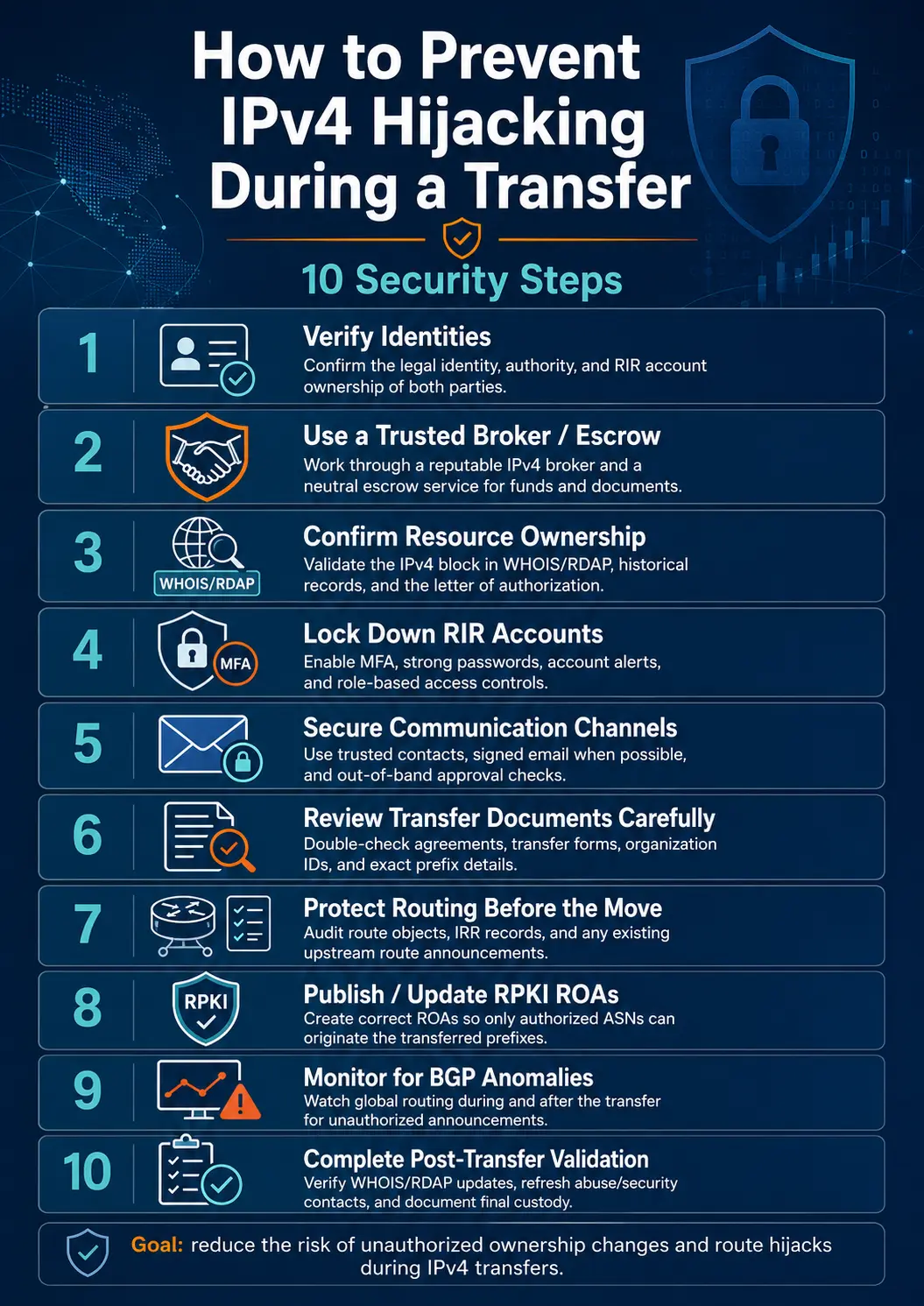
How to Prevent IPv4 Hijacking During a Transfer: 10 Security Steps
Transferring IPv4 address space is not only a commercial and registry process. It is also a sensitive routing operation. During an IPv4 transfer, control of a prefix moves from one organization to another. Registry records, Route Origin Authorizations, Internet Routing Registry objects, upstream-provider filters, reverse DNS settings, and live BGP announcements may all need to change. When these changes are completed in the wrong order—or when identity and authorizationRead more Related Posts How to Prevent IPv4 Hijacking During a Transfer: 10 Security Steps Transferring IPv4 address space is not only a commercial and registry process. It is also a sensitive routing operation. During Why the Cheapest IPv4 Lease May Cost More in the Long Run A low monthly price may look attractive during procurement, but the real cost of leased IPv4 addresses includes much more What Is a /24 IPv4 Subnet and Why Is It Popular for Leasing? A /24 IPv4 subnet is one of the most common block sizes in the IPv4 leasing market. For hosting providers, .related-post {} .related-post .post-list { text-align: left; } .related-post .post-list .item { margin: 5px; padding: 10px; } .related-post .headline { font-size: 18px !important; color: #999999 !important; } .related-post .post-list .item .post_thumb { max-height: 220px; margin: 10px 0px; padding: 0px; display: block; } .related-post .post-list .item .post_title { font-size: 16px; color: #3f3f3f; margin: 10px 0px; padding: 0px; display: block; text-decoration: none; } .related-post .post-list .item .post_excerpt { font-size: 13px; color: #3f3f3f; margin: 10px 0px; padding: 0px; display: block; text-decoration: none; } @media only screen and (min-width: 1024px) { .related-post .post-list .item { width: 30%; } } @media only screen and (min-width: 768px) and (max-width: 1023px) { .related-post .post-list .item { width: 90%; } } @media only screen and (min-width: 0px) and (max-width: 767px) { .related-post .post-list .item { width: 90%; } }
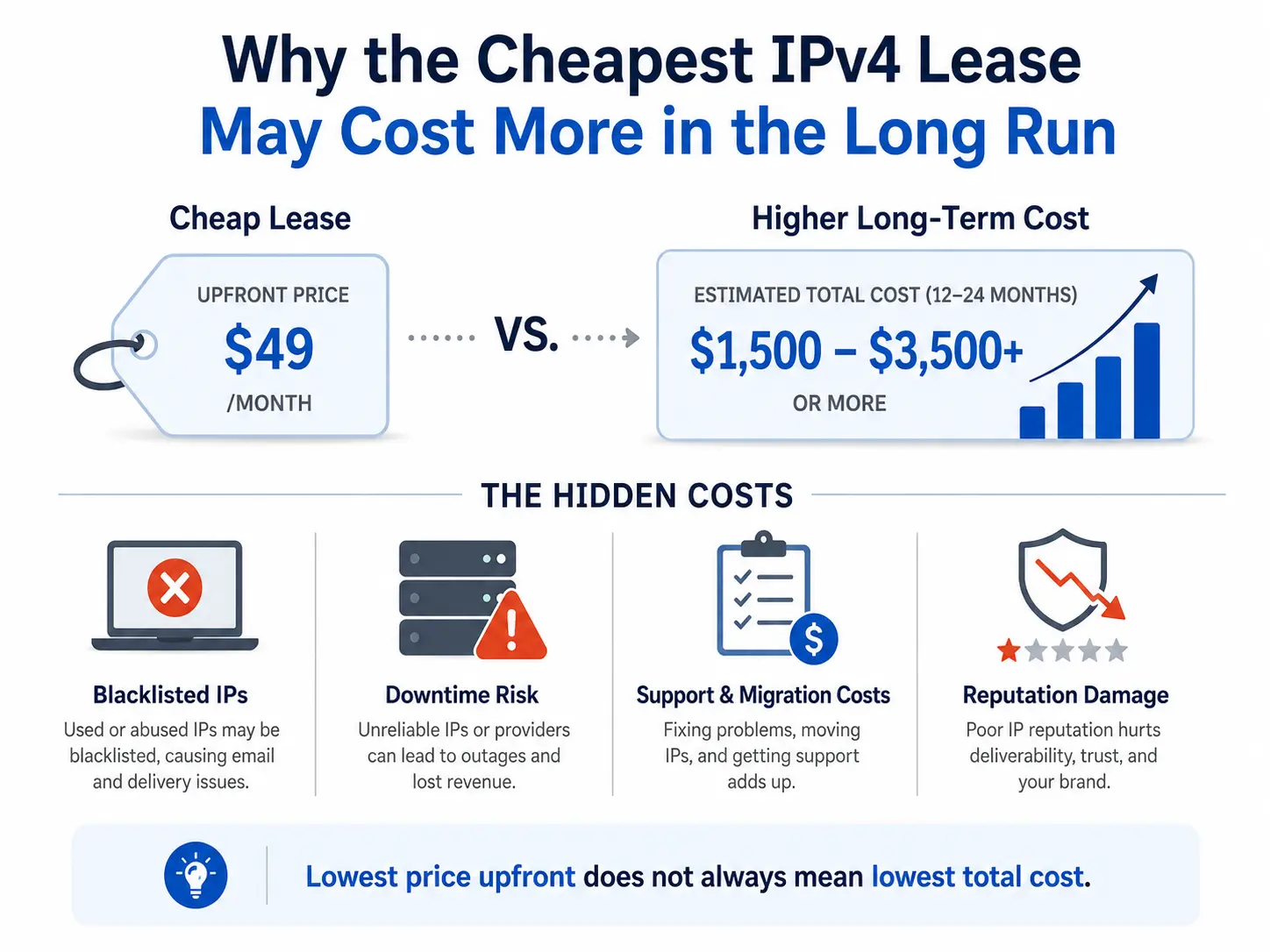
Why the Cheapest IPv4 Lease May Cost More in the Long Run
A low monthly price may look attractive during procurement, but the real cost of leased IPv4 addresses includes much more than the advertised rate. Poor IP reputation, incomplete routing authorisation, deployment delays, weak technical support, incorrect geolocation and uncertain renewal terms can quickly erase the initial saving. For testing or short-lived projects, a basic low-cost IPv4 lease may be sufficient. For production networks, however, businesses should evaluate the totalRead more Related Posts How to Prevent IPv4 Hijacking During a Transfer: 10 Security Steps Transferring IPv4 address space is not only a commercial and registry process. It is also a sensitive routing operation. During Why the Cheapest IPv4 Lease May Cost More in the Long Run A low monthly price may look attractive during procurement, but the real cost of leased IPv4 addresses includes much more What Is a /24 IPv4 Subnet and Why Is It Popular for Leasing? A /24 IPv4 subnet is one of the most common block sizes in the IPv4 leasing market. For hosting providers, .related-post {} .related-post .post-list { text-align: left; } .related-post .post-list .item { margin: 5px; padding: 10px; } .related-post .headline { font-size: 18px !important; color: #999999 !important; } .related-post .post-list .item .post_thumb { max-height: 220px; margin: 10px 0px; padding: 0px; display: block; } .related-post .post-list .item .post_title { font-size: 16px; color: #3f3f3f; margin: 10px 0px; padding: 0px; display: block; text-decoration: none; } .related-post .post-list .item .post_excerpt { font-size: 13px; color: #3f3f3f; margin: 10px 0px; padding: 0px; display: block; text-decoration: none; } @media only screen and (min-width: 1024px) { .related-post .post-list .item { width: 30%; } } @media only screen and (min-width: 768px) and (max-width: 1023px) { .related-post .post-list .item { width: 90%; } } @media only screen and (min-width: 0px) and (max-width: 767px) { .related-post .post-list .item { width: 90%; } }
What causes IPv4 deals to stall after the first agreement
IPv4 deals usually stall after the first agreement because agreeing on price is only the commercial beginning—not operational completion. A buyer and seller may agree on a block and price within hours, but the transaction can still be delayed by unclear ownership, incomplete documents, mismatched Regional Internet Registry requirements, recipient eligibility, reputation concerns, payment conditions, or missing routing authorization. The most common causes are: The seller’s authority over theRead more Related Posts How to Prevent IPv4 Hijacking During a Transfer: 10 Security Steps Transferring IPv4 address space is not only a commercial and registry process. It is also a sensitive routing operation. During Why the Cheapest IPv4 Lease May Cost More in the Long Run A low monthly price may look attractive during procurement, but the real cost of leased IPv4 addresses includes much more What Is a /24 IPv4 Subnet and Why Is It Popular for Leasing? A /24 IPv4 subnet is one of the most common block sizes in the IPv4 leasing market. For hosting providers, .related-post {} .related-post .post-list { text-align: left; } .related-post .post-list .item { margin: 5px; padding: 10px; } .related-post .headline { font-size: 18px !important; color: #999999 !important; } .related-post .post-list .item .post_thumb { max-height: 220px; margin: 10px 0px; padding: 0px; display: block; } .related-post .post-list .item .post_title { font-size: 16px; color: #3f3f3f; margin: 10px 0px; padding: 0px; display: block; text-decoration: none; } .related-post .post-list .item .post_excerpt { font-size: 13px; color: #3f3f3f; margin: 10px 0px; padding: 0px; display: block; text-decoration: none; } @media only screen and (min-width: 1024px) { .related-post .post-list .item { width: 30%; } } @media only screen and (min-width: 768px) and (max-width: 1023px) { .related-post .post-list .item { width: 90%; } } @media only screen and (min-width: 0px) and (max-width: 767px) { .related-post .post-list .item { width: 90%; } }
