Top 5 Benefits of Leasing IP Addresses for Global Businesses
 Stephanie
- Leasing IP addresses offers scalable, cost‑effective access to address space without the burden of ownership.
- It enables global businesses to improve performance, localisation and security across multiple regions.
Table of Contents
What does leasing IP addresses mean for global businesses?
Instead of buying IPv4 or IPv6 blocks altogether, leasing entails renting them from a supplier. This provides quick access to address space across several areas, which is essential for multinational corporations given the shortage of IPv4. Through leasing, expansions and short-term requirements can be easily met by transferring the cost from a significant capital investment to a manageable operational outlay. Renting or leasing addresses from Regional Internet Registries (RIRs) and brokers has become a common tactic since the IPv4 free pool has been completely exhausted.
Immediate scalability without large capital outlay
One of the strongest advantages of leasing IP addresses is financial flexibility. Instead of spending tens or hundreds of thousands of pounds to buy /18 or /19 blocks, businesses can rent the exact number of addresses needed, on demand. A recent analysis shows that leasing IPv4 addresses costs between US$0.30 and US$2.50 per IP per month, whereas purchasing even a small block may cost US$35 to US$60 per address. This is particularly valuable for start‑ups or organisations launching temporary infrastructure, as it reduces upfront costs and enables better use of budget elsewhere.
Geographic diversity and improved localisation
For global operations, having IP addresses that appear located in target markets can significantly improve service delivery. Leasing allows organisations to obtain IP blocks from different regions quickly. Pacific Connect points out that geographic diversity helps build a localised online presence and supports region‑specific marketing or content strategies. Whether it is a CDN needing presence in several continents or an e‑commerce platform aiming to appear “local”, leasing delivers geographic agility.
Speed of deployment and operational agility
When buying IP blocks, the process can take weeks or months, involving registry transfer and complex paperwork. Leasing is much quicker, with leasing platforms offering setup within days or even hours. LARUS boasts delivery of IPv4 address space within 48 hours, including Letter of Authorisation and global routing setup. This immediacy is key for businesses reacting to sudden capacity needs, whether launching marketing campaigns, extending infrastructure to new sites, or scaling support during peak seasons.
Address hygiene and security operations
Reputable leasing providers perform black‑list checks and offer abuse management services to protect clients from misbehaving IP ranges. InterLIR explains that leased blocks are carefully vetted and validated to ensure clean history. This is essential for entities sending email or managing private networks—weighing reputation and compliance risks. Leasing providers often include monitoring and routing protection, reducing management overhead and protecting customers’ services from hijacking or abuse.
Flexible lease terms and predictable budgeting
Leases usually offer an easy path to scale up or down. Unlike outright purchase, where addresses could remain unused, leases can be adjusted to align with demand. InterLIR cites flexibility and reduced risk of overcommitment as key advantages of leasing over buying. Pacific Connect highlights another benefit—leasing frees capital that can be invested elsewhere, offering immediate cost savings. As a result, leased assets become an operational expense, possibly with tax advantages over capital expenditure.
Operational considerations and best practise
While the advantages are compelling, leasing IP addresses carries important considerations. Organisations must carefully evaluate lease terms, compatibility with existing infrastructure, reputation history, lease break clauses and provider support. InterLIR warns that some providers may impose usage restrictions that might affect route policies or address portability. To get the most value, treat leasing as part of an overall IP strategy—choose clean addresses, align lease duration to business goals, and ensure providers offer global routing and RPKI/WHOIS updates. Excellent brokers like LARUS, play a key role in these processes.
Leasing compared to purchasing: a cost analysis
Cost‑benefit analysis demonstrates that leasing becomes less economical if used longer than around 3 to 4 years. According to PubConcierge, leasing might cost US$12 per IP in one year (at US$1/month), while a purchase at US$50 per IP becomes cost‑effective around the 4‑year mark. The break‑even timeframe depends on lease duration and business needs. For long‑term projects, purchasing may be preferable, but leasing remains advantageous for flexible and temporary deployments.
Supporting IPv6 transition
While IPv4 remains dominant, especially in legacy systems, IPv6 adoption continues. Leasing providers increasingly support IPv6 address leasing as well. Lease Packet offers both IPv4 and IPv6 leasing, allowing global businesses to future‑proof their infrastructure as part of a dual‑stack or IPv6‑first strategy.
Also Read: Can Your Business Survive a US$100 IPv4 Liability Gap?
Also Read: About IPv6: Benefits, Adoption & IPv4 Transition Planning
FAQs
1. What is the main difference between leasing and buying IP addresses?
Leasing involves renting address blocks as a flexible operational expense. Buying gives ownership as a capital asset but requires high upfront cost and long‑term commitment.
2. How quickly can a business get leased IP addresses?
Many providers, such as LARUS, promise setup and allocation within 48 hours after paperwork is complete .
3. Are leased IP addresses safe to use?
Yes, if sourced from reputable providers. Brokers conduct blacklist checks and set up abuse‑management frameworks to ensure address integrity.
4. When does leasing become more expensive than buying?
Based on current rates, leasing surpasses the cost of buying around the three to four year mark per IP address.
5. Can leased IP addresses handle global operations?
Absolutely. Leasing allows businesses to rent IP blocks from different regions, enabling localisation, compliance and better end‑user performance.
Related Posts
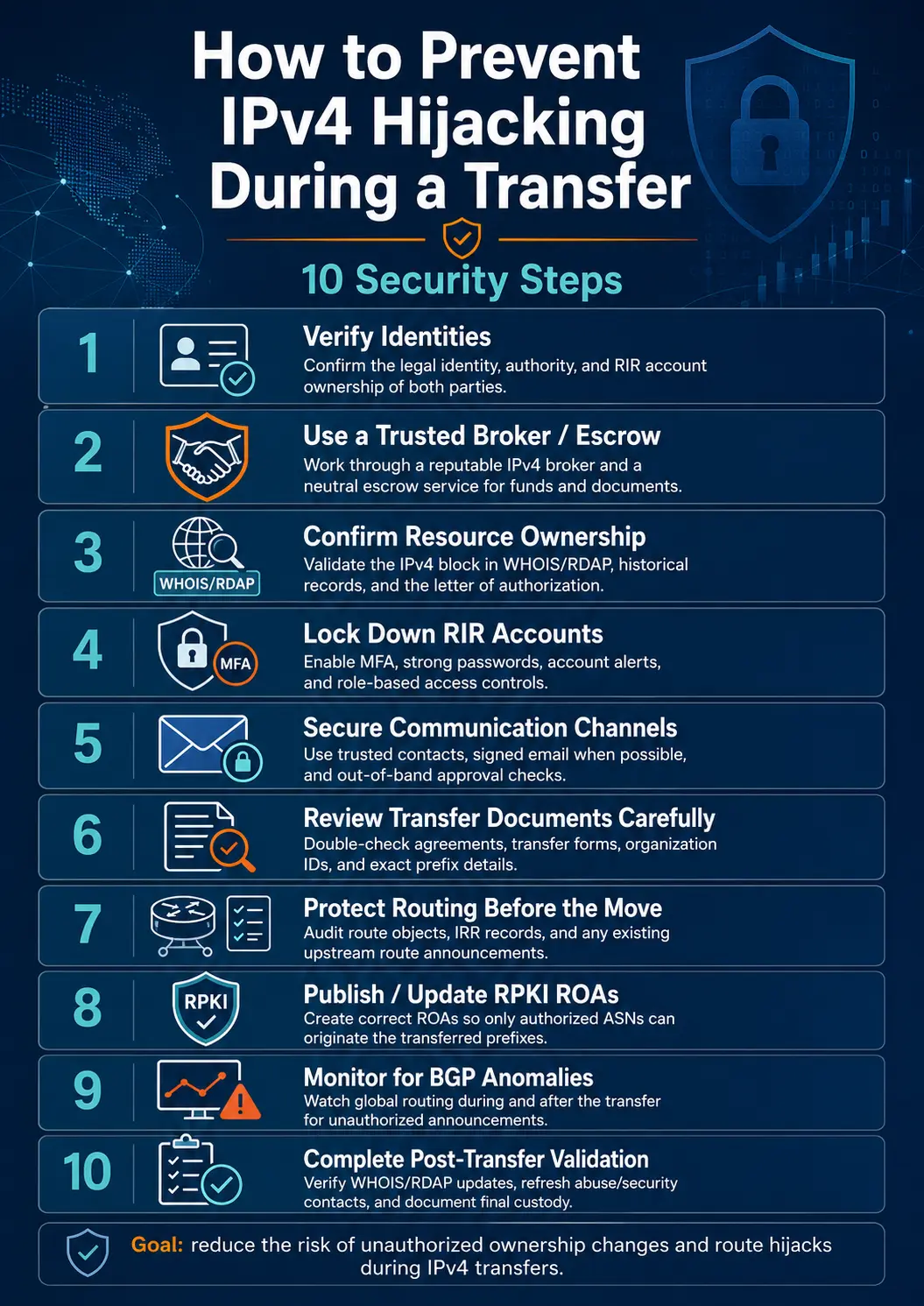
How to Prevent IPv4 Hijacking During a Transfer: 10 Security Steps
Transferring IPv4 address space is not only a commercial and registry process. It is also a sensitive routing operation. During an IPv4 transfer, control of a prefix moves from one organization to another. Registry records, Route Origin Authorizations, Internet Routing Registry objects, upstream-provider filters, reverse DNS settings, and live BGP announcements may all need to change. When these changes are completed in the wrong order—or when identity and authorizationRead more Related Posts How to Prevent IPv4 Hijacking During a Transfer: 10 Security Steps Transferring IPv4 address space is not only a commercial and registry process. It is also a sensitive routing operation. During Why the Cheapest IPv4 Lease May Cost More in the Long Run A low monthly price may look attractive during procurement, but the real cost of leased IPv4 addresses includes much more What Is a /24 IPv4 Subnet and Why Is It Popular for Leasing? A /24 IPv4 subnet is one of the most common block sizes in the IPv4 leasing market. For hosting providers, .related-post {} .related-post .post-list { text-align: left; } .related-post .post-list .item { margin: 5px; padding: 10px; } .related-post .headline { font-size: 18px !important; color: #999999 !important; } .related-post .post-list .item .post_thumb { max-height: 220px; margin: 10px 0px; padding: 0px; display: block; } .related-post .post-list .item .post_title { font-size: 16px; color: #3f3f3f; margin: 10px 0px; padding: 0px; display: block; text-decoration: none; } .related-post .post-list .item .post_excerpt { font-size: 13px; color: #3f3f3f; margin: 10px 0px; padding: 0px; display: block; text-decoration: none; } @media only screen and (min-width: 1024px) { .related-post .post-list .item { width: 30%; } } @media only screen and (min-width: 768px) and (max-width: 1023px) { .related-post .post-list .item { width: 90%; } } @media only screen and (min-width: 0px) and (max-width: 767px) { .related-post .post-list .item { width: 90%; } }
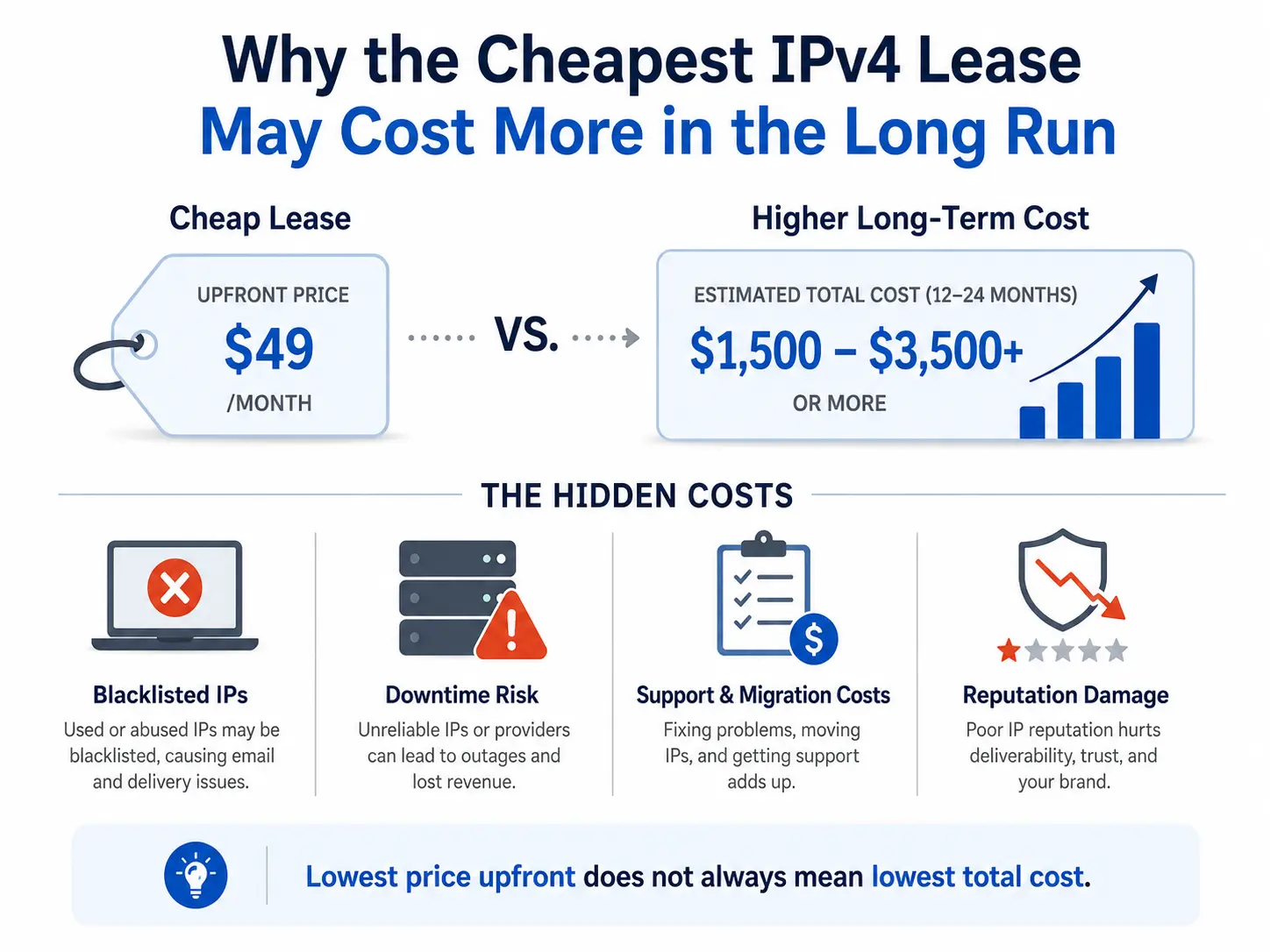
Why the Cheapest IPv4 Lease May Cost More in the Long Run
A low monthly price may look attractive during procurement, but the real cost of leased IPv4 addresses includes much more than the advertised rate. Poor IP reputation, incomplete routing authorisation, deployment delays, weak technical support, incorrect geolocation and uncertain renewal terms can quickly erase the initial saving. For testing or short-lived projects, a basic low-cost IPv4 lease may be sufficient. For production networks, however, businesses should evaluate the totalRead more Related Posts How to Prevent IPv4 Hijacking During a Transfer: 10 Security Steps Transferring IPv4 address space is not only a commercial and registry process. It is also a sensitive routing operation. During Why the Cheapest IPv4 Lease May Cost More in the Long Run A low monthly price may look attractive during procurement, but the real cost of leased IPv4 addresses includes much more What Is a /24 IPv4 Subnet and Why Is It Popular for Leasing? A /24 IPv4 subnet is one of the most common block sizes in the IPv4 leasing market. For hosting providers, .related-post {} .related-post .post-list { text-align: left; } .related-post .post-list .item { margin: 5px; padding: 10px; } .related-post .headline { font-size: 18px !important; color: #999999 !important; } .related-post .post-list .item .post_thumb { max-height: 220px; margin: 10px 0px; padding: 0px; display: block; } .related-post .post-list .item .post_title { font-size: 16px; color: #3f3f3f; margin: 10px 0px; padding: 0px; display: block; text-decoration: none; } .related-post .post-list .item .post_excerpt { font-size: 13px; color: #3f3f3f; margin: 10px 0px; padding: 0px; display: block; text-decoration: none; } @media only screen and (min-width: 1024px) { .related-post .post-list .item { width: 30%; } } @media only screen and (min-width: 768px) and (max-width: 1023px) { .related-post .post-list .item { width: 90%; } } @media only screen and (min-width: 0px) and (max-width: 767px) { .related-post .post-list .item { width: 90%; } }
What causes IPv4 deals to stall after the first agreement
IPv4 deals usually stall after the first agreement because agreeing on price is only the commercial beginning—not operational completion. A buyer and seller may agree on a block and price within hours, but the transaction can still be delayed by unclear ownership, incomplete documents, mismatched Regional Internet Registry requirements, recipient eligibility, reputation concerns, payment conditions, or missing routing authorization. The most common causes are: The seller’s authority over theRead more Related Posts How to Prevent IPv4 Hijacking During a Transfer: 10 Security Steps Transferring IPv4 address space is not only a commercial and registry process. It is also a sensitive routing operation. During Why the Cheapest IPv4 Lease May Cost More in the Long Run A low monthly price may look attractive during procurement, but the real cost of leased IPv4 addresses includes much more What Is a /24 IPv4 Subnet and Why Is It Popular for Leasing? A /24 IPv4 subnet is one of the most common block sizes in the IPv4 leasing market. For hosting providers, .related-post {} .related-post .post-list { text-align: left; } .related-post .post-list .item { margin: 5px; padding: 10px; } .related-post .headline { font-size: 18px !important; color: #999999 !important; } .related-post .post-list .item .post_thumb { max-height: 220px; margin: 10px 0px; padding: 0px; display: block; } .related-post .post-list .item .post_title { font-size: 16px; color: #3f3f3f; margin: 10px 0px; padding: 0px; display: block; text-decoration: none; } .related-post .post-list .item .post_excerpt { font-size: 13px; color: #3f3f3f; margin: 10px 0px; padding: 0px; display: block; text-decoration: none; } @media only screen and (min-width: 1024px) { .related-post .post-list .item { width: 30%; } } @media only screen and (min-width: 768px) and (max-width: 1023px) { .related-post .post-list .item { width: 90%; } } @media only screen and (min-width: 0px) and (max-width: 767px) { .related-post .post-list .item { width: 90%; } }
