What is IPv6 Addressing
 admin
admin
1.0 What is IPv6
Imagine the internet as a vast, intricate network of roads where each device, be it a computer, smartphone, or any internet-enabled gadget, is a vehicle needing a unique address to travel the digital highways.
Table of Contents
IPv6, the sixth iteration of the Internet Protocol, provides these addresses in the form of a 128-bit hexadecimal value. This extensive address space is a stark contrast to its predecessor, IPv4, which used a 32-bit address scheme, resulting in the exhaustion of available addresses due to the explosive growth of internet-connected devices.
2.0 Key Characteristics of IPv6
2.1 Hexadecimal Notation
IPv6 addresses use hexadecimal notation (numbers and lettters) and consist of eight groups of four hexadecimal digits separated by colons. This alphanumeric representation allows for a significantly larger number of possible addresses.
2.2 Address Types: Unicast, Multicast, and Anycast
IPv6 introduces different types of addresses. Unicast addresses identify a single interface, multicast addresses identify multiple interfaces, and anycast addresses represent a group of interfaces where data is sent to the nearest one.
2.3 Internet of Things (IoT) Compatibility
The proliferation of IoT devices requires a robust addressing system. IPv6’s broad address space and efficient routing make it ideal for connecting and managing myriad IoT devices. Due to IPv4 limitations and security concerns, this address space may be exhausted and is less suitable for
2.4 Automatic Configuration (SLAAC)
IPv6 introduces several noteworthy features. One such feature is Stateless Address Auto configuration (SLAAC), allowing devices to configure their addresses automatically without the need for a centralized DHCP server.
3.0 Differences between IPv4 and IPv6
3.1 Address Length
The most evident difference between IPv6 and its predecessor is address length. IPv4 addresses are 32 bits long, and its limited 4.3 billion addresses, became insufficient as the number of devices surged, while IPv6 addresses are 128 bits long, offering an exponentially larger pool of addresses.
3.2 Improved Security
IPv6 incorporates features like IPsec (Internet Protocol Security) as a mandatory element, enhancing the security of data transmitted over networks. It enhances network security through built-in IPsec (Internet Protocol Security), ensuring encrypted communication between devices.
4.0 Why Support IPv6?
Supporting IPv6 is no longer an option; it’s a necessity. With the proliferation of Internet of Things (IoT) devices and the ongoing transition to an all-encompassing digital society, IPv6 provides the means to accommodate this surge seamlessly.
Internet Service Providers (ISPs), businesses, and governments worldwide are making the shift to IPv6 to guarantee continued connectivity for their users and to enable the proliferation of innovative technologies.
5.0 Advantages and Disadvantages of IPv6
5.1 Advantages of IPv6
a. Efficient Routing:
IPv6 introduces a hierarchical address allocation system that reduces the size of routing tables. This efficient routing enhances the speed and effectiveness of data transmission across networks.
b. Increased Capacity:
With its 128-bit addressing scheme, IPv6 provides an extensive address space compared to IPv4. This abundance of addresses accommodates the growing number of devices connected to the internet and supports the growth of the Internet of Things (IoT) industry.
c. Enhanced Security:
IPv6 incorporates built-in security features through Internet Protocol Security (IPsec), providing end-to-end encryption and authentication. This helps protect data and communication from unauthorized access and cyber threats
d. Aggregation of Prefixes:
IPv6 allows easy aggregation of prefixes assigned to IP networks, which simplifies routing table management and enhances network efficiency
e. Larger Data Packets:
IPv6 supports larger packet sizes, enabling more data to be transmitted simultaneously. This feature optimizes bandwidth usage and enhances overall network performance
5.2 Disadvantages of IPv6
a. Transition Challenges:
Migrating from IPv4 to IPv6 presents technical challenges, such as ensuring compatibility between the two protocols during the coexistence phase
b. Coexistence with IPv4:
During the transition period, devices using IPv4 need to coexist with those using IPv6. This compatibility requirement can lead to complexities in managing dual-stack networks.
c. Conversion Time:
The process of converting infrastructure, software, and devices from IPv4 to IPv6 can be time-consuming and resource-intensive.
d. Slow Global Adoption:
While IPv6 offers numerous benefits, its adoption has been relatively slow due to various factors, including the vast number of existing IPv4 devices and networks.
e. Cost of Replacement:
Replacing IPv4 devices with IPv6-capable ones can incur costs for organizations, especially when dealing with legacy systems. Hardware and system upgrades might be necessary to make a network fully compatible with IPv6.
f. Complexity in Addressing:
IPv6 addresses are longer and can be challenging to remember or manage, potentially leading to addressing complexities
IPv6 offers several advantages, including efficient routing, increased capacity, and enhanced security. However, the transition and coexistence challenges, along with slow global adoption and addressing complexities, contribute to its disadvantages. Organizations must carefully evaluate their needs and weigh the pros and cons before making the transition to IPv6.
6.0 How Does IPv6 Work?
At its core, IPv6 functions similarly to its predecessor by routing data packets across networks. The key difference lies in the expanded address space and the elimination of Network Address Translation (NAT).
NA allows you to use only one public IP address and assign private IP addresses to devices within your network. It is a technique used in IPv4 to conserve addresses. However, it often hindered peer-to-peer communication. IPv6’s abundant addresses and simplified header structure facilitate direct communication, enhancing the efficiency of data transfer.
7.0 Challenges of Implementing IPv6
7.1. Network Hardware and Software Compatibility
a. Highlighting Outdated Network Devices and Software:
The foremost challenge lies in the vast number of network components that do not possess native IPv6 compatibility. Routers, firewalls, and other network equipment designed for IPv4 can create bottlenecks, leading to performance degradation and potential security breaches.
b. Emphasizing the Importance of Updating:
To circumvent these issues, it is imperative for organizations to invest in upgrading their network infrastructure. Up-to-date routers, firewalls, and other devices that support IPv6 ensure seamless communication and enhance network security.
This transition is not just a technological upgrade; it’s a safeguard against cyber threats.
7.2. Lack of IPv6 Knowledge
a. Addressing the Skill Gap:
The lack of skilled professionals equipped to handle IPv6-related challenges is a roadblock to its smooth integration. Organizations often struggle to find individuals with comprehensive knowledge of IPv6 implementation.
b. Suggesting Training and Certification:
To bridge this gap, training and certification programs play a vital role. Encouraging network administrators and IT professionals to undergo IPv6-focused training can empower them with the necessary skills.
Certification programs validate their expertise, boosting their confidence and ensuring they’re equipped to handle the complexities of IPv6 adoption.
7.3. Addressing Scheme Transition
a. Navigating Addressing Format Incompatibility:
IPv4 and IPv6 employ different addressing formats, making a smooth transition challenging. Organizations must reconfigure their networks to accommodate the longer IPv6 addresses, requiring a comprehensive restructuring.
b. Dealing with Dual-Stack Complexity and Translation Mechanisms:
Organizations often opt for a dual-stack approach, allowing both IPv4 and IPv6 to coexist during the transition. However, simultaneously managing two address formats adds complexity.
Additionally, the need for translation mechanisms, like NAT64, arises due to the incompatibility between the two protocols. NAT64 facilitates communication between IPv4 and IPv6 devices by translating their addresses, enabling seamless interaction.
8.0 Conclusion
IPv6 stands as the solution to the challenges posed by the rapidly expanding digital landscape. Its extensive address space, enhanced security features, and efficiency improvements make it the backbone of the future internet.
While the transition might present hurdles, the benefits far outweigh the challenges. Embracing IPv6 is not just a technological shift, but a strategic step towards ensuring uninterrupted connectivity and innovation in the digital age.
Frequently Asked Questions
a. Is IPv6 fully replacing IPv4?
While IPv6 is designed to replace IPv4 eventually, the transition is gradual due to the sheer scale of existing IPv4 infrastructure.
b. How does IPv6 impact cybersecurity?
IPv6’s built-in IPsec enhances security, but misconfigurations can still pose risks. Proper implementation and regular updates are crucial.
c. Will my current devices work with IPv6?
Most modern devices are IPv6-compatible, but older devices might need updates or replacements to fully utilize IPv6.
d. How does IPv6 affect website owners and businesses?
Website owners and businesses must ensure their online presence is accessible via IPv6 to cater to users and devices leveraging this protocol.
e. What steps can organizations take to ease the transition to IPv6?
Organizations should conduct thorough assessments, upgrade systems, train IT staff, and gradually implement IPv6 alongside IPv4 during the transition.
f. Is it necessary for all devices to transition to IPv6 immediately?
While it’s recommended for future-proofing, a gradual transition using dual-stack implementation allows devices to communicate using both IPv4 and IPv6.
Related Posts
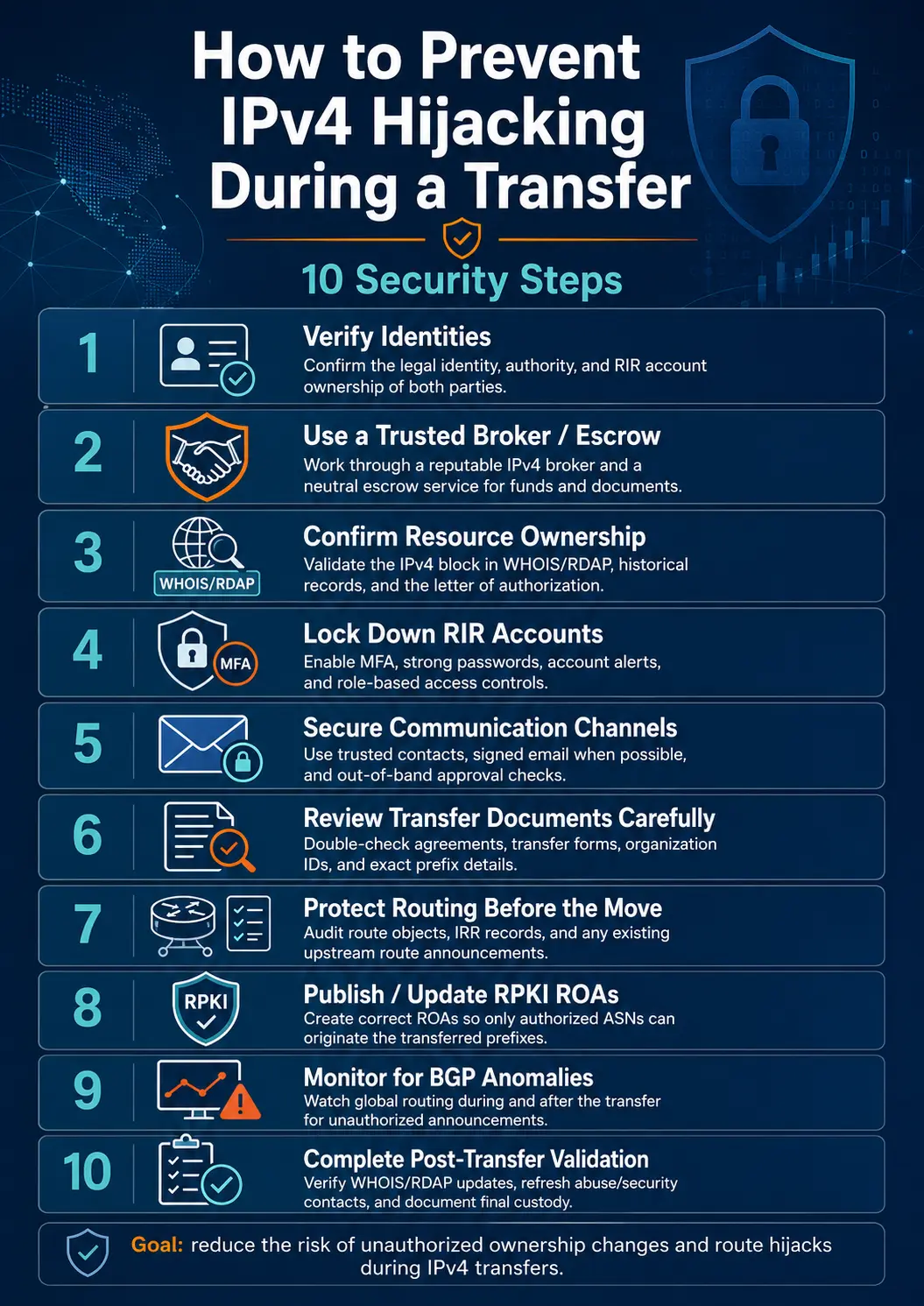
How to Prevent IPv4 Hijacking During a Transfer: 10 Security Steps
Transferring IPv4 address space is not only a commercial and registry process. It is also a sensitive routing operation. During an IPv4 transfer, control of a prefix moves from one organization to another. Registry records, Route Origin Authorizations, Internet Routing Registry objects, upstream-provider filters, reverse DNS settings, and live BGP announcements may all need to change. When these changes are completed in the wrong order—or when identity and authorizationRead more Related Posts How to Prevent IPv4 Hijacking During a Transfer: 10 Security Steps Transferring IPv4 address space is not only a commercial and registry process. It is also a sensitive routing operation. During Why the Cheapest IPv4 Lease May Cost More in the Long Run A low monthly price may look attractive during procurement, but the real cost of leased IPv4 addresses includes much more What Is a /24 IPv4 Subnet and Why Is It Popular for Leasing? A /24 IPv4 subnet is one of the most common block sizes in the IPv4 leasing market. For hosting providers, .related-post {} .related-post .post-list { text-align: left; } .related-post .post-list .item { margin: 5px; padding: 10px; } .related-post .headline { font-size: 18px !important; color: #999999 !important; } .related-post .post-list .item .post_thumb { max-height: 220px; margin: 10px 0px; padding: 0px; display: block; } .related-post .post-list .item .post_title { font-size: 16px; color: #3f3f3f; margin: 10px 0px; padding: 0px; display: block; text-decoration: none; } .related-post .post-list .item .post_excerpt { font-size: 13px; color: #3f3f3f; margin: 10px 0px; padding: 0px; display: block; text-decoration: none; } @media only screen and (min-width: 1024px) { .related-post .post-list .item { width: 30%; } } @media only screen and (min-width: 768px) and (max-width: 1023px) { .related-post .post-list .item { width: 90%; } } @media only screen and (min-width: 0px) and (max-width: 767px) { .related-post .post-list .item { width: 90%; } }
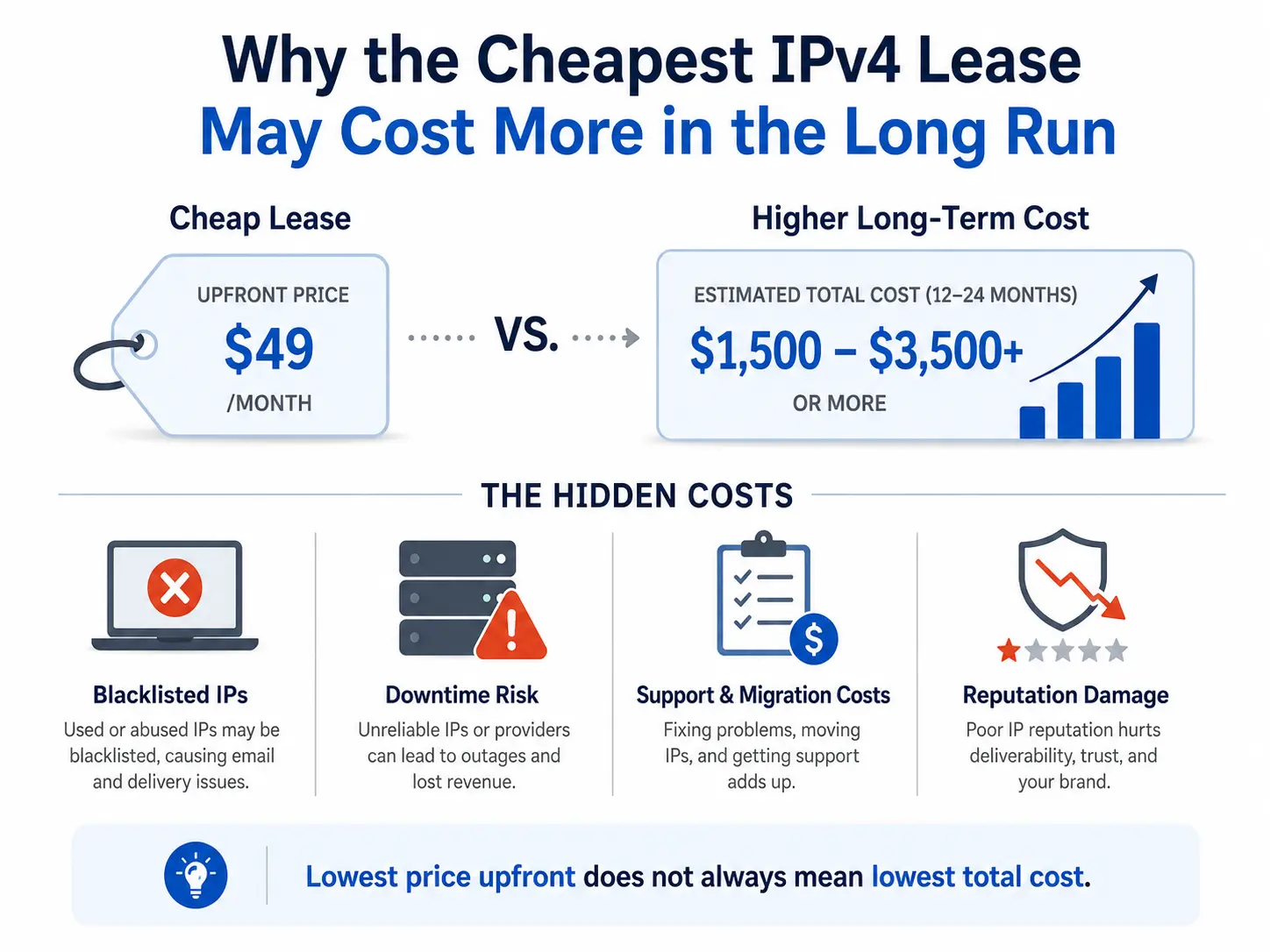
Why the Cheapest IPv4 Lease May Cost More in the Long Run
A low monthly price may look attractive during procurement, but the real cost of leased IPv4 addresses includes much more than the advertised rate. Poor IP reputation, incomplete routing authorisation, deployment delays, weak technical support, incorrect geolocation and uncertain renewal terms can quickly erase the initial saving. For testing or short-lived projects, a basic low-cost IPv4 lease may be sufficient. For production networks, however, businesses should evaluate the totalRead more Related Posts How to Prevent IPv4 Hijacking During a Transfer: 10 Security Steps Transferring IPv4 address space is not only a commercial and registry process. It is also a sensitive routing operation. During Why the Cheapest IPv4 Lease May Cost More in the Long Run A low monthly price may look attractive during procurement, but the real cost of leased IPv4 addresses includes much more What Is a /24 IPv4 Subnet and Why Is It Popular for Leasing? A /24 IPv4 subnet is one of the most common block sizes in the IPv4 leasing market. For hosting providers, .related-post {} .related-post .post-list { text-align: left; } .related-post .post-list .item { margin: 5px; padding: 10px; } .related-post .headline { font-size: 18px !important; color: #999999 !important; } .related-post .post-list .item .post_thumb { max-height: 220px; margin: 10px 0px; padding: 0px; display: block; } .related-post .post-list .item .post_title { font-size: 16px; color: #3f3f3f; margin: 10px 0px; padding: 0px; display: block; text-decoration: none; } .related-post .post-list .item .post_excerpt { font-size: 13px; color: #3f3f3f; margin: 10px 0px; padding: 0px; display: block; text-decoration: none; } @media only screen and (min-width: 1024px) { .related-post .post-list .item { width: 30%; } } @media only screen and (min-width: 768px) and (max-width: 1023px) { .related-post .post-list .item { width: 90%; } } @media only screen and (min-width: 0px) and (max-width: 767px) { .related-post .post-list .item { width: 90%; } }
What causes IPv4 deals to stall after the first agreement
IPv4 deals usually stall after the first agreement because agreeing on price is only the commercial beginning—not operational completion. A buyer and seller may agree on a block and price within hours, but the transaction can still be delayed by unclear ownership, incomplete documents, mismatched Regional Internet Registry requirements, recipient eligibility, reputation concerns, payment conditions, or missing routing authorization. The most common causes are: The seller’s authority over theRead more Related Posts How to Prevent IPv4 Hijacking During a Transfer: 10 Security Steps Transferring IPv4 address space is not only a commercial and registry process. It is also a sensitive routing operation. During Why the Cheapest IPv4 Lease May Cost More in the Long Run A low monthly price may look attractive during procurement, but the real cost of leased IPv4 addresses includes much more What Is a /24 IPv4 Subnet and Why Is It Popular for Leasing? A /24 IPv4 subnet is one of the most common block sizes in the IPv4 leasing market. For hosting providers, .related-post {} .related-post .post-list { text-align: left; } .related-post .post-list .item { margin: 5px; padding: 10px; } .related-post .headline { font-size: 18px !important; color: #999999 !important; } .related-post .post-list .item .post_thumb { max-height: 220px; margin: 10px 0px; padding: 0px; display: block; } .related-post .post-list .item .post_title { font-size: 16px; color: #3f3f3f; margin: 10px 0px; padding: 0px; display: block; text-decoration: none; } .related-post .post-list .item .post_excerpt { font-size: 13px; color: #3f3f3f; margin: 10px 0px; padding: 0px; display: block; text-decoration: none; } @media only screen and (min-width: 1024px) { .related-post .post-list .item { width: 30%; } } @media only screen and (min-width: 768px) and (max-width: 1023px) { .related-post .post-list .item { width: 90%; } } @media only screen and (min-width: 0px) and (max-width: 767px) { .related-post .post-list .item { width: 90%; } }
