How to Identify an IPv6 Prefix
 admin
admin
In IPv4, we use a subnet mask to identify the network that a device belongs to. But for IPv6, we use a prefix instead.
Table of Contents
How to Identify IPv6 Address on Windows, Mac, Android, and iOS:
1.0 Windows
1. Open a command prompt.
2. Type “ipconfig” and press Enter.
3. Locate the “IPv6 Address” field. An entry in this field indicates the presence of an IPv6 address.
2.0 Mac
1. Open a Terminal window.
2. Type “ipconfig getifaddr en0” and press Enter.
3. Observe the IPv6 address. If one is listed, it confirms the existence of an IPv6 address.
3.0 Android
1. Open the Settings app.
2. Navigate to “Network & Internet.”
3. Select “Wi-Fi.”
4. Choose the network you are connected to.
5. Verify the presence of an IPv6 address. Its presence indicates the existence of an IPv6 address.
4.0 iOS
1. Open the Settings app.
2. Access “Wi-Fi.”
3. Select the network to which you are connected.
4. Verify the presence of an IPv6 address in the settings. If one is displayed, it confirms the presence of an IPv6 address.
About IPv6 Prefixes: The Basics
An IPv6 prefix serves as the segment of an IPv6 address that designates the network. In other words, it determines whether a device belongs to a given network or if it should be routed elsewhere. The remaining portion of an IP address specifies the host within that network.
For instance, consider the IPv6 address 2001:1111:2222:3333::/64. In this example, the prefix consists of 64 bits. The initial 64 bits of the address refer to the network, while the subsequent 64 bits signify the host.
As you may notice, the prefix is denoted by a slash followed by the number of bits constituting the prefix. This notation is called classless inter-domain routing (CIDR) and is commonly used for setting up networks.
To determine the IPv6 prefix of an address, follow these steps:
1. Convert the IPv6 address to binary.
2. Calculate the count of leading zeros within the binary address.
3. The number of leading zeros equates to the prefix length.
For example, the binary rendition of the IPv6 address 2001:1111:2222:3333::/64 appears as follows:
11000000 00000001 00000011 00000011 00000011 00000000 00000000 00000000
This binary address contains 64 leading zeros, indicating a prefix length of 64.
Alternatively, you can skip doing the math by using different web-based tools to identify the IPv6 prefix of an address.
When operating with IPv6, understanding how IPv6 prefixes work is important. This will help you manage your network better and improve its performance.
Additional points to consider about IPv6:
1. The minimum prefix length is 64 bits.
2. The maximum prefix length is 128 bits.
3. Common prefix lengths encompass 64 bits and 128 bits.
4. Prefixes can be subdivided to form smaller subnets.
5. Aggregating prefixes facilitates the creation of larger networks.
If you are still unsure about how to verify your IPv6 address, consider reaching out to your Internet service provider (ISP). They can provide information about the availability of IPv6 in their services and guide you in configuration.
However, if you have concerns regarding IPv4, i.lease can help you. We are a reputable broker of IPv4 assets, with experts who can provide professional help for both IPv4 and IPv6.
Related Article
Related Posts
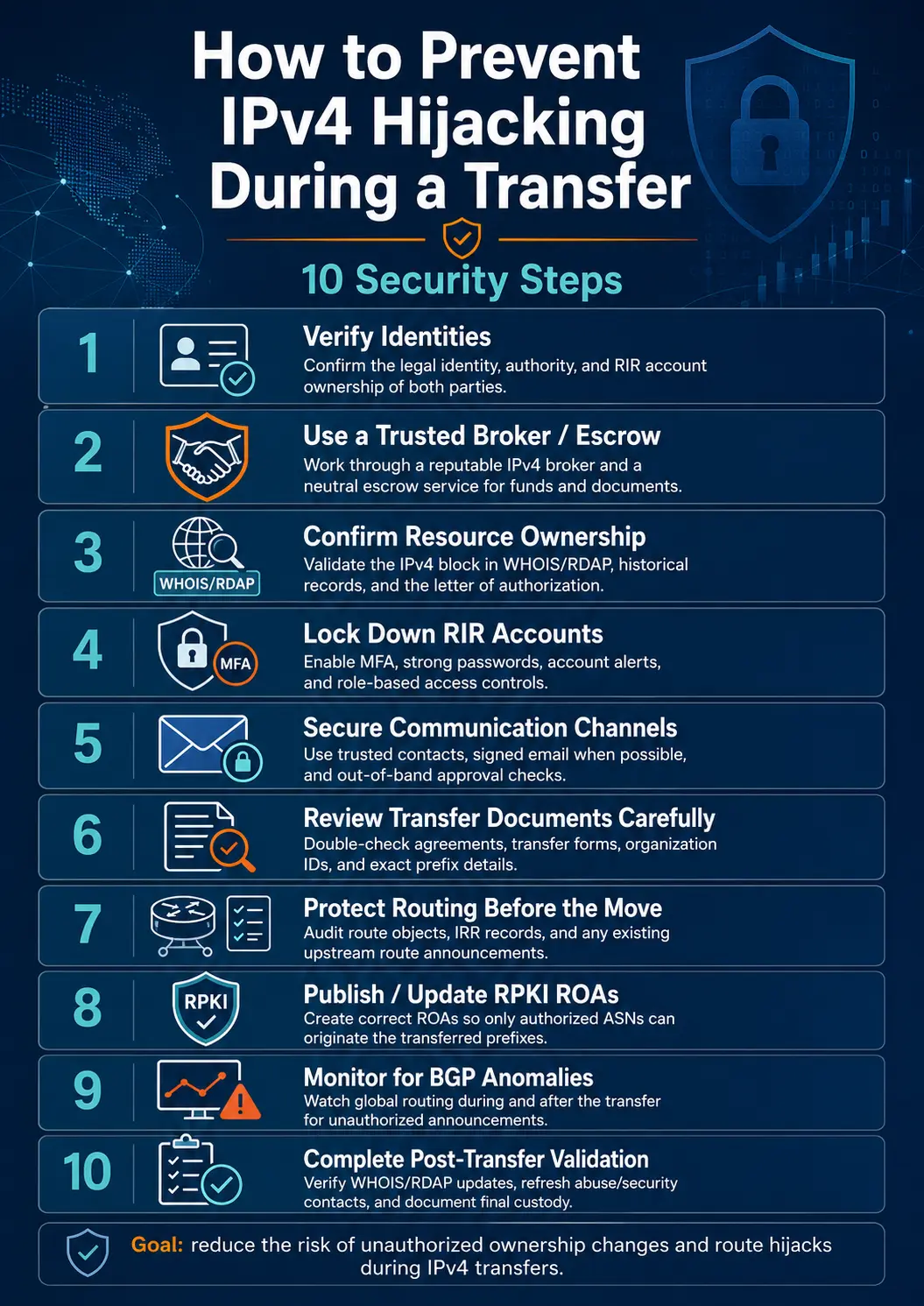
How to Prevent IPv4 Hijacking During a Transfer: 10 Security Steps
Transferring IPv4 address space is not only a commercial and registry process. It is also a sensitive routing operation. During an IPv4 transfer, control of a prefix moves from one organization to another. Registry records, Route Origin Authorizations, Internet Routing Registry objects, upstream-provider filters, reverse DNS settings, and live BGP announcements may all need to change. When these changes are completed in the wrong order—or when identity and authorizationRead more Related Posts How to Prevent IPv4 Hijacking During a Transfer: 10 Security Steps Transferring IPv4 address space is not only a commercial and registry process. It is also a sensitive routing operation. During Why the Cheapest IPv4 Lease May Cost More in the Long Run A low monthly price may look attractive during procurement, but the real cost of leased IPv4 addresses includes much more What Is a /24 IPv4 Subnet and Why Is It Popular for Leasing? A /24 IPv4 subnet is one of the most common block sizes in the IPv4 leasing market. For hosting providers, .related-post {} .related-post .post-list { text-align: left; } .related-post .post-list .item { margin: 5px; padding: 10px; } .related-post .headline { font-size: 18px !important; color: #999999 !important; } .related-post .post-list .item .post_thumb { max-height: 220px; margin: 10px 0px; padding: 0px; display: block; } .related-post .post-list .item .post_title { font-size: 16px; color: #3f3f3f; margin: 10px 0px; padding: 0px; display: block; text-decoration: none; } .related-post .post-list .item .post_excerpt { font-size: 13px; color: #3f3f3f; margin: 10px 0px; padding: 0px; display: block; text-decoration: none; } @media only screen and (min-width: 1024px) { .related-post .post-list .item { width: 30%; } } @media only screen and (min-width: 768px) and (max-width: 1023px) { .related-post .post-list .item { width: 90%; } } @media only screen and (min-width: 0px) and (max-width: 767px) { .related-post .post-list .item { width: 90%; } }
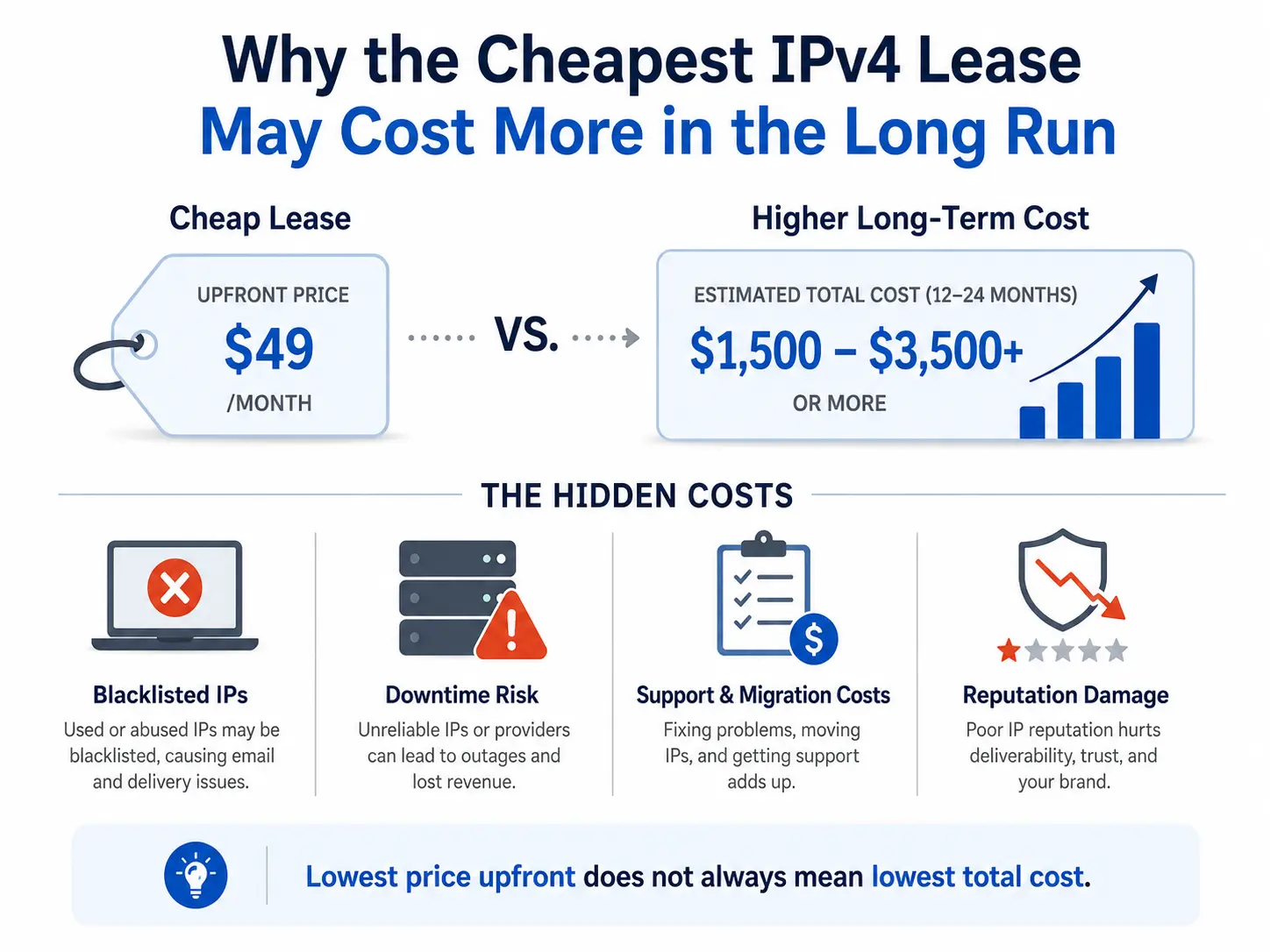
Why the Cheapest IPv4 Lease May Cost More in the Long Run
A low monthly price may look attractive during procurement, but the real cost of leased IPv4 addresses includes much more than the advertised rate. Poor IP reputation, incomplete routing authorisation, deployment delays, weak technical support, incorrect geolocation and uncertain renewal terms can quickly erase the initial saving. For testing or short-lived projects, a basic low-cost IPv4 lease may be sufficient. For production networks, however, businesses should evaluate the totalRead more Related Posts How to Prevent IPv4 Hijacking During a Transfer: 10 Security Steps Transferring IPv4 address space is not only a commercial and registry process. It is also a sensitive routing operation. During Why the Cheapest IPv4 Lease May Cost More in the Long Run A low monthly price may look attractive during procurement, but the real cost of leased IPv4 addresses includes much more What Is a /24 IPv4 Subnet and Why Is It Popular for Leasing? A /24 IPv4 subnet is one of the most common block sizes in the IPv4 leasing market. For hosting providers, .related-post {} .related-post .post-list { text-align: left; } .related-post .post-list .item { margin: 5px; padding: 10px; } .related-post .headline { font-size: 18px !important; color: #999999 !important; } .related-post .post-list .item .post_thumb { max-height: 220px; margin: 10px 0px; padding: 0px; display: block; } .related-post .post-list .item .post_title { font-size: 16px; color: #3f3f3f; margin: 10px 0px; padding: 0px; display: block; text-decoration: none; } .related-post .post-list .item .post_excerpt { font-size: 13px; color: #3f3f3f; margin: 10px 0px; padding: 0px; display: block; text-decoration: none; } @media only screen and (min-width: 1024px) { .related-post .post-list .item { width: 30%; } } @media only screen and (min-width: 768px) and (max-width: 1023px) { .related-post .post-list .item { width: 90%; } } @media only screen and (min-width: 0px) and (max-width: 767px) { .related-post .post-list .item { width: 90%; } }
What causes IPv4 deals to stall after the first agreement
IPv4 deals usually stall after the first agreement because agreeing on price is only the commercial beginning—not operational completion. A buyer and seller may agree on a block and price within hours, but the transaction can still be delayed by unclear ownership, incomplete documents, mismatched Regional Internet Registry requirements, recipient eligibility, reputation concerns, payment conditions, or missing routing authorization. The most common causes are: The seller’s authority over theRead more Related Posts How to Prevent IPv4 Hijacking During a Transfer: 10 Security Steps Transferring IPv4 address space is not only a commercial and registry process. It is also a sensitive routing operation. During Why the Cheapest IPv4 Lease May Cost More in the Long Run A low monthly price may look attractive during procurement, but the real cost of leased IPv4 addresses includes much more What Is a /24 IPv4 Subnet and Why Is It Popular for Leasing? A /24 IPv4 subnet is one of the most common block sizes in the IPv4 leasing market. For hosting providers, .related-post {} .related-post .post-list { text-align: left; } .related-post .post-list .item { margin: 5px; padding: 10px; } .related-post .headline { font-size: 18px !important; color: #999999 !important; } .related-post .post-list .item .post_thumb { max-height: 220px; margin: 10px 0px; padding: 0px; display: block; } .related-post .post-list .item .post_title { font-size: 16px; color: #3f3f3f; margin: 10px 0px; padding: 0px; display: block; text-decoration: none; } .related-post .post-list .item .post_excerpt { font-size: 13px; color: #3f3f3f; margin: 10px 0px; padding: 0px; display: block; text-decoration: none; } @media only screen and (min-width: 1024px) { .related-post .post-list .item { width: 30%; } } @media only screen and (min-width: 768px) and (max-width: 1023px) { .related-post .post-list .item { width: 90%; } } @media only screen and (min-width: 0px) and (max-width: 767px) { .related-post .post-list .item { width: 90%; } }
