IP Subnetting and CIDR: A Guide for Internet Professionals
 Chan
Chan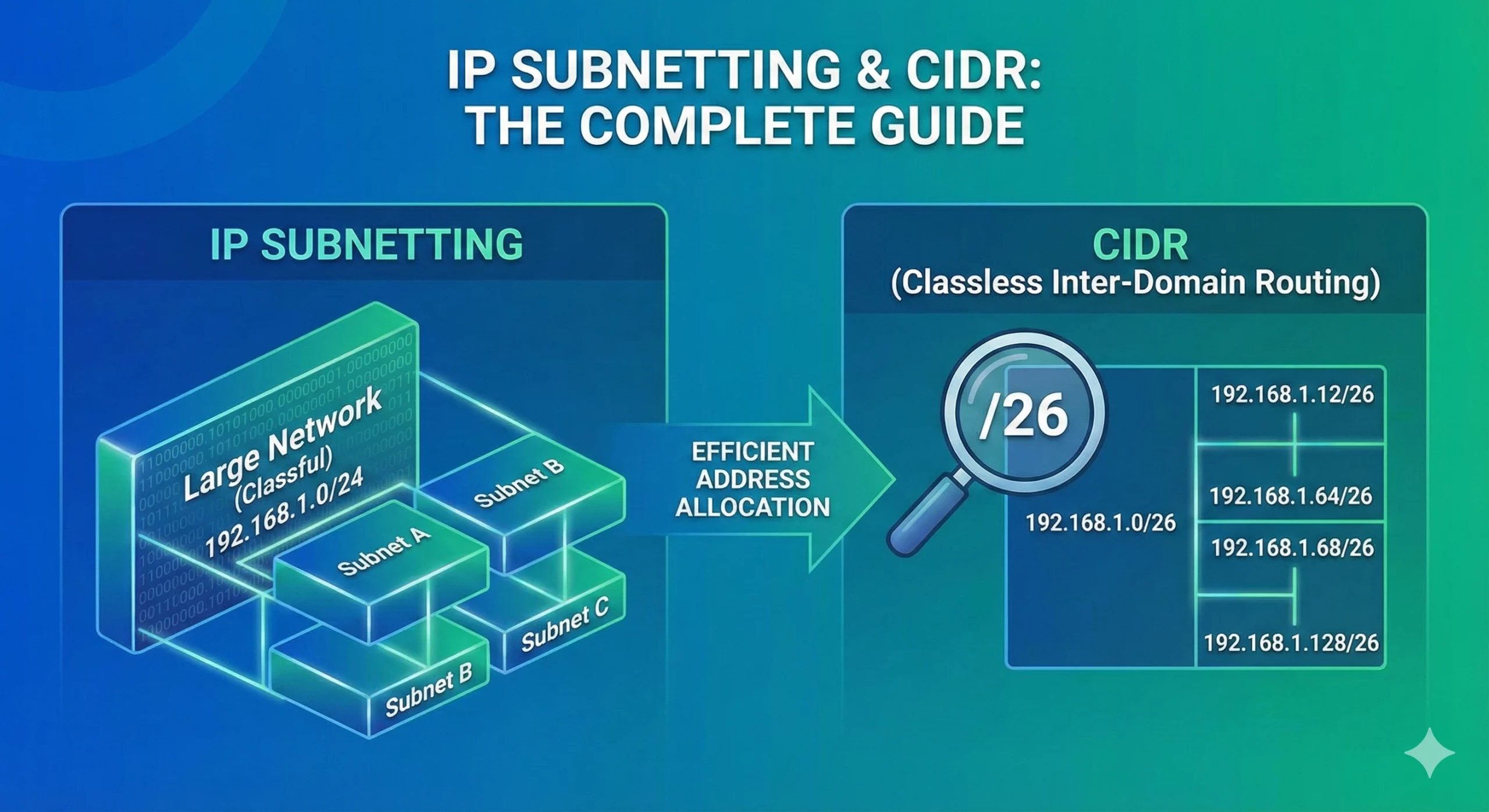
In Internet communication, IP addressing is a cornerstone technology that allows devices to connect and exchange information seamlessly. For Internet Service Providers (ISPs) and IT professionals, understanding IP subnetting and CIDR (Classless Inter-Domain Routing) is essential for efficient network management and scalability.
Table of Contents
This article delves into IP subnetting and CIDR concepts, highlighting their significance and practical application.
What Is IP Subnetting?
IP subnetting is the process of dividing a large IP network into smaller, more manageable segments called subnets. It’s like splitting a large parcel of land into smaller lots for specific use, allowing better organization and utilization.
Why Subnet?
Efficient Use of IP Addresses: With the finite IPv4 address space, subnetting ensures that addresses are allocated according to the specific needs of different network segments.
Improved Security: By segmenting networks, sensitive data can be isolated, reducing the risk of unauthorized access.
Reduced Network Traffic: Subnetting localizes traffic within each subnet, reducing congestion and improving performance.
CIDR: Classless Inter-Domain Routing
Introduced in the 1990s, CIDR replaced the rigid class-based system of IP addressing. CIDR provides a more flexible and efficient way to allocate IP addresses by allowing subnet masks of variable lengths.
Key Features of CIDR
Variable-Length Subnet Masking (VLSM): CIDR allows network administrators to define subnet masks of varying lengths, optimizing address utilization.
Aggregation (Supernetting): CIDR enables route aggregation, combining multiple IP networks into a single, summarized route. This reduces the size of routing tables and improves router efficiency.
Elimination of Classes: Traditional IP classes (A, B, C) are no longer restrictive; with CIDR, the network portion of an address is defined by the prefix length (e.g., /8, /16, /24).
Practical Applications of Subnetting and CIDR
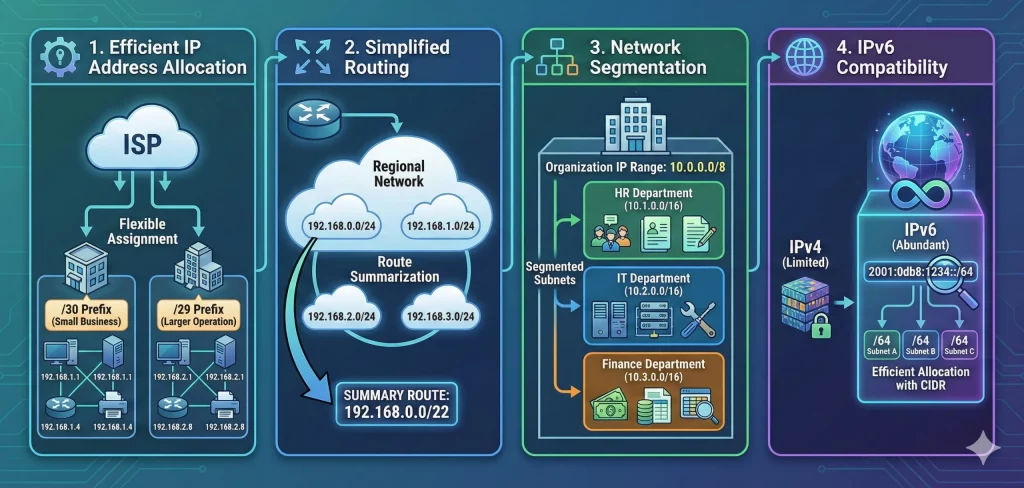
1. Efficient IP Address Allocation
ISPs often face the challenge of allocating IP addresses efficiently to customers. With CIDR, an ISP can allocate prefixes such as /30 for small businesses needing 4 addresses or /29 for slightly larger operations requiring 8 addresses.
2. Simplified Routing
Subnetting combined with CIDR allows for route summarization. For example, an ISP managing several networks in the range 192.168.0.0/24 through 192.168.3.0/24 can summarize these into a single route: 192.168.0.0/22.
3. Network Segmentation
Organizations can segment their networks by departments or functions. For instance, an IP range like 10.0.0.0/8 can be divided into subnets for HR (10.1.0.0/16), IT (10.2.0.0/16), and so on.
4. IPv6 Compatibility
CIDR is critical in IPv6, where addresses are plentiful, but efficient allocation is still necessary. With its 128-bit addressing scheme, IPv6 uses CIDR to break large address spaces into usable subnets (e.g., 2001:0db8:1234::/64).
In a nutshell
IP subnetting and CIDR are indispensable tools for managing modern networks. They enable ISPs and IT professionals to allocate IP addresses efficiently, reduce network congestion, and simplify routing. Mastering these concepts is crucial in the era of increasing internet connectivity and the transition to IPv6. With thoughtful planning and the right tools, subnetting and CIDR can significantly enhance network performance and scalability.
Trusted IPv4 Leasing for Business Growth
Get enterprise-grade IPv4 space quickly, with seamless deployment and end-to-end management.
Get Started with i.leaseArticles connexes

Primauté du code en cours d’exécution : pourquoi la location d’adresses IPv4 doit être jugée sur la base de preuves opérationnelles
La location IPv4 commence souvent par une question simple : Ce fournisseur peut-il nous fournir les adresses ? Mais pour les entreprises qui dépendent de l’IPv4 pour l’hébergement, le VPN, le SaaS, le cloud, les télécommunications, la sécurité, la livraison d’e-mails ou les plateformes destinées aux clients, cette question ne suffit pas. Une meilleure question est : Cette structure IPv4 peut-elle prouver qu’elle fonctionne sur le plan opérationnel ?Read more Related Posts La Running-Code Primacy: por qué el arrendamiento de IPv4 debe juzgarse mediante pruebas operativas El arrendamiento de IPv4 suele comenzar con una pregunta simple: ¿Puede este proveedor darnos las direcciones? Pero para las empresas Read more Risques liés au renouvellement d’IPv4 : quand le manque de responsabilisation se transforme en trahison du code en cours d’exécution La plupart des entreprises entrent sur le marché IPv4 avec un objectif simple. Elles ont besoin d’adresses. Peut-être en ont-elles Read more Pourquoi la plupart des entreprises sont exposées accidentellement au risque d’échec d’attribution d’adresse IPv4 La rareté de l’IPv4 est largement comprise. Ce que de nombreuses entreprises sous-estiment encore, c’est le risque de continuité lié Read more .related-post {} .related-post .post-list { text-align: left; } .related-post .post-list .item { margin: 5px; padding: 10px; } .related-post .headline { font-size: 18px !important; color: #999999 !important; } .related-post .post-list .item .post_thumb { max-height: 220px; margin: 10px 0px; padding: 0px; display: block; } .related-post .post-list .item .post_title { font-size: 16px; color: #3f3f3f; margin: 10px 0px; padding: 0px; display: block; text-decoration: none; } .related-post .post-list .item .post_excerpt { font-size: 13px; color: #3f3f3f; margin: 10px 0px; padding: 0px; display: block; text-decoration: none; } @media only screen and (min-width: 1024px) { .related-post .post-list .item { width: 30%; } } @media only screen and (min-width: 768px) and (max-width: 1023px) { .related-post .post-list .item { width: 90%; } } @media only screen and (min-width: 0px) and (max-width: 767px) { .related-post .post-list .item { width: 90%; } }
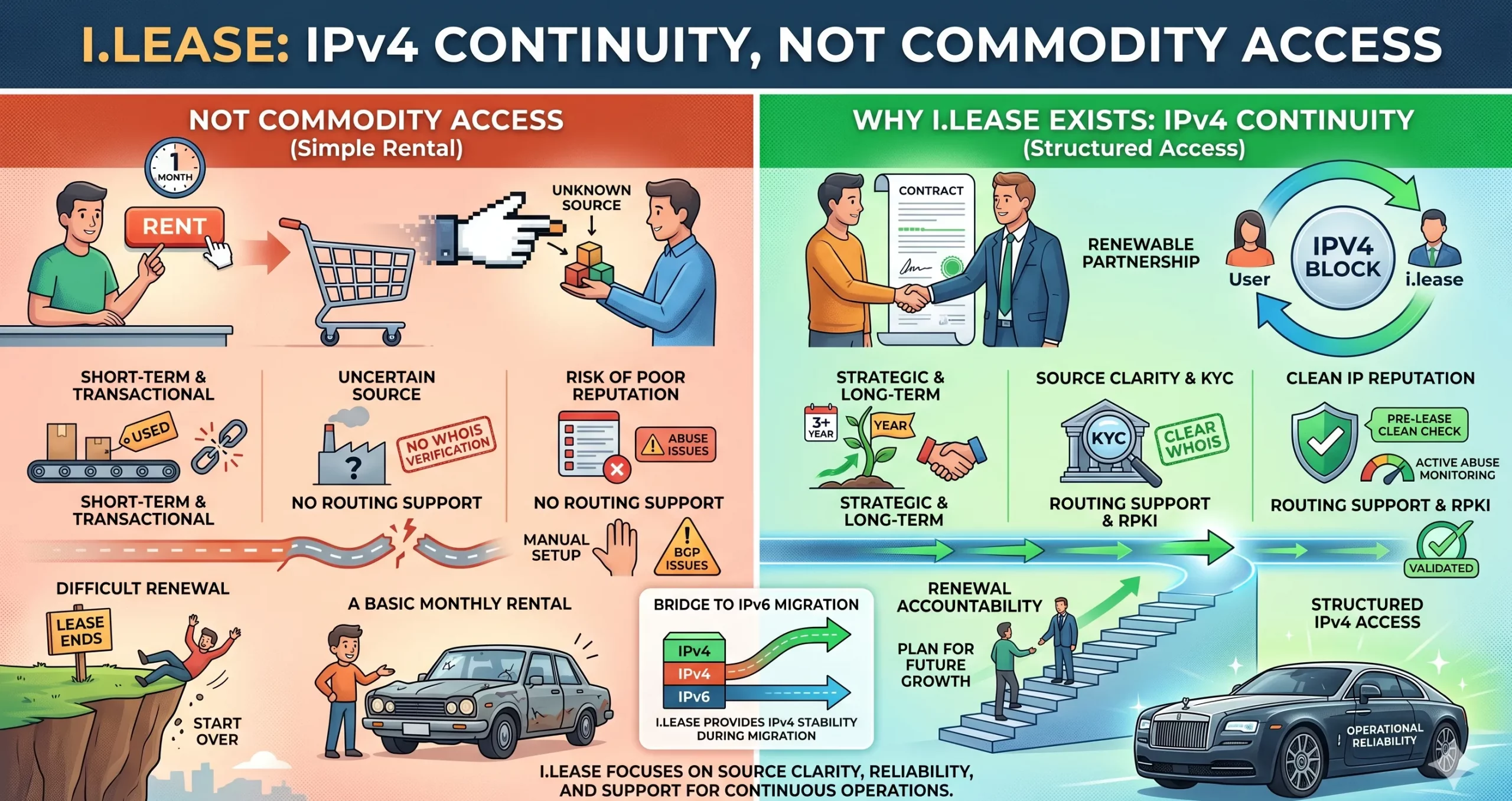
Risques liés au renouvellement d’IPv4 : quand le manque de responsabilisation se transforme en trahison du code en cours d’exécution
La plupart des entreprises entrent sur le marché IPv4 avec un objectif simple. Elles ont besoin d’adresses. Peut-être en ont-elles besoin pour l’hébergement. Peut-être en ont-elles besoin pour une infrastructure VPN. Peut-être en ont-elles besoin pour des services cloud, des plateformes SaaS, l’expansion télécom, des systèmes e-mail, des outils de cybersécurité ou des applications destinées aux clients. Elles recherchent donc un fournisseur IPv4. Elles comparent les prix. Elles vérifientRead more Related Posts Risk Placement in IPv4 Transactions: What Enterprises Should Know The IPv4 market has quietly evolved into a structured secondary asset class. As global IPv4 exhaustion continues, enterprises, ISPs, and Read more Understanding Operational Risk in IPv4 Address Markets IPv4 has long stopped being a simple technical identifier system. It has become a constrained, priced, and operationally embedded infrastructure Read more Primauté du code en cours d’exécution : pourquoi la location d’adresses IPv4 doit être jugée sur la base de preuves opérationnelles La location IPv4 commence souvent par une question simple :Ce fournisseur peut-il nous fournir les adresses ?Mais pour les entreprises Read more .related-post {} .related-post .post-list { text-align: left; } .related-post .post-list .item { margin: 5px; padding: 10px; } .related-post .headline { font-size: 18px !important; color: #999999 !important; } .related-post .post-list .item .post_thumb { max-height: 220px; margin: 10px 0px; padding: 0px; display: block; } .related-post .post-list .item .post_title { font-size: 16px; color: #3f3f3f; margin: 10px 0px; padding: 0px; display: block; text-decoration: none; } .related-post .post-list .item .post_excerpt { font-size: 13px; color: #3f3f3f; margin: 10px 0px; padding: 0px; display: block; text-decoration: none; } @media only screen and (min-width: 1024px) { .related-post .post-list .item { width: 30%; } } @media only screen and (min-width: 768px) and (max-width: 1023px) { .related-post .post-list .item { width: 90%; } } @media only screen and (min-width: 0px) and (max-width: 767px) { .related-post .post-list .item { width: 90%; } }

Pourquoi la plupart des entreprises sont exposées accidentellement au risque d’échec d’attribution d’adresse IPv4
La rareté de l’IPv4 est largement comprise. Ce que de nombreuses entreprises sous-estiment encore, c’est le risque de continuité lié à la manière dont les ressources d’adressage sont gouvernées et maintenues. Les entreprises maintiennent souvent une utilisation opérationnelle des ressources IPv4 sans disposer d’une visibilité complète sur les conditions de continuité qui soutiennent ces allocations. La dépendance croissante à la location, aux transferts et aux infrastructures gérées par desRead more Related Posts Risk Placement in IPv4 Transactions: What Enterprises Should Know The IPv4 market has quietly evolved into a structured secondary asset class. As global IPv4 exhaustion continues, enterprises, ISPs, and Read more Understanding Operational Risk in IPv4 Address Markets IPv4 has long stopped being a simple technical identifier system. It has become a constrained, priced, and operationally embedded infrastructure Read more Primauté du code en cours d’exécution : pourquoi la location d’adresses IPv4 doit être jugée sur la base de preuves opérationnelles La location IPv4 commence souvent par une question simple :Ce fournisseur peut-il nous fournir les adresses ?Mais pour les entreprises Read more .related-post {} .related-post .post-list { text-align: left; } .related-post .post-list .item { margin: 5px; padding: 10px; } .related-post .headline { font-size: 18px !important; color: #999999 !important; } .related-post .post-list .item .post_thumb { max-height: 220px; margin: 10px 0px; padding: 0px; display: block; } .related-post .post-list .item .post_title { font-size: 16px; color: #3f3f3f; margin: 10px 0px; padding: 0px; display: block; text-decoration: none; } .related-post .post-list .item .post_excerpt { font-size: 13px; color: #3f3f3f; margin: 10px 0px; padding: 0px; display: block; text-decoration: none; } @media only screen and (min-width: 1024px) { .related-post .post-list .item { width: 30%; } } @media only screen and (min-width: 768px) and (max-width: 1023px) { .related-post .post-list .item { width: 90%; } } @media only screen and (min-width: 0px) and (max-width: 767px) { .related-post .post-list .item { width: 90%; } }
