The Future of Internet Addressing: IPv4 vs. IPv6
 admin
admin
Devices that connect over the Internet rely on a system called IP addressing to find each other. Currently, there are two versions of IP addressing: IPv4 and IPv6. Let’s look into the future of IPv4 and
Table of Contents
IPv4 vs IPv6
IPv4, the older iteration, was developed in the 1970s and utilizes 32-bit addresses. There are only 4.3 billion available addresses– a small number when you think about the smartphones, tablets, and smart home technologies that need to connect to the Internet.
In contrast, IPv6, introduced in the 1990s, uses 128-bit addresses. The result is 340 undecillion addresses, a huge number that will not deplete in the foreseeable future. IPv6 also boasts superior security and efficiency compared to its IPv4 counterpart.
1.0 Is IPv6 the Future of IPv4?
IPv6 is necessary because we are running out of IPv4 addresses. As more devices connect to the internet, we’re running low on available IPv4 addresses. This can lead to connectivity problems and make websites inaccessible.
There are a few ways to adopt IPv6. One option is to upgrade routers to dual-stack routers that can handle both IPv4 and IPv6. Alternatively, you can use tunneling services to wrap IPv6 traffic in IPv4 packets. Tunneling will allow IPv4 routers to receive IPv6 packets since these will be enclosed in formats that the routers can read.
IPv6 has some advantages. It:
a. offers a massive number of addresses
b. improves security with modern authentication
c. makes networks more efficient with smaller packets;
d. and supports features like multicast routing and mobile IP.
e. many major websites and services now support IPv6.
IPv6 is the future of internet addressing because it provides scalability, security, and efficiency that IPv4 can’t match.
2.0 IPv4’s Value Continues to Grow
Despite IPv6 being the future of the Internet, IPv4 remains relevant. In fact, the value of IPv4 addresses is likely to increase.
The idea of IP addresses being valuable assets is relatively new. In the early days of the internet, Internet Service Providers (ISPs) assigned IP addresses without much thought to their value. However, as the internet grew, the demand for IP addresses increased, making them more important. Consequently, this also drove their market value.
IP addresses, while not ownable, are managed through rights that allow address “owners” to change their registry entries. These rights are tradable commodities on the open market: you can buy and sell the rights to IP addresses.
Some may even buy IPv4 addresses with the intent of re-selling when the prices go up.
The rapid growth of the digital economy is driving up the demand for IP addresses. In this scenario, IPv6 plays a crucial role. It’s important for individuals and businesses to get ready for this shift.
3.0 We Are Running Out of IPv4 Addresses
As IPv4 addresses become scarcer, obtaining new ones will become more challenging. This could lead to devices struggling to connect to the internet and websites failing to load. The only way forward is to slowly transition to IPv6.
In the end, you will want to fully switch your network to IPv6. In broad strokes, these are the stepps to migrating fully to IPv6:
- Get an IPv6 address block from your ISP.
- Set up your router to support IPv6.
- Configure your devices to use IPv6.
Once you’ve done this, you can access IPv6 services on the Internet. But there are a few things you need to keep in mind. First, not all devices and apps support IPv6 yet. You might need to purchase some upgrades.
Second, some websites and services may not work with IPv6. You might come across some DNS errors in such cases. But this is more a rare occurence than the norm.If you’re thinking about moving to IPv6, you can contact i.lease for professional opinion.
Moreover, i.lease can help you need to lease IPv4 address while you are transitioning to IPv6.
Related Article
Related Posts
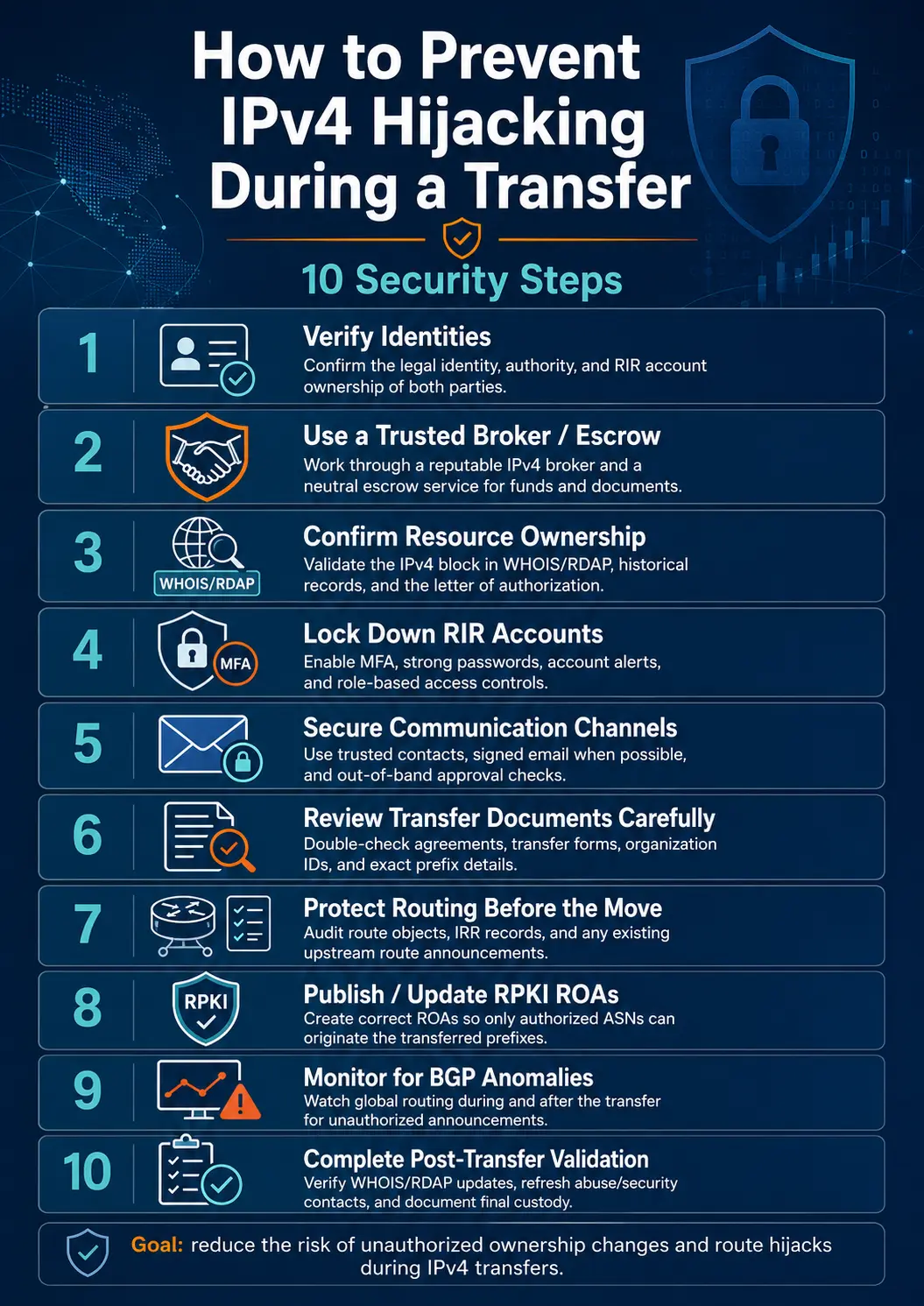
How to Prevent IPv4 Hijacking During a Transfer: 10 Security Steps
Transferring IPv4 address space is not only a commercial and registry process. It is also a sensitive routing operation. During an IPv4 transfer, control of a prefix moves from one organization to another. Registry records, Route Origin Authorizations, Internet Routing Registry objects, upstream-provider filters, reverse DNS settings, and live BGP announcements may all need to change. When these changes are completed in the wrong order—or when identity and authorizationRead more Related Posts How to Prevent IPv4 Hijacking During a Transfer: 10 Security Steps Transferring IPv4 address space is not only a commercial and registry process. It is also a sensitive routing operation. During Why the Cheapest IPv4 Lease May Cost More in the Long Run A low monthly price may look attractive during procurement, but the real cost of leased IPv4 addresses includes much more What Is a /24 IPv4 Subnet and Why Is It Popular for Leasing? A /24 IPv4 subnet is one of the most common block sizes in the IPv4 leasing market. For hosting providers, .related-post {} .related-post .post-list { text-align: left; } .related-post .post-list .item { margin: 5px; padding: 10px; } .related-post .headline { font-size: 18px !important; color: #999999 !important; } .related-post .post-list .item .post_thumb { max-height: 220px; margin: 10px 0px; padding: 0px; display: block; } .related-post .post-list .item .post_title { font-size: 16px; color: #3f3f3f; margin: 10px 0px; padding: 0px; display: block; text-decoration: none; } .related-post .post-list .item .post_excerpt { font-size: 13px; color: #3f3f3f; margin: 10px 0px; padding: 0px; display: block; text-decoration: none; } @media only screen and (min-width: 1024px) { .related-post .post-list .item { width: 30%; } } @media only screen and (min-width: 768px) and (max-width: 1023px) { .related-post .post-list .item { width: 90%; } } @media only screen and (min-width: 0px) and (max-width: 767px) { .related-post .post-list .item { width: 90%; } }
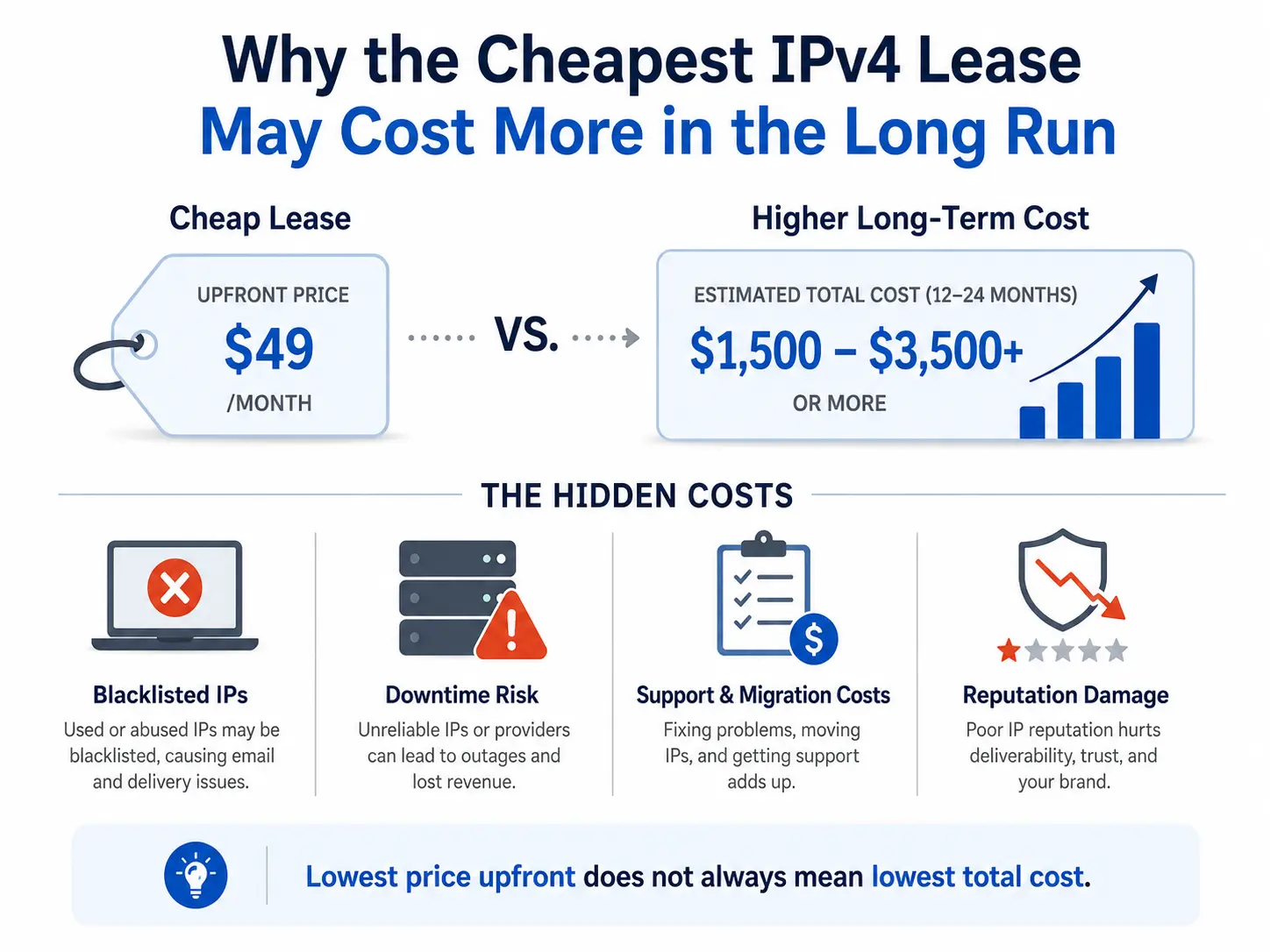
Why the Cheapest IPv4 Lease May Cost More in the Long Run
A low monthly price may look attractive during procurement, but the real cost of leased IPv4 addresses includes much more than the advertised rate. Poor IP reputation, incomplete routing authorisation, deployment delays, weak technical support, incorrect geolocation and uncertain renewal terms can quickly erase the initial saving. For testing or short-lived projects, a basic low-cost IPv4 lease may be sufficient. For production networks, however, businesses should evaluate the totalRead more Related Posts How to Prevent IPv4 Hijacking During a Transfer: 10 Security Steps Transferring IPv4 address space is not only a commercial and registry process. It is also a sensitive routing operation. During Why the Cheapest IPv4 Lease May Cost More in the Long Run A low monthly price may look attractive during procurement, but the real cost of leased IPv4 addresses includes much more What Is a /24 IPv4 Subnet and Why Is It Popular for Leasing? A /24 IPv4 subnet is one of the most common block sizes in the IPv4 leasing market. For hosting providers, .related-post {} .related-post .post-list { text-align: left; } .related-post .post-list .item { margin: 5px; padding: 10px; } .related-post .headline { font-size: 18px !important; color: #999999 !important; } .related-post .post-list .item .post_thumb { max-height: 220px; margin: 10px 0px; padding: 0px; display: block; } .related-post .post-list .item .post_title { font-size: 16px; color: #3f3f3f; margin: 10px 0px; padding: 0px; display: block; text-decoration: none; } .related-post .post-list .item .post_excerpt { font-size: 13px; color: #3f3f3f; margin: 10px 0px; padding: 0px; display: block; text-decoration: none; } @media only screen and (min-width: 1024px) { .related-post .post-list .item { width: 30%; } } @media only screen and (min-width: 768px) and (max-width: 1023px) { .related-post .post-list .item { width: 90%; } } @media only screen and (min-width: 0px) and (max-width: 767px) { .related-post .post-list .item { width: 90%; } }
What causes IPv4 deals to stall after the first agreement
IPv4 deals usually stall after the first agreement because agreeing on price is only the commercial beginning—not operational completion. A buyer and seller may agree on a block and price within hours, but the transaction can still be delayed by unclear ownership, incomplete documents, mismatched Regional Internet Registry requirements, recipient eligibility, reputation concerns, payment conditions, or missing routing authorization. The most common causes are: The seller’s authority over theRead more Related Posts How to Prevent IPv4 Hijacking During a Transfer: 10 Security Steps Transferring IPv4 address space is not only a commercial and registry process. It is also a sensitive routing operation. During Why the Cheapest IPv4 Lease May Cost More in the Long Run A low monthly price may look attractive during procurement, but the real cost of leased IPv4 addresses includes much more What Is a /24 IPv4 Subnet and Why Is It Popular for Leasing? A /24 IPv4 subnet is one of the most common block sizes in the IPv4 leasing market. For hosting providers, .related-post {} .related-post .post-list { text-align: left; } .related-post .post-list .item { margin: 5px; padding: 10px; } .related-post .headline { font-size: 18px !important; color: #999999 !important; } .related-post .post-list .item .post_thumb { max-height: 220px; margin: 10px 0px; padding: 0px; display: block; } .related-post .post-list .item .post_title { font-size: 16px; color: #3f3f3f; margin: 10px 0px; padding: 0px; display: block; text-decoration: none; } .related-post .post-list .item .post_excerpt { font-size: 13px; color: #3f3f3f; margin: 10px 0px; padding: 0px; display: block; text-decoration: none; } @media only screen and (min-width: 1024px) { .related-post .post-list .item { width: 30%; } } @media only screen and (min-width: 768px) and (max-width: 1023px) { .related-post .post-list .item { width: 90%; } } @media only screen and (min-width: 0px) and (max-width: 767px) { .related-post .post-list .item { width: 90%; } }
