LACNIC: All You Need To Know
 Chan
Chan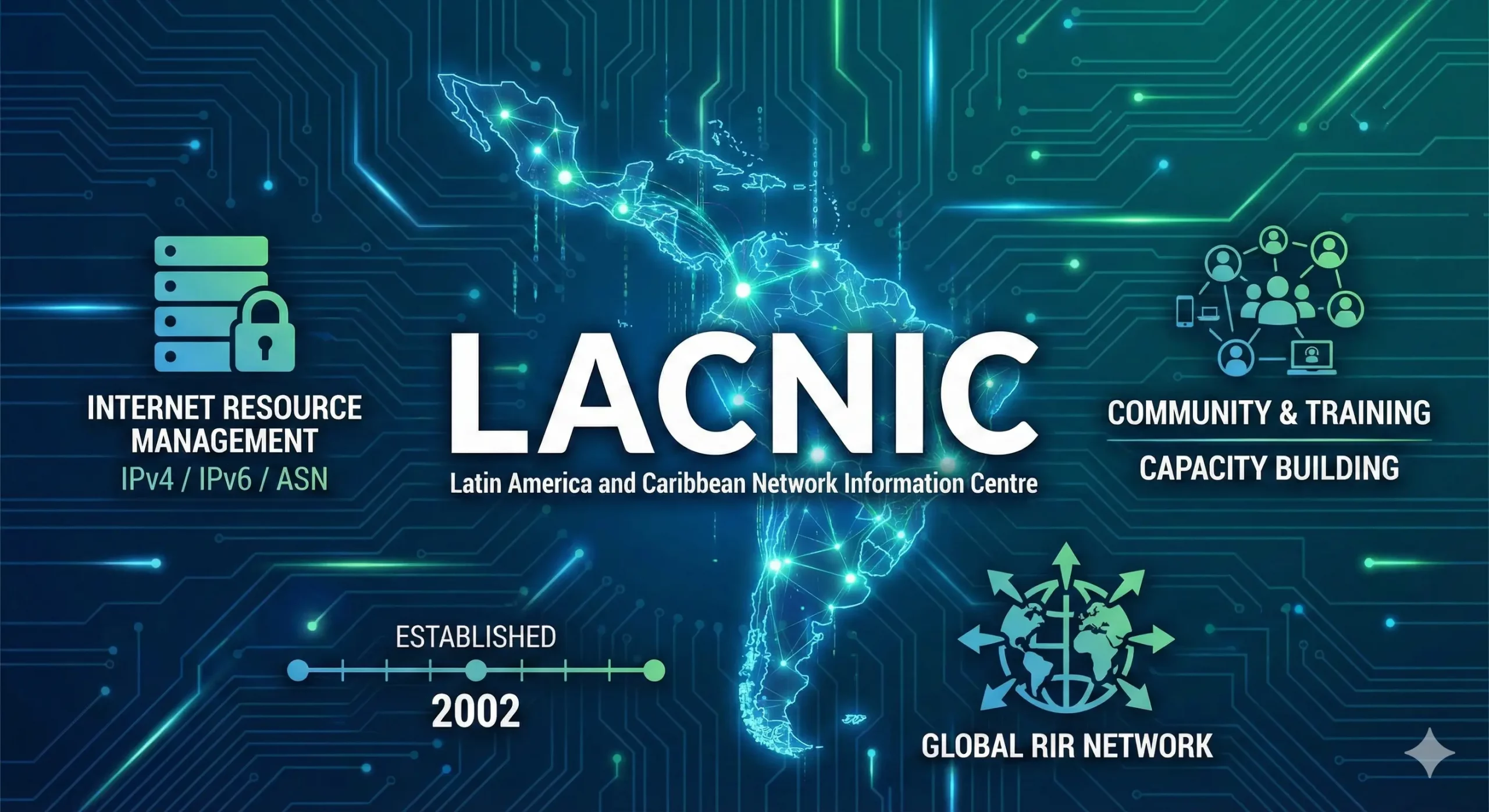
LACNIC: Strengthening Internet Infrastructure in Latin America and the Caribbean
The Latin America and Caribbean Network Information Center (LACNIC) plays a vital role in shaping the digital landscape of Latin America and the Caribbean. As the region’s designated Regional Internet Registry (RIR), LACNIC is responsible for managing and distributing Internet number resources, including IPv4, IPv6 addresses, and Autonomous System Numbers (ASNs).
Table of Contents
Operating as a non-profit community-led organization, LACNIC ensures the fair allocation of resources and actively contributes to Internet development, security, and policy-making in its 33 covered territories. With over 12,000 members, LACNIC fosters collaboration between governments, Internet service providers (ISPs), and the wider digital community to promote a secure and efficient internet ecosystem.
What is LACNIC
LACNIC is one of the five globally recognized Regional Internet Registries (RIRs) that oversee IP address distribution and Internet governance worldwide. The organization operates alongside:
- AFRINIC – Serving the African continent
- APNIC – Managing the Asia-Pacific region
- ARIN – Covering North America and parts of the Caribbean
- RIPE NCC – Serving Europe, the Middle East, and parts of Central Asia
Since its establishment in 2002, LACNIC has played a pivotal role in ensuring the efficient allocation of Internet number resources in Latin America and the Caribbean. The organization receives these resources from the Internet Assigned Numbers Authority (IANA) and redistributes them according to regional demand and policies.
Beyond resource management, LACNIC is committed to enhancing Internet accessibility, security, and governance, providing its members with technical training, cybersecurity solutions, and active participation in shaping global Internet policies.
Membership and Governance Model
LACNIC stands out for its community-driven governance approach. The organization is overseen by a board of seven directors, elected directly by its members. This democratic model ensures that decision-making aligns with the needs and priorities of the regional internet community.
Membership provides several key benefits beyond IP address allocation, including:
- Influence in Policy Development: Members can participate in shaping regional internet governance policies.
- Technical Training via LACNIC Campus: Online and in-person courses on network management, security, and IPv6 adoption.
- Cybersecurity Support from LACNIC CSIRT: A dedicated team that assists in preventing cyber threats and securing regional internet operations.
- Representation in Global Internet Governance Forums: LACNIC advocates for regional interests on the global stage.
- Collaboration with Internet Exchange Points (IXPs) and Tech Providers: Helping members optimize network performance and resource management.
Key Functions and Services Provided by LACNIC
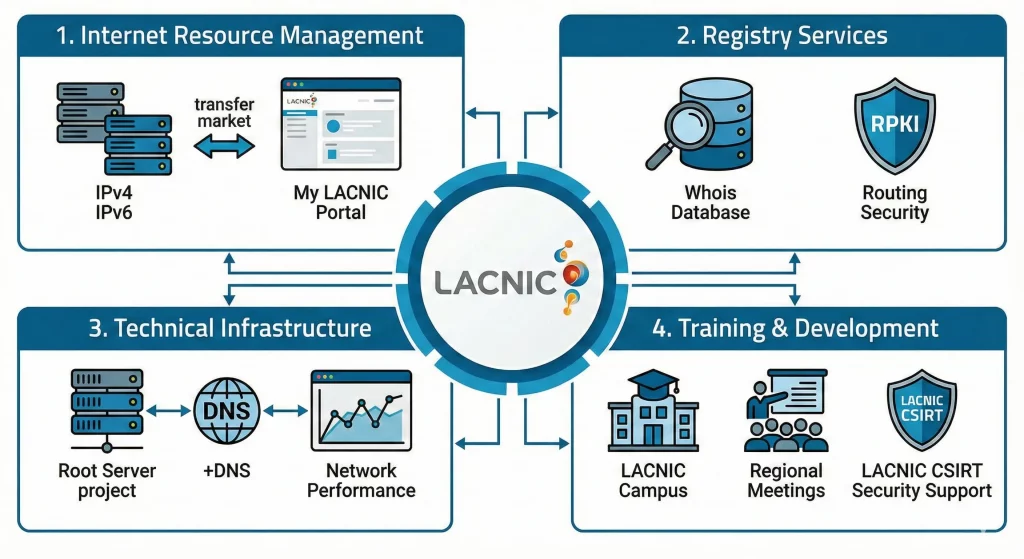
LACNIC’s core mission is to strengthen and support Internet infrastructure across Latin America and the Caribbean. To achieve this, the organization provides a range of technical and strategic services, ensuring stability, security, and growth.
1. Internet Resource management
LACNIC oversees the allocation of IPv4 and IPv6 addresses and ASNs across Latin America and the Caribbean. The organization maintains a transfer market for IPv4 resources and promotes IPv6 adoption through streamlined allocation processes. Through its My LACNIC portal, members can manage their resources and handle administrative tasks efficiently.
2. Registry services
The LACNIC Whois database serves as the authoritative registry for IP allocations in the region. The database helps identify resource ownership, supports abuse prevention, and maintains transparency in resource distribution. LACNIC’s RPKI services enhance routing security by validating resource ownership and preventing unauthorized announcements.
3. Technical infrastructure
LACNIC provides essential DNS services, including Reverse DNS Management and the +RAICES project, which maintains root server copies to improve regional internet stability. The Internet Routing Registry helps operators manage routing policies, while monitoring tools track network performance and security across the region.
4. Training and development
LACNIC Campus provides training on IPv6, security, and network management. It hosts regional meetings for knowledge sharing and policy discussions. Through LACNIC CSIRT, members get security support and best practices guidance.
Trusted IPv4 Leasing for Business Growth
Get enterprise-grade IPv4 space quickly, with seamless deployment and end-to-end management.
Get Started with i.leaseArticles connexes

Primauté du code en cours d’exécution : pourquoi la location d’adresses IPv4 doit être jugée sur la base de preuves opérationnelles
La location IPv4 commence souvent par une question simple : Ce fournisseur peut-il nous fournir les adresses ? Mais pour les entreprises qui dépendent de l’IPv4 pour l’hébergement, le VPN, le SaaS, le cloud, les télécommunications, la sécurité, la livraison d’e-mails ou les plateformes destinées aux clients, cette question ne suffit pas. Une meilleure question est : Cette structure IPv4 peut-elle prouver qu’elle fonctionne sur le plan opérationnel ?Read more Related Posts La Running-Code Primacy: por qué el arrendamiento de IPv4 debe juzgarse mediante pruebas operativas El arrendamiento de IPv4 suele comenzar con una pregunta simple: ¿Puede este proveedor darnos las direcciones? Pero para las empresas Read more Risques liés au renouvellement d’IPv4 : quand le manque de responsabilisation se transforme en trahison du code en cours d’exécution La plupart des entreprises entrent sur le marché IPv4 avec un objectif simple. Elles ont besoin d’adresses. Peut-être en ont-elles Read more Pourquoi la plupart des entreprises sont exposées accidentellement au risque d’échec d’attribution d’adresse IPv4 La rareté de l’IPv4 est largement comprise. Ce que de nombreuses entreprises sous-estiment encore, c’est le risque de continuité lié Read more .related-post {} .related-post .post-list { text-align: left; } .related-post .post-list .item { margin: 5px; padding: 10px; } .related-post .headline { font-size: 18px !important; color: #999999 !important; } .related-post .post-list .item .post_thumb { max-height: 220px; margin: 10px 0px; padding: 0px; display: block; } .related-post .post-list .item .post_title { font-size: 16px; color: #3f3f3f; margin: 10px 0px; padding: 0px; display: block; text-decoration: none; } .related-post .post-list .item .post_excerpt { font-size: 13px; color: #3f3f3f; margin: 10px 0px; padding: 0px; display: block; text-decoration: none; } @media only screen and (min-width: 1024px) { .related-post .post-list .item { width: 30%; } } @media only screen and (min-width: 768px) and (max-width: 1023px) { .related-post .post-list .item { width: 90%; } } @media only screen and (min-width: 0px) and (max-width: 767px) { .related-post .post-list .item { width: 90%; } }
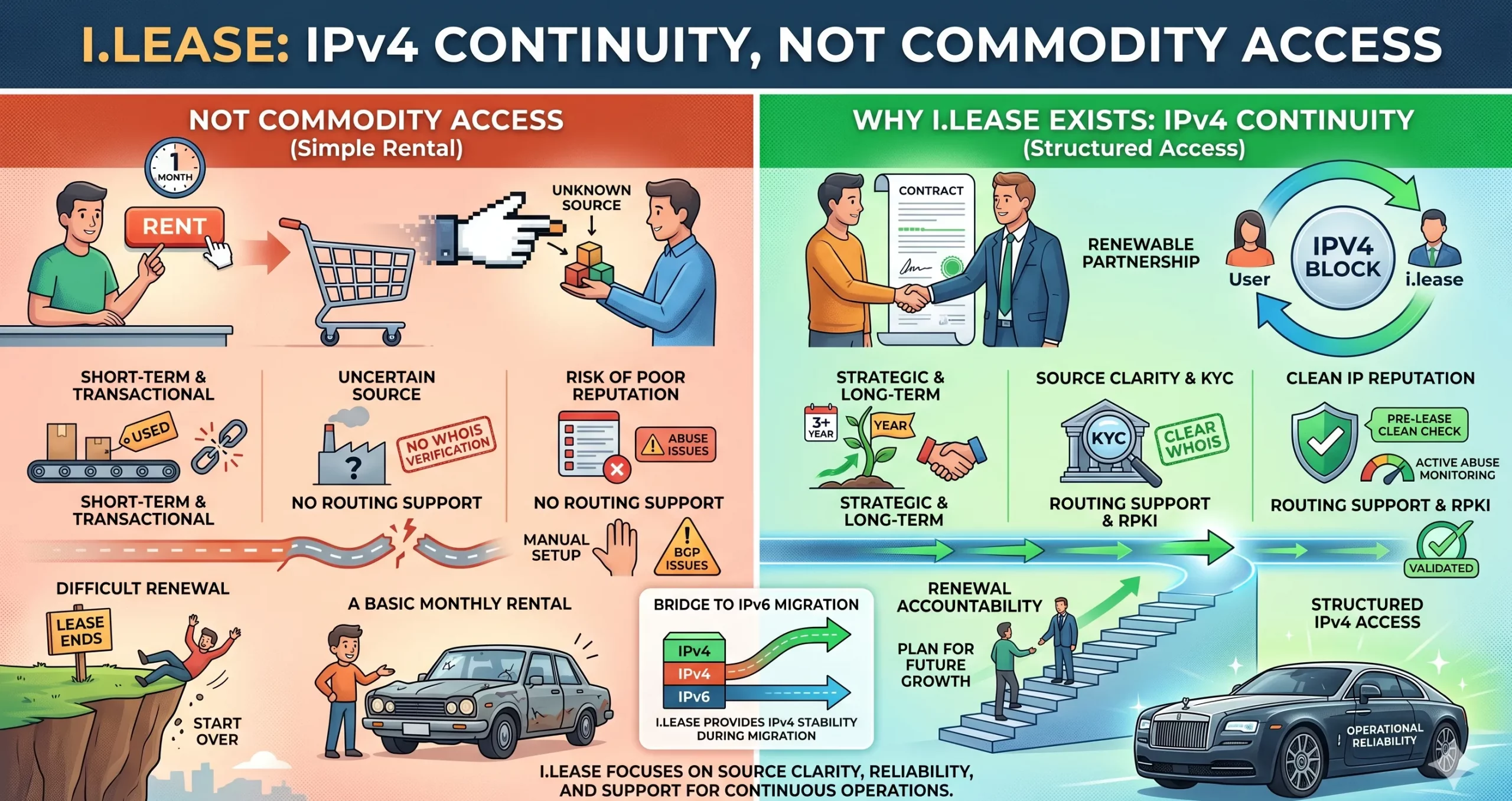
Risques liés au renouvellement d’IPv4 : quand le manque de responsabilisation se transforme en trahison du code en cours d’exécution
La plupart des entreprises entrent sur le marché IPv4 avec un objectif simple. Elles ont besoin d’adresses. Peut-être en ont-elles besoin pour l’hébergement. Peut-être en ont-elles besoin pour une infrastructure VPN. Peut-être en ont-elles besoin pour des services cloud, des plateformes SaaS, l’expansion télécom, des systèmes e-mail, des outils de cybersécurité ou des applications destinées aux clients. Elles recherchent donc un fournisseur IPv4. Elles comparent les prix. Elles vérifientRead more Related Posts Risk Placement in IPv4 Transactions: What Enterprises Should Know The IPv4 market has quietly evolved into a structured secondary asset class. As global IPv4 exhaustion continues, enterprises, ISPs, and Read more Understanding Operational Risk in IPv4 Address Markets IPv4 has long stopped being a simple technical identifier system. It has become a constrained, priced, and operationally embedded infrastructure Read more Primauté du code en cours d’exécution : pourquoi la location d’adresses IPv4 doit être jugée sur la base de preuves opérationnelles La location IPv4 commence souvent par une question simple :Ce fournisseur peut-il nous fournir les adresses ?Mais pour les entreprises Read more .related-post {} .related-post .post-list { text-align: left; } .related-post .post-list .item { margin: 5px; padding: 10px; } .related-post .headline { font-size: 18px !important; color: #999999 !important; } .related-post .post-list .item .post_thumb { max-height: 220px; margin: 10px 0px; padding: 0px; display: block; } .related-post .post-list .item .post_title { font-size: 16px; color: #3f3f3f; margin: 10px 0px; padding: 0px; display: block; text-decoration: none; } .related-post .post-list .item .post_excerpt { font-size: 13px; color: #3f3f3f; margin: 10px 0px; padding: 0px; display: block; text-decoration: none; } @media only screen and (min-width: 1024px) { .related-post .post-list .item { width: 30%; } } @media only screen and (min-width: 768px) and (max-width: 1023px) { .related-post .post-list .item { width: 90%; } } @media only screen and (min-width: 0px) and (max-width: 767px) { .related-post .post-list .item { width: 90%; } }
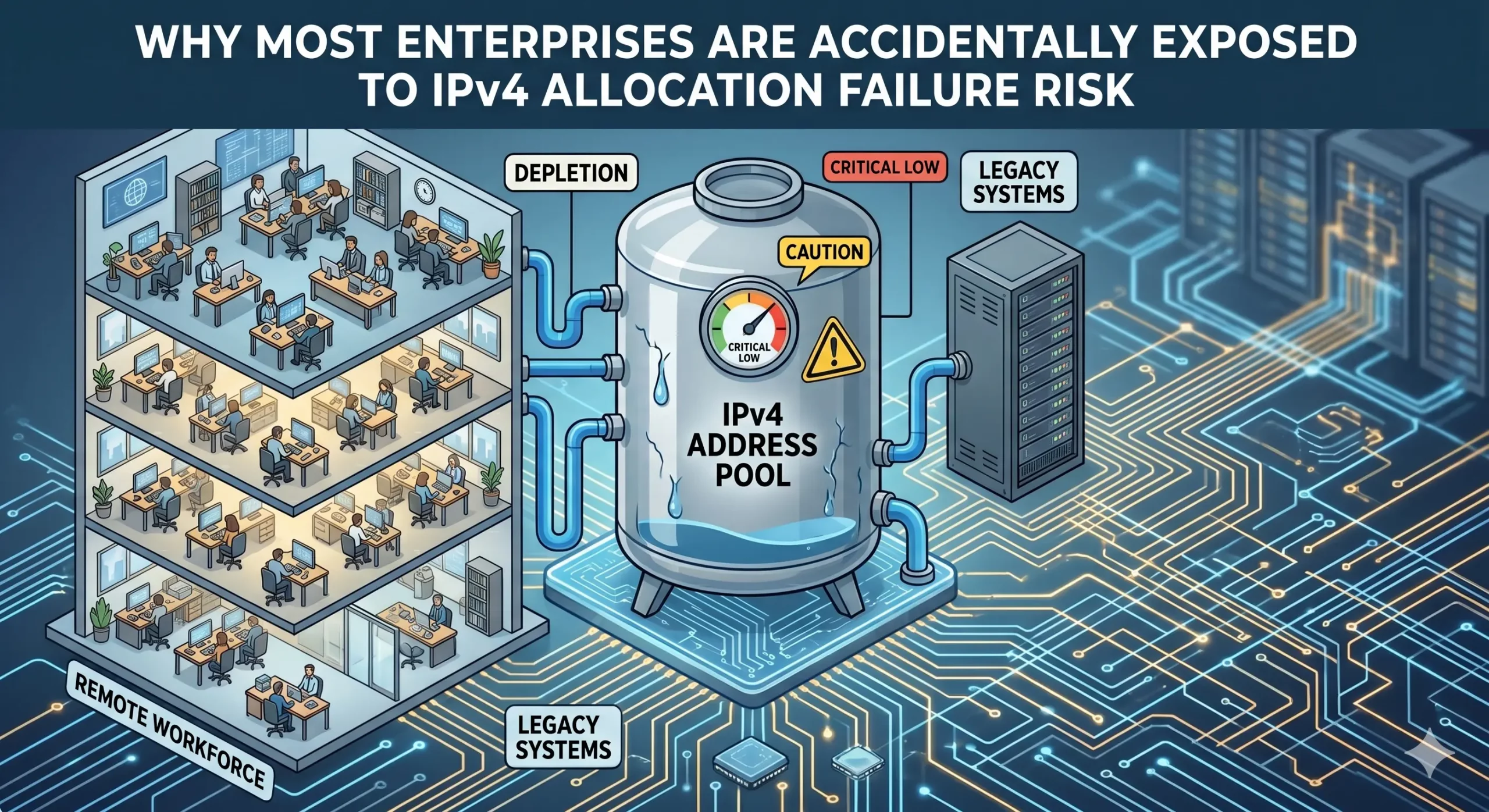
Pourquoi la plupart des entreprises sont exposées accidentellement au risque d’échec d’attribution d’adresse IPv4
La rareté de l’IPv4 est largement comprise. Ce que de nombreuses entreprises sous-estiment encore, c’est le risque de continuité lié à la manière dont les ressources d’adressage sont gouvernées et maintenues. Les entreprises maintiennent souvent une utilisation opérationnelle des ressources IPv4 sans disposer d’une visibilité complète sur les conditions de continuité qui soutiennent ces allocations. La dépendance croissante à la location, aux transferts et aux infrastructures gérées par desRead more Related Posts Risk Placement in IPv4 Transactions: What Enterprises Should Know The IPv4 market has quietly evolved into a structured secondary asset class. As global IPv4 exhaustion continues, enterprises, ISPs, and Read more Understanding Operational Risk in IPv4 Address Markets IPv4 has long stopped being a simple technical identifier system. It has become a constrained, priced, and operationally embedded infrastructure Read more Primauté du code en cours d’exécution : pourquoi la location d’adresses IPv4 doit être jugée sur la base de preuves opérationnelles La location IPv4 commence souvent par une question simple :Ce fournisseur peut-il nous fournir les adresses ?Mais pour les entreprises Read more .related-post {} .related-post .post-list { text-align: left; } .related-post .post-list .item { margin: 5px; padding: 10px; } .related-post .headline { font-size: 18px !important; color: #999999 !important; } .related-post .post-list .item .post_thumb { max-height: 220px; margin: 10px 0px; padding: 0px; display: block; } .related-post .post-list .item .post_title { font-size: 16px; color: #3f3f3f; margin: 10px 0px; padding: 0px; display: block; text-decoration: none; } .related-post .post-list .item .post_excerpt { font-size: 13px; color: #3f3f3f; margin: 10px 0px; padding: 0px; display: block; text-decoration: none; } @media only screen and (min-width: 1024px) { .related-post .post-list .item { width: 30%; } } @media only screen and (min-width: 768px) and (max-width: 1023px) { .related-post .post-list .item { width: 90%; } } @media only screen and (min-width: 0px) and (max-width: 767px) { .related-post .post-list .item { width: 90%; } }
