Mastering IPv4 Address Leasing: Best Practices
 admin
admin
Leasing offers a two-way advantage. For lessors, it is an opportunity to make recurring revenue. For lessees, it is a way to meet their needs for IP addresses without making big financial commitments.
Table of Contents
There are some best practices and pitfalls that come with IP address leasing. These will be discussed later on.
For us to have a better picture on the idea of IPv4 leasing, it’s important to take a look back to how it started.
1.0 When did the leasing of unused IP addresses start?
In 1988, the Internet Assigned Numbers Authority (IANA) was entrusted with the task of distributing IP addresses. Subsequently, from 1992 to 2004, five Regional Internet Registries (RIRs) emerged to exercise greater control over the allocation of new IP addresses to Local Internet Registries (LIRs) within five distinct geographic regions.
In 2011, IANA officially allocated the final remaining blocks of unused IPv4 addresses. The RIRs also rapidly depleted their unused resources. Presently, both IANA and the RIRs primarily focus on reclaiming and reallocating dormant IP addresses.
Nevertheless, the procedures are stringent, and most companies can only request small IP address blocks periodically, resulting in months or even years of waiting.
Despite the depletion of IPv4 addresses, the expansion of the internet persists. Approximately 20% of the entire IPv4 pool remains unused, held by IP address holders from the 1980s and 1990s, who are reluctant to release their unused assets. Instead, they opt to sell them. The IPv4 market took off in the early 2010s when major companies like Microsoft and Google initiated the acquisition of IPv4 space.
Today, prominent corporations, particularly Amazon, continue to acquire IPv4 addresses at substantial costs. Smaller ISPs may not compete with the buying power of these hyperscalers, but they now have the option to lease IP address blocks.
2.0 Key factors contributing to the rise of the IPv4 lease market
1. Depletion of the IPv4 address pool due to increasing internet users.
2. Slower-than-expected adoption of IPv6 as a replacement for IPv4.
3. High demand and limited supply causing inflated buying and selling prices.
4. Major internet providers securing unused IPv4 addresses at high prices, making it difficult for smaller companies to compete.
3.0 IP Leasing Strategy
The market for buying and selling IPv4 assets continues to thrive. The market price of an IP address can hit anywhere from $35 to $50. This means that a company with an excess of hundreds of thousands of IP addresses could potentially generate millions of dollars by putting their surplus addresses up for sale.
However, companies can achieve even higher profits through IP address leasing. The key lies in the greater yield gains achievable in the global IP market, which currently averages around 25%.
Assuming an average selling price of $30 per IP address for specific quantities of subnets, which are commonly traded, a company could boost its revenue by 43% by opting for leasing, even though it may initially seem like a less lucrative choice.
Leasing has historically taken a backseat to selling, with critics finding the process cumbersome due to a lack of transparency in comparison to the sales process. However, the market has matured, and the leasing process now resembles traditional sales processes more closely.
These days, it only takes a few minutes for IP owners to set the price and manage the lease. A reputable broker like i.lease can deal with aspects such as IP reputation and abuse management.
Further innovations are in progress. Among them, brokers are developing infrastructure to minimize the back-and-forth interactions between IP holders and Internet registries.
4.0 Lease Pitfalls to Avoid When Making Your First Transaction
While leasing offers its advantages, there are some pitfalls that can affect both the lessor and the lessee. These are a few things to keep in mind:
The lessor may require the addresses before the lease term expires.
Lessees might need the addresses for a longer duration than initially anticipated.
Malicious or Negligent Lessees: In some cases, lessees with malicious intentions may use the addresses spam or dubious activities. This could lead to websites blacklisting traffic from these addresses.
If you intend to lease IPv4 addresses, take the time to ensure that you are getting those assets from legitimate IPv4 brokers.
5.0 Closing Thought
IP address leasing comes with potential risks, both for the lessor and the lessee. A reputable IP address broker can help mitigate such risks. Contact i.lease today to get professional guidance on IP address leasing.
Related Article
Articles connexes

Primauté du code en cours d’exécution : pourquoi la location d’adresses IPv4 doit être jugée sur la base de preuves opérationnelles
La location IPv4 commence souvent par une question simple : Ce fournisseur peut-il nous fournir les adresses ? Mais pour les entreprises qui dépendent de l’IPv4 pour l’hébergement, le VPN, le SaaS, le cloud, les télécommunications, la sécurité, la livraison d’e-mails ou les plateformes destinées aux clients, cette question ne suffit pas. Une meilleure question est : Cette structure IPv4 peut-elle prouver qu’elle fonctionne sur le plan opérationnel ?Read more Related Posts La Running-Code Primacy: por qué el arrendamiento de IPv4 debe juzgarse mediante pruebas operativas El arrendamiento de IPv4 suele comenzar con una pregunta simple: ¿Puede este proveedor darnos las direcciones? Pero para las empresas Read more Risques liés au renouvellement d’IPv4 : quand le manque de responsabilisation se transforme en trahison du code en cours d’exécution La plupart des entreprises entrent sur le marché IPv4 avec un objectif simple. Elles ont besoin d’adresses. Peut-être en ont-elles Read more Pourquoi la plupart des entreprises sont exposées accidentellement au risque d’échec d’attribution d’adresse IPv4 La rareté de l’IPv4 est largement comprise. Ce que de nombreuses entreprises sous-estiment encore, c’est le risque de continuité lié Read more .related-post {} .related-post .post-list { text-align: left; } .related-post .post-list .item { margin: 5px; padding: 10px; } .related-post .headline { font-size: 18px !important; color: #999999 !important; } .related-post .post-list .item .post_thumb { max-height: 220px; margin: 10px 0px; padding: 0px; display: block; } .related-post .post-list .item .post_title { font-size: 16px; color: #3f3f3f; margin: 10px 0px; padding: 0px; display: block; text-decoration: none; } .related-post .post-list .item .post_excerpt { font-size: 13px; color: #3f3f3f; margin: 10px 0px; padding: 0px; display: block; text-decoration: none; } @media only screen and (min-width: 1024px) { .related-post .post-list .item { width: 30%; } } @media only screen and (min-width: 768px) and (max-width: 1023px) { .related-post .post-list .item { width: 90%; } } @media only screen and (min-width: 0px) and (max-width: 767px) { .related-post .post-list .item { width: 90%; } }
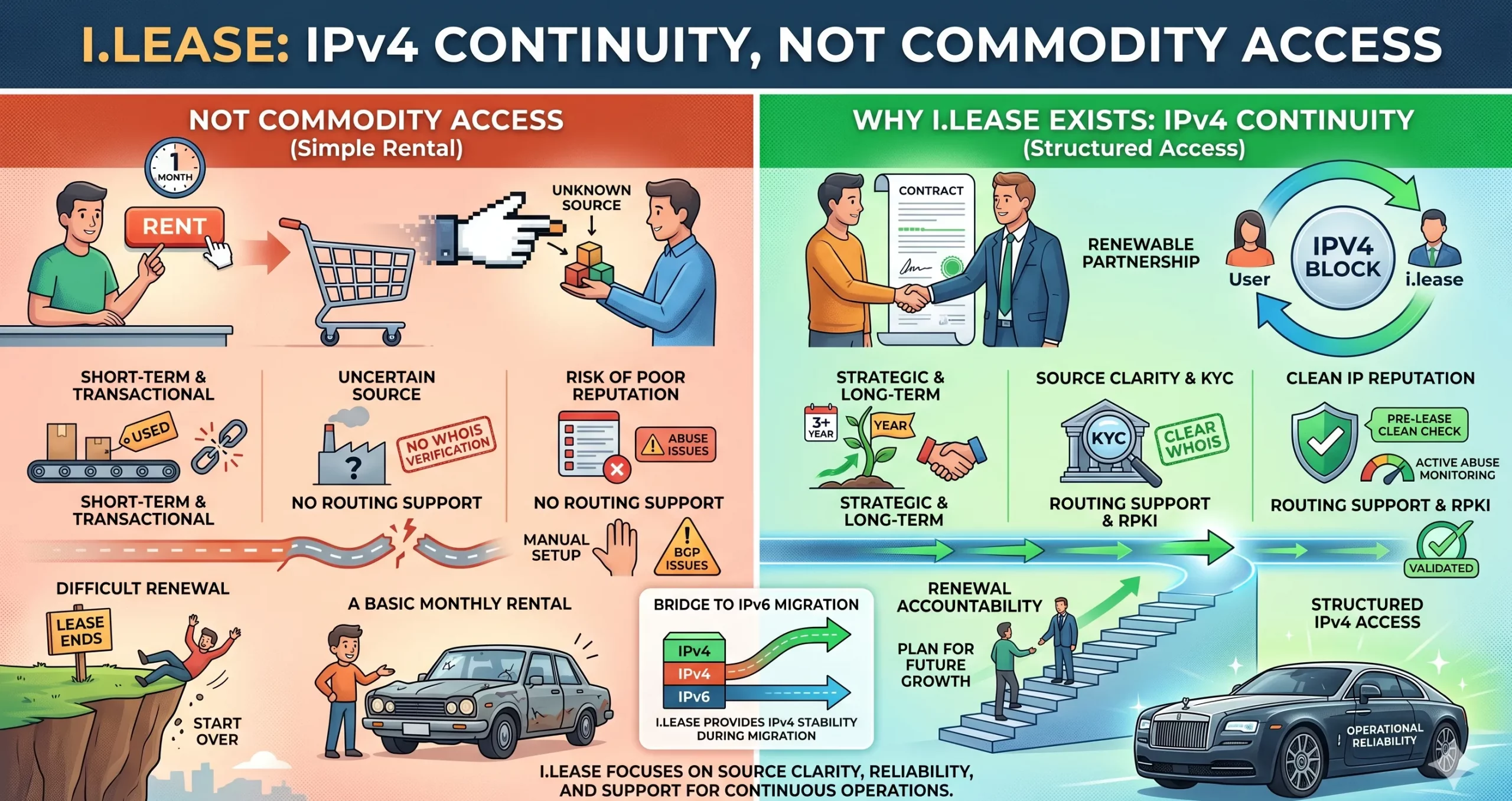
Risques liés au renouvellement d’IPv4 : quand le manque de responsabilisation se transforme en trahison du code en cours d’exécution
La plupart des entreprises entrent sur le marché IPv4 avec un objectif simple. Elles ont besoin d’adresses. Peut-être en ont-elles besoin pour l’hébergement. Peut-être en ont-elles besoin pour une infrastructure VPN. Peut-être en ont-elles besoin pour des services cloud, des plateformes SaaS, l’expansion télécom, des systèmes e-mail, des outils de cybersécurité ou des applications destinées aux clients. Elles recherchent donc un fournisseur IPv4. Elles comparent les prix. Elles vérifientRead more Related Posts Risk Placement in IPv4 Transactions: What Enterprises Should Know The IPv4 market has quietly evolved into a structured secondary asset class. As global IPv4 exhaustion continues, enterprises, ISPs, and Read more Understanding Operational Risk in IPv4 Address Markets IPv4 has long stopped being a simple technical identifier system. It has become a constrained, priced, and operationally embedded infrastructure Read more Primauté du code en cours d’exécution : pourquoi la location d’adresses IPv4 doit être jugée sur la base de preuves opérationnelles La location IPv4 commence souvent par une question simple :Ce fournisseur peut-il nous fournir les adresses ?Mais pour les entreprises Read more .related-post {} .related-post .post-list { text-align: left; } .related-post .post-list .item { margin: 5px; padding: 10px; } .related-post .headline { font-size: 18px !important; color: #999999 !important; } .related-post .post-list .item .post_thumb { max-height: 220px; margin: 10px 0px; padding: 0px; display: block; } .related-post .post-list .item .post_title { font-size: 16px; color: #3f3f3f; margin: 10px 0px; padding: 0px; display: block; text-decoration: none; } .related-post .post-list .item .post_excerpt { font-size: 13px; color: #3f3f3f; margin: 10px 0px; padding: 0px; display: block; text-decoration: none; } @media only screen and (min-width: 1024px) { .related-post .post-list .item { width: 30%; } } @media only screen and (min-width: 768px) and (max-width: 1023px) { .related-post .post-list .item { width: 90%; } } @media only screen and (min-width: 0px) and (max-width: 767px) { .related-post .post-list .item { width: 90%; } }
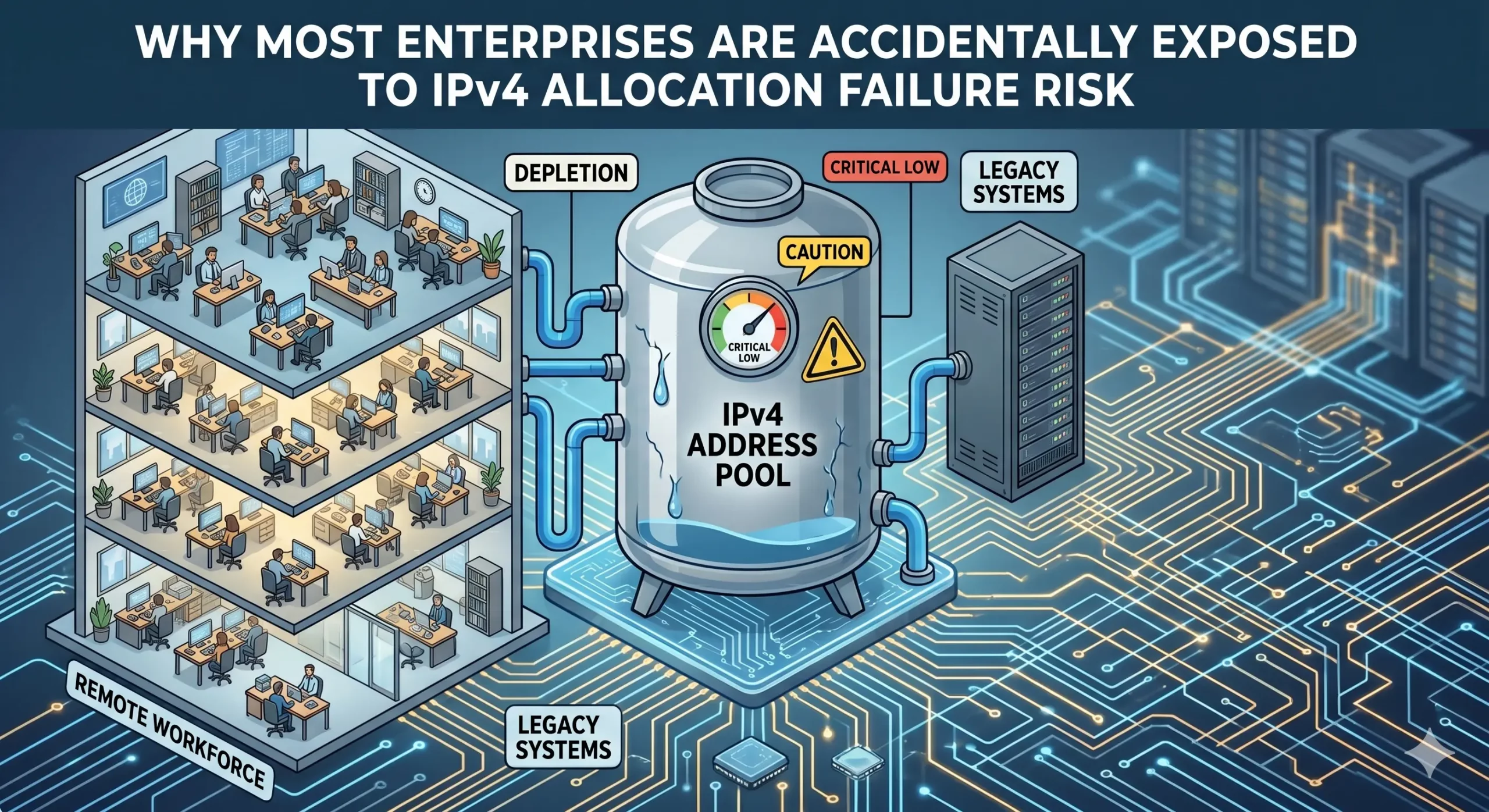
Pourquoi la plupart des entreprises sont exposées accidentellement au risque d’échec d’attribution d’adresse IPv4
La rareté de l’IPv4 est largement comprise. Ce que de nombreuses entreprises sous-estiment encore, c’est le risque de continuité lié à la manière dont les ressources d’adressage sont gouvernées et maintenues. Les entreprises maintiennent souvent une utilisation opérationnelle des ressources IPv4 sans disposer d’une visibilité complète sur les conditions de continuité qui soutiennent ces allocations. La dépendance croissante à la location, aux transferts et aux infrastructures gérées par desRead more Related Posts Risk Placement in IPv4 Transactions: What Enterprises Should Know The IPv4 market has quietly evolved into a structured secondary asset class. As global IPv4 exhaustion continues, enterprises, ISPs, and Read more Understanding Operational Risk in IPv4 Address Markets IPv4 has long stopped being a simple technical identifier system. It has become a constrained, priced, and operationally embedded infrastructure Read more Primauté du code en cours d’exécution : pourquoi la location d’adresses IPv4 doit être jugée sur la base de preuves opérationnelles La location IPv4 commence souvent par une question simple :Ce fournisseur peut-il nous fournir les adresses ?Mais pour les entreprises Read more .related-post {} .related-post .post-list { text-align: left; } .related-post .post-list .item { margin: 5px; padding: 10px; } .related-post .headline { font-size: 18px !important; color: #999999 !important; } .related-post .post-list .item .post_thumb { max-height: 220px; margin: 10px 0px; padding: 0px; display: block; } .related-post .post-list .item .post_title { font-size: 16px; color: #3f3f3f; margin: 10px 0px; padding: 0px; display: block; text-decoration: none; } .related-post .post-list .item .post_excerpt { font-size: 13px; color: #3f3f3f; margin: 10px 0px; padding: 0px; display: block; text-decoration: none; } @media only screen and (min-width: 1024px) { .related-post .post-list .item { width: 30%; } } @media only screen and (min-width: 768px) and (max-width: 1023px) { .related-post .post-list .item { width: 90%; } } @media only screen and (min-width: 0px) and (max-width: 767px) { .related-post .post-list .item { width: 90%; } }
